AI search for plastic surgeons concerns how a practice's information may appear in generated search answers, including Google's AI Overviews and AI Mode. It is an additional discovery context, not a replacement for an accurate website or a guarantee that an agency can make an AI system recommend a particular surgeon.
For practice owners, the useful questions are practical: can the system access the right information, is that information reliable and specific, what controls exist, and what evidence shows visibility? The answers should be tied to the actual product and the date, because AI-search interfaces and reporting are changing quickly.
This guide reflects official Google documentation checked in September 2026. It does not assume that Google, ChatGPT, and every other AI service use identical systems or controls.
AI search for plastic surgeons still depends on useful source material
Google's generative AI optimization guidance says foundational SEO remains relevant and does not require special AI schema, llms.txt files, or a particular writing formula. Eligible pages still need appropriate search access, and inclusion is not guaranteed.
For a practice, that means accurate procedure information, identifiable clinicians, real locations, and a clear explanation of the consultation process remain sensible priorities. Do not abandon them to publish a large volume of repetitive question pages aimed at imagined AI prompts.
The distinctive material should come from the practice's actual operation and qualified expertise. A generic article rewritten into shorter paragraphs does not become original evidence. Nor does a synthetic patient story become trustworthy because it sounds specific.
Practical check. Ask what verified information a proposed AI-search project will add or improve. If the answer is only a new file, schema package, or wording formula, request a clearer rationale.
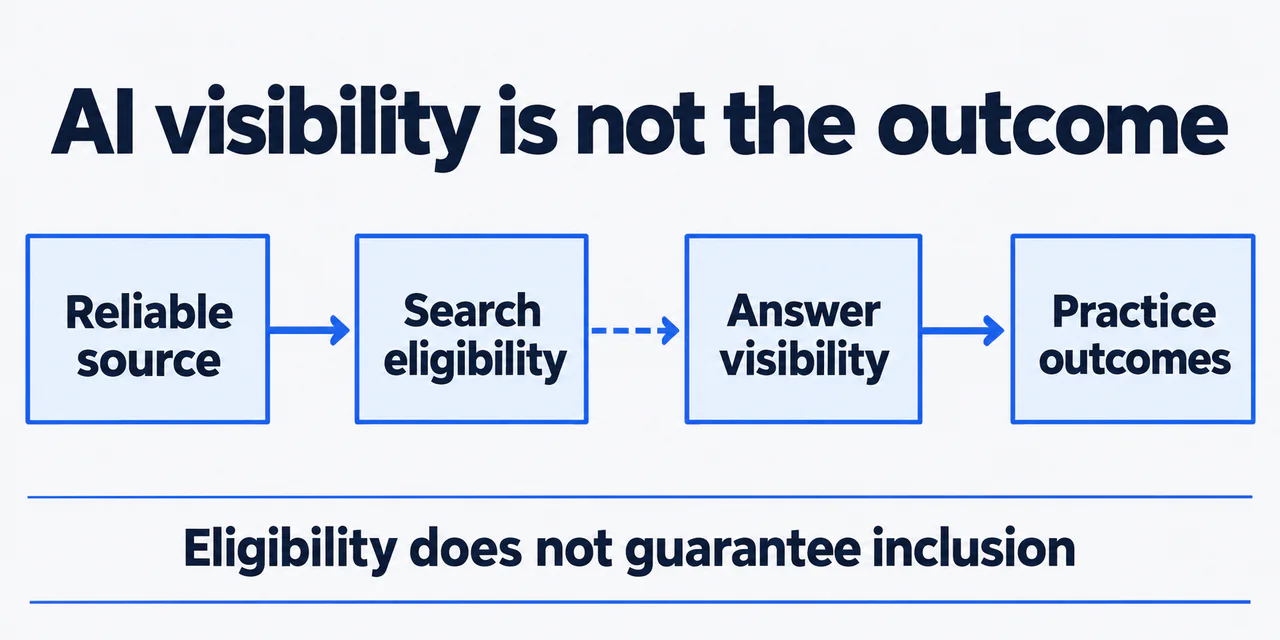
Illustrative measurement framework. Reliable content and search eligibility do not guarantee inclusion in an AI-generated answer. Measure answer visibility separately from practice outcomes.
View full-size diagram (opens in a new tab)Distinguish a mention, a citation, and a patient outcome
A generated answer may name a practice, link to a page, summarize information, or omit the practice entirely. Those are different observations. A mention without a link is not a website visit. A displayed link is not necessarily a click. A click is not an attended consultation.
When a vendor reports AI visibility, ask exactly what was measured. Was it a manually tested prompt, a third-party monitoring panel, a Search Console impression, or a referral recorded on the website? Each has a different scope and limitation.
Also distinguish factual accuracy from commercial visibility. If an AI answer names the practice but gives the wrong location or attributes a service it does not offer, the priority is correcting the underlying public information where possible, not celebrating the mention.
Clinical claims deserve special care. A generated answer may compress nuance or combine sources. The practice should maintain clear, qualified source content, but it cannot control every external summary. Avoid promising that website optimization will make AI advice clinically safe or complete.
Practical check. Require screenshots or exports with the product, date, prompt or report definition, and observed result. An unexplained “AI score” is not enough.
Use the current Google controls correctly
Google's August 31, 2026 update states that its new generative AI controls and insights have rolled out worldwide. Search Console now provides an inclusion control for specified generative AI search features. The decision to include or exclude the site should be made by the authorized website owner, with an understanding of the consequences.
Do not confuse this setting with a general search-indexing instruction or with controls related to model training. These are different choices. An SEO provider should explain which control it proposes to change and why, rather than referring vaguely to “blocking AI.”
Keep a record of the current setting and any inherited property configuration. If several vendors have access, designate who may change it. An unnoticed setting change could affect the interpretation of later visibility data.
This is a governance decision as well as a technical one. The practice should know whether it wants its content eligible for these experiences and how that choice fits its broader publishing approach. The SEO process should document material changes to search controls.
Practical check. Ask the provider to name the exact control and its scope before authorizing an edit. Do not accept a sitewide robots change as a generic answer to every AI concern.
Read AI reporting without inventing metrics
Google's Generative AI performance report documentation currently describes impression reporting for AI Overviews and AI Mode, with dimensions including pages, countries, dates, and devices. It should not be presented as a complete record of every AI prompt, referral, or conversion.
The documentation also notes that report availability can depend on sufficient impressions and other access conditions. Absence of a visible report is not, by itself, proof of a penalty. Check the actual property, inclusion setting, and available data before diagnosing the reason.
Keep the report's aggregation rules in mind. Page totals and property totals can represent different counting methods. Do not add overlapping report totals to ordinary search totals as though each were a separate audience.
Third-party prompt monitoring can supplement observation, but it is a sample of defined tests. Results may vary by wording, location, account context, and time. A panel of selected prompts is not a census of all prospective patients' AI use.
Practical check. Put the measurement definition immediately beside the reported number. “Impressions in this Google report” is clearer than “AI patients reached.”
Prioritize content that a real visitor would value
Review the pages most relevant to your priority services. Make sure the practice name, clinician identity, location, and service relationships are consistent. Correct ambiguous statements about who performs a procedure or where consultations occur.
Add genuine detail where it helps understanding: the consultation sequence, how the practice explains decisions, which questions require individualized assessment, and where a reader can verify credentials. Medical information still requires qualified review.
Use images, diagrams, and video when they clarify the subject, not as decorative proof of expertise. A real clinician explaining a process can be useful if the content is accurate and appropriately approved. An AI-generated clinician or invented patient story should not be presented as real experience.
The practice-owner SEO guide and local SEO overview remain relevant because reliable pages and business information support several discovery contexts, not only a particular AI interface.
Practical check. Ask whether the proposed improvement would still help someone who arrived directly or through a referral. If so, it is more likely to be a durable investment than a product-specific trick.
Evaluate AI-search services as specific work
An agency proposal should describe the pages reviewed, technical checks performed, information corrected, monitoring method, and reporting limits. “GEO” or “AEO” can be labels for useful work, but the label does not establish a new proprietary ranking mechanism.
Be skeptical of guaranteed recommendations, undisclosed prompt panels, invented authority scores, or claims that a secret schema package controls AI answers. Ask for the evidence behind the method and what would count as a failed hypothesis.
Do not buy inauthentic mentions or fabricated discussions to manufacture apparent popularity. Apart from reputational concerns, such tactics are not a substitute for legitimate, verifiable information about the practice.
Keep the commercial objective explicit. The practice may want better information accuracy, broader discovery, or more relevant inquiries. Those are related goals, but they need different measures. A campaign can improve source quality without immediately producing a measurable increase in consultations.
Practical check. Ask the agency to separate deliverables it controls from outcomes it can only influence. The same distinction should apply to ordinary SEO and AI-search work.
Frequently asked questions
Do we need a separate AI version of every page?
No special duplicate version is required for Google AI search. Focus on useful, accessible source pages. Duplicating content solely for an AI label can create unnecessary maintenance and overlap.
Will llms.txt make Google recommend our practice?
Google's current guidance says it does not use llms.txt for search visibility or ranking. Other systems may have different uses, so evaluate those separately. Do not buy the file as a guaranteed Google visibility solution.
Can an agency guarantee an AI Overview citation?
No agency controls the generated answer for every query and context. Ask for specific work and transparent measurement rather than a guaranteed citation or recommendation.
Can we measure all AI traffic in one dashboard?
Not completely. Different products expose different data, and referrals or impressions do not capture every interaction. Report the source and limitations of each metric rather than combining incompatible numbers.
Should we remove FAQs now that Google changed rich results?
Keep FAQs when they answer useful reader questions. Their value does not depend on a particular rich-result format. Update any claim that FAQ markup guarantees enhanced Google presentation.
Keep the strategy grounded in evidence
AI-search work should leave the practice with more accurate information and a clearer understanding of visibility, not just a new vocabulary. If you want to assess readiness, request an SEO audit that distinguishes source quality, technical eligibility, product settings, and measurable outcomes.