Plastic surgery SEO best practices help a practice become easier to find, understand, and evaluate in unpaid search results. The useful outcome is not simply more visitors. It is more appropriate prospective patients reaching the right information and a workable consultation pathway, without misleading claims or careless handling of personal information.
A practice can have an attractive website and still make that journey difficult. Google may not be able to index important pages. A prospective patient may find an article but never discover which surgeon performs the procedure. The phone may ring, but the call may not reach someone who can explain the next step.
This guide gives practice owners a way to separate those problems and decide what deserves attention first. It concerns marketing operations, not medical advice or a promise of surgical outcomes.
Plastic surgery SEO best practices in the right order
Start with five decisions: which services you want to grow, whether the relevant pages are accessible to search engines, whether your local information is accurate, whether the website earns an informed inquiry, and how you will measure progress.
| Priority | Question to answer | Evidence to request |
|---|---|---|
| Practice fit | Which procedures and locations can accept more consultations? | A priority list approved by the practice |
| Search access | Can important pages be discovered and indexed? | Page-level inspection and a technical issue log |
| Local identity | Does Google show the correct business and practitioners? | An inventory of profiles, owners, and destinations |
| Patient information | Does each page explain the service and next step honestly? | Clinically reviewed pages and tested contact routes |
| Business measurement | Are inquiries becoming attended consultations? | Aggregate funnel counts with consistent definitions |
These priorities are connected, but they are not interchangeable. Publishing articles will not correct an accidentally blocked website. A map ranking will not repair a broken appointment form. More inquiries are not necessarily useful when they concern a procedure the surgeon does not offer.
Practical check. Ask your team to name the single biggest obstacle between a suitable search and an attended consultation. If nobody can identify it, start with diagnosis rather than a larger content order.
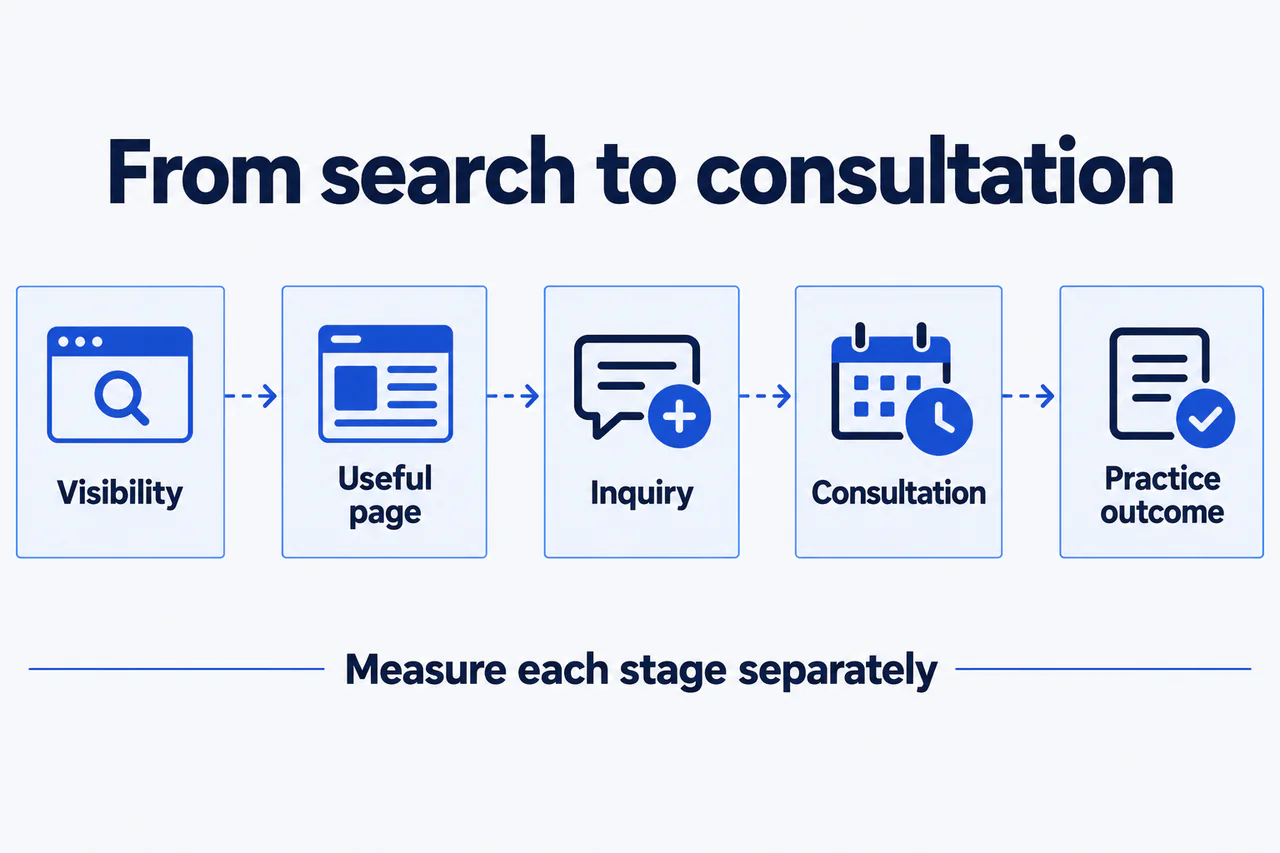
Illustrative framework. Visibility, a useful page, an inquiry, an attended consultation, and a later practice outcome are separate stages—not interchangeable measures of success.
View full-size diagram (opens in a new tab)Define the practice you actually want to grow
SEO planning should begin with the practice's capacity and clinical scope. A surgeon seeking more revision consultations has different priorities from a new group trying to introduce several practitioners. A location that only provides consultations should not imply that surgery occurs there.
Create a service inventory with the procedure, responsible surgeon, consultation location, availability, and business priority. Include the reason for each priority. A procedure might be important because it fits the surgeon's expertise and available operating time, not because a keyword tool reports the highest search volume.
Then establish a sensible geographic focus. A local consultation practice may depend on nearby demand. A practice that genuinely serves traveling patients may need accurate information about consultations, travel coordination, and follow-up arrangements. The latter is a real operational commitment, not a reason to insert dozens of city names into otherwise identical pages.
Separate three demand groups: searches for your practice or surgeon by name, searches for a procedure or provider without your name, and research questions from people who are not ready to choose. Each can be valuable, but they should not be combined into one growth claim.
An illustrative planning decision: if the practice already receives many branded searches but has little visibility for its priority procedure, improving that procedure's page may be more useful than writing another general introduction to cosmetic surgery. This is a hypothesis to test against your data, not a universal ordering rule.
Practical check. Before approving a keyword, ask who would answer the resulting inquiry and what appropriate next step the practice could offer.
Build a small, clear page structure before a large library
The homepage should explain the practice, its location, and the broad reason someone might choose to learn more. Procedure pages should explain distinct services. Surgeon biographies establish who provides care. Location pages help people understand where they will be seen. Articles answer narrower questions that deserve more explanation than the main service page can comfortably contain.
This division is about intent, not one page for every phrase. Searches such as “rhinoplasty surgeon” and “nose surgery specialist” may belong on the same substantive page. A different spelling or word order is not, by itself, a new patient need.
For every proposed page, write a one-sentence purpose. “Explain our approach to this procedure and help someone decide whether to request a consultation” is a coherent purpose. “Rank for twenty variations” is not an editorial purpose.
Give related pages meaningful connections. A procedure page can link to the relevant surgeon, an appropriately authorized gallery, and the consultation location. An article can explain a particular question and lead back to that procedure page. The connections should help a reader move forward, not merely distribute keywords.
Our guide library uses this separation between broad explanations and narrower questions. The same principle can keep a surgical practice's website useful as it grows.
Practical check. Read only the navigation labels and page headings. Could a new patient distinguish services, people, locations, and educational content without opening every page?
Establish whether Google can access the important pages
Technical SEO starts with a practical distinction: a page can exist for a visitor without being eligible or selected to appear in search. An indexing restriction, broken server response, incorrect canonical URL, or missing crawlable link can interfere with the process.
Ask for a page-level review of the homepage, priority procedures, biographies, locations, and important galleries. A broad site-health score is not a substitute. The report should name affected URLs, describe the issue in plain language, and identify who can fix it.
Google Search Console is useful for checking how Google sees individual URLs and for monitoring search performance. It should be controlled by the practice, with appropriate access granted to vendors. Verification alone does not guarantee indexing, and repeated submission does not compensate for a weak or inaccessible page.
Mobile use deserves direct testing. Open the site on a phone, follow the procedure navigation, inspect image loading, and try the contact route. Check whether a sticky banner obscures content or a gallery prevents scrolling. Test keyboard access as well. A page does not become useful merely because an automated test assigns it a favorable score.
Keep a release log. Record changes to templates, navigation, forms, redirects, and tracking. Without that history, a later traffic change becomes much harder to investigate.
Practical check. Ask the implementer to show one important page working in both the rendered browser and the search inspection evidence, then explain any differences.
Treat local search as an accurate identity system
Local results connect searches with real businesses and practitioners. Google identifies relevance, distance, and prominence as major considerations in local ranking. You can improve how accurately the practice is represented, but you cannot make every searcher physically close to your office.
Review business names, addresses, phone numbers, categories, hours, website destinations, and appointment links. A temporary schedule change is not a minor detail when someone is deciding whether to visit. Keep profile ownership under practice control and document who maintains each listing.
Practice and practitioner profiles need individual assessment. The right arrangement depends on how the organization and public-facing clinicians actually operate. Do not create extra listings simply to occupy more results, and do not assume every surgeon at every address automatically qualifies.
Relevant directory and professional profiles can help people corroborate the practice's identity. Prioritize accurate, useful listings over an impressive submission count. The practical question is whether a listing helps a person verify or contact the practice, not whether an agency can include it in a large spreadsheet.
Our local SEO service overview explains where this work fits within an ongoing engagement.
Practical check. Search for the practice from a patient's perspective and compare the displayed phone, address, and hours with the information staff would give over the phone.
Write pages that support an informed decision
A procedure page should make the service understandable without pretending to replace a consultation. It should identify who performs it, describe the practice's actual process, and explain what a consultation can establish. Clinical statements about suitability, risks, alternatives, and recovery need review by an appropriately qualified clinician.
Specificity is more useful than superlatives. Explain how consultations are arranged, which location a patient should contact, what information the practice needs initially, and where people can learn about the surgeon. Do not invent a distinctive technique or universal recovery timeline to make the page sound original.
If pricing is discussed, explain what the stated figure includes and excludes. If the practice cannot responsibly provide a public estimate, explain how a personalized quote is determined instead of hiding behind a vague promise of affordability.
Before-and-after photographs can add relevant information when consent, presentation, and context are handled appropriately. They should not be altered to imply an outcome or treated as proof that another patient will obtain the same result. A marketing writer is not the right person to approve medical claims or decide whether a consent form covers a new use.
Give each page an accountable author or reviewer where relevant. Make credentials verifiable, and distinguish the writer from the clinician who reviewed medical information. A review date should correspond to a real review, not an automatic timestamp.
Practical check. Ask a staff member who regularly handles inquiries to highlight questions the page leaves unanswered, then have the surgeon separate factual additions from claims requiring qualification.
Earn trust beyond your own website
Links, mentions, reviews, and professional affiliations are different forms of evidence. A legitimate association profile verifies something different from a patient review. A local news article is not a medical credential. Avoid treating all of them as interchangeable “authority.”
Start with relationships that already exist: professional memberships, hospitals or facilities where an affiliation is accurate, community involvement, and educational work. Check whether your profiles are correct and whether useful information can be linked naturally.
Do not buy a package of anonymous links and assume the quantity is an asset. Google's spam policies address manipulative link practices and other attempts to manufacture rankings. A vendor should be able to explain the source, purpose, and commercial terms of any proposed placement.
Reviews need their own privacy-aware process. Staff should use neutral requests and an approved response policy. A patient mentioning a treatment publicly does not give the practice unrestricted permission to discuss that person's care in response.
Practical check. For a proposed trust signal, ask exactly what it proves and whether an independent visitor can verify it. Remove badges and claims that cannot survive that question.
Measure the journey without confusing its stages
Search impressions show exposure. Clicks show visits from search results. Website events may show an interaction. None of those, by itself, proves that a consultation occurred or that a procedure generated collected revenue.
Agree on definitions before reviewing a dashboard. An inquiry might be a unique new contact, excluding spam and existing-patient administration. A qualified inquiry might meet the practice's operational criteria, without implying clinical eligibility. An attended consultation is a separate event. A completed procedure and its collected contribution belong later in the journey.
Use aggregate counts and an approved data flow. Do not send patient identities, health details, or unrestricted form contents into marketing tools merely to produce a more detailed report. Privacy review belongs before tracking installation, not after a dashboard is connected.
Compare appropriate time periods and account for delays. Someone who discovers the practice in one month may consult in another. Counting that person's eventual outcome against a different month's marketing spend can produce a misleading return calculation.
At each review, ask four questions: what changed, what was implemented, what alternative explanations remain, and what decision follows. Our SEO process provides context for organizing those reviews; an individual plan still needs a baseline and agreed responsibilities.
Practical check. Pick one dashboard number and ask the team to define its numerator, denominator, source, and exclusions. If any are unknown, do not use it as a contractual success measure yet.
Decide what the practice does and what a specialist does
The practice supplies clinical judgment, service priorities, accurate operational information, and approval. An SEO specialist can research demand, diagnose technical issues, propose page improvements, implement agreed work, and explain results. Developers, writers, photographers, and privacy advisers may have separate roles.
Make those responsibilities explicit. “The agency handles content” does not answer who confirms medical accuracy. “We provide analytics” does not answer who authorizes tracking or owns the accounts. “Unlimited support” does not establish turnaround time or the scope of implementation.
For a new engagement, a reasonable initial sequence is to establish access and baselines, address material blockers, improve priority pages, then test the next opportunity. This is a planning sequence, not a promise that a fixed amount of growth will arrive within a fixed number of days.
Read SurgeonSEO's service positioning alongside any proposal so that the commercial offer is distinct from this educational guide. Compare the written scope, evidence, and responsibilities, not just the confidence of the sales presentation.
Practical check. Before signing, make sure every priority task has an owner, an approval route, and a way to verify completion.
Frequently asked questions
Is SEO worth doing if most patients come from referrals?
It can be, because referred people may still search for the surgeon before contacting the practice. Measure whether search is supporting that existing demand as well as attracting new, nonbranded demand. Do not label every branded inquiry as a newly acquired SEO patient.
Should we write blogs before improving procedure pages?
Usually, resolve important service-information gaps first. A blog is useful when it answers a distinct question and connects to a relevant next step. It should not compensate for a procedure page that fails to explain the practice's offering.
Can we guarantee the first position in our city?
No agency controls Google's rankings or every searcher's results. You can agree on work, reporting, and commercial remedies, but a refund policy does not create control over search outcomes. Ask how any promised result will be defined and measured.
How often should a surgeon review website content?
Set a review process based on the type of information and the pace of change. Update promptly when services, clinicians, locations, or important clinical guidance change. A scheduled review is useful only if someone actually checks the content and records the decision.
What is the first thing a practice owner should do?
Choose a priority service and follow its journey from search to inquiry. Check the page, profile, contact route, and staff handoff. If the main obstacle remains unclear, request a focused assessment rather than purchasing a larger volume of unspecified SEO work.
Turn the guide into a short priority list
You do not need to implement every tactic at once. Identify the service that matters, the evidence currently missing, and the person responsible for the next improvement. Review the effect before expanding the work.
If you want help identifying that first obstacle, request a practice SEO audit and bring your priority procedures, locations, and current reporting. The useful starting point is a diagnosis you can act on, not a promise that every practice needs the same package.