Plastic surgery procedure pages should explain a real service, identify the clinician and location involved, answer important decision questions, and offer a clear next step. They should support an informed consultation request without presenting general information as personalized medical advice.
The best starting point is not a competitor's word count. It is the set of questions a prospective patient needs answered before deciding whether to contact this practice. Some answers are clinical, some are practical, and some concern trust. Each needs an appropriate source and reviewer.
Plastic surgery procedure pages need a defined job
Write a one-sentence purpose before drafting: this page explains a particular procedure as offered by this practice and helps a reader decide whether to request a consultation. That purpose separates it from a general educational article, a surgeon biography, and a photo gallery.
Choose one canonical page for the service unless there is a genuine reason for distinct versions. Synonyms and everyday language can usually be explained on the same page. Separate pages for slightly different keyword wordings often create redundant maintenance work.
The page should also state its limits. It can explain what a consultation considers, but it cannot determine a visitor's suitability. It can describe the practice's general process, but it should not imply that every patient follows an identical course.
Practical check. If the page could be transferred to another surgeon's website with only the name changed, it needs more verified practice-specific information.
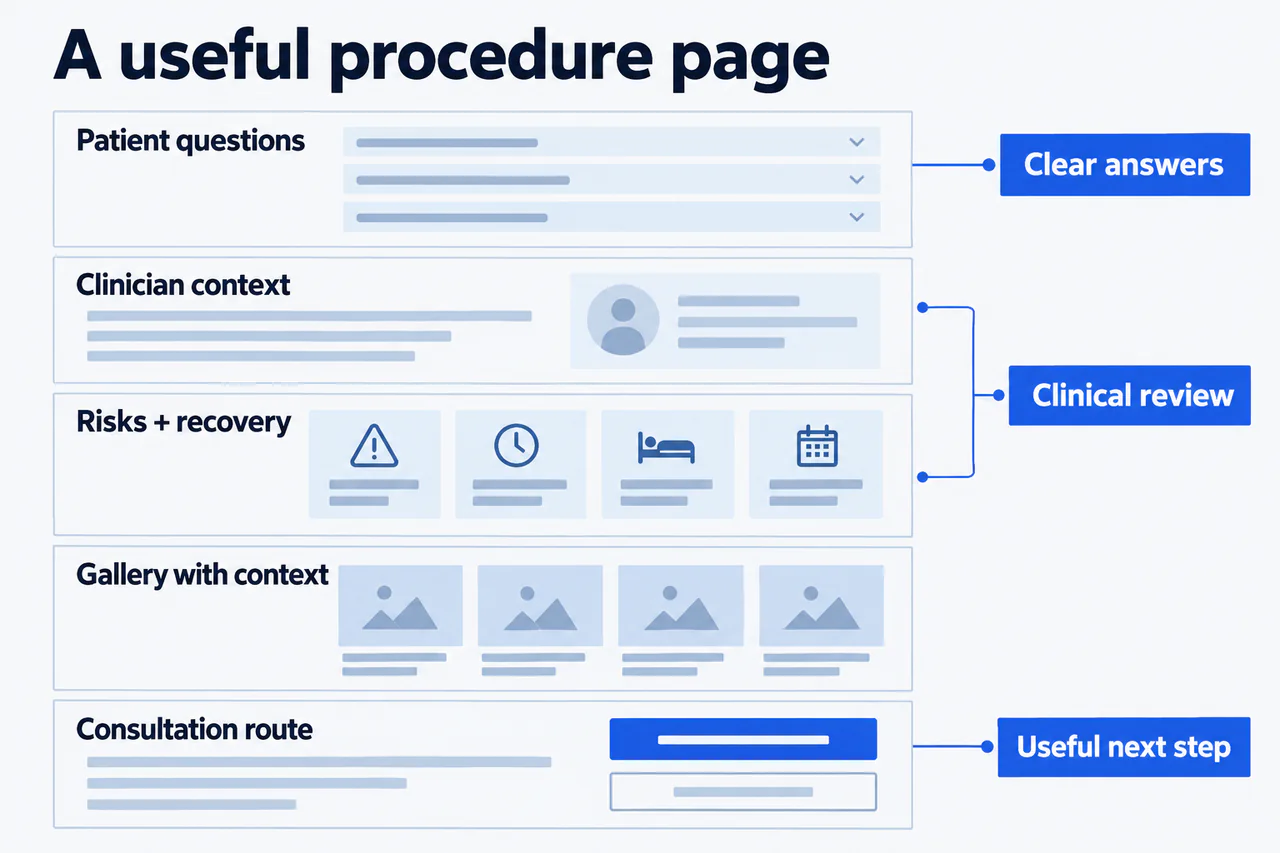
Illustrative page wireframe. Patient questions, clinician context, risks and recovery, a contextual gallery, and a clear consultation route serve different needs on a procedure page.
View full-size diagram (opens in a new tab)Cover the clinical questions with qualified review
Ask the clinician to identify the questions that matter for the procedure: its purpose, possible alternatives, what assessment involves, meaningful limitations, risks, and recovery considerations. The writer's role is to organize and explain the approved information clearly.
Avoid universal claims such as “no downtime,” “scarless,” or “suitable for everyone” unless the qualified reviewer can justify precisely what is meant and the language is appropriate. A disclaimer at the bottom does not repair a misleading promise near the top.
Differentiate a typical discussion from a personal recommendation. For example, a page can explain that the consultation considers goals, medical history, and relevant clinical factors. It should not present a short online checklist as proof that the reader qualifies for surgery.
When describing recovery, clarify that individual circumstances vary and that the treating team supplies personalized instructions. Do not invent a detailed recovery timetable simply because competitor pages use one. If a timeline is published, it should be approved, contextualized, and maintained.
Practical check. Ask the reviewer to mark statements that require qualification, not just spelling corrections. Medical review should be visible in the workflow and attributable to a real person.
Explain the actual practice experience
Prospective patients often need practical answers alongside clinical information. Who conducts the consultation? Where does it take place? How is an appointment requested? Is a referral required in the practice's particular workflow? What happens after an inquiry is submitted?
Publish only arrangements the practice can consistently deliver. If the surgeon does not personally answer every initial inquiry, do not imply otherwise. If consultations and surgery take place at different facilities, make that distinction clear.
Pricing deserves context. Where the practice publishes a range or starting figure, explain what it covers, what may be separate, and why a personalized estimate may differ. Where no public amount is appropriate, explain the quotation process without suggesting that a consultation guarantees treatment.
The reader should be able to identify the relevant surgeon and follow a link to a substantive biography. Credentials and affiliations should be accurate and verifiable. A decorative badge is not a substitute for a clear statement of who provides care.
Our practice-owner SEO guide explains why procedure, biography, and location pages work best as connected parts of the website.
Practical check. Ask the intake team which misunderstandings repeatedly consume time. Correct the page where the misunderstanding begins, provided the answer is accurate and appropriate to publish.
Use evidence and images with context
An authorized gallery may help visitors understand the type of work a practice presents, but it must not imply guaranteed outcomes. Images should have accurate labels and appropriate context, with rights and patient authorization reviewed for the intended use.
Do not use AI-generated before-and-after photographs, synthetic patient testimonials, or stock images presented as actual cases. A diagram can explain the consultation process, but it should be labelled as an illustration and should not impersonate clinical evidence.
Use descriptive alt text based on the image's purpose. Avoid adding a string of procedure and city keywords. Decorative images should be handled differently from informative ones, and captions should carry important context that sighted readers also need.
Keep galleries usable on mobile devices and with keyboard navigation. A visitor should not have to fight an overlay to return to the service information. Test the page with images slow to load as well as on a fast office connection.
Practical check. For every visual, identify its purpose, rights holder, authorization status where relevant, and the claim a reader might infer from it.
Test the consultation route and approval process
The call to action should explain what happens next. “Request a consultation” is clearer when the page also says who responds and how the process begins, provided those statements reflect real operations.
Keep the initial form proportionate to its purpose and route sensitive information through approved systems. Do not collect detailed medical histories merely because a generic marketing template includes a large free-text box. Privacy and security review should guide the actual configuration.
Use clear labels, understandable error messages, and a confirmation that does not expose private information. The W3C form-label guidance provides a practical accessibility starting point. Test the entire route with synthetic data and verify receipt at the practice.
Before publication, have separate signoffs for clinical content, operational accuracy, image permissions, and technical behavior. The SurgeonSEO process can provide an editorial structure, but the practice must supply the people authorized to approve its claims and operations.
Practical check. Keep the approval record with the page brief so that future editors know which sections need a clinician rather than a marketing-only update.
Frequently asked questions
How long should a procedure page be?
Long enough to answer the page's real questions without repetition. A word target can help plan production, but it is not a ranking requirement. Remove generic filler before adding another section.
Should a surgeon write every word?
Not necessarily. A skilled writer can interview the surgeon and organize the material, while the qualified clinician reviews medical statements. The published attribution should accurately distinguish writing from medical review.
Should each procedure have its own page?
Distinct services often deserve distinct pages, but closely related terms may belong together. Decide based on patient intent and the actual offering, not only keyword differences. Avoid creating thin pages for services the practice does not provide.
Can FAQs replace the main explanation?
No. FAQs are useful for residual questions, not as a substitute for a coherent page. The core service, clinician, location, and next step should be understandable before the FAQ section.
Do we need a gallery on every procedure page?
No. Use a relevant gallery when appropriate, authorized material is available and its presentation is responsible. Accurate text and an honest explanation are preferable to unsuitable or fabricated visual proof.
Use a page-level acceptance checklist
Before calling the page finished, confirm that it explains the service, identifies the responsible clinician, gives accurate practical details, uses approved evidence, and supports a tested next step. You can browse the related SEO guides for adjacent decisions or request a procedure-page audit to identify what is missing from existing pages.