Blogging for plastic surgeons is worth doing when an article answers a real question that deserves more explanation than a service page can provide. It is not a requirement to publish a fixed number of posts every month, and it should not take priority over incomplete procedure pages or inaccurate practice information.
A useful blog helps people understand decisions, discover relevant services, and evaluate the practice's approach. A weak blog repeats generic procedure summaries while leaving the actual consultation process unclear. The difference is editorial judgment, not publishing frequency.
Blogging for plastic surgeons should begin with a page decision
Before approving an article, decide whether the answer belongs on an existing page, in a new article, or nowhere on the site. Some questions are central to understanding a procedure and should be addressed on its main page. Others need a deeper explanation with their own scope and review.
| Proposed topic | Better first question | Likely action |
|---|---|---|
| Basic explanation of an offered procedure | Is the service page already complete? | Improve the procedure page first |
| A narrow recurring consultation question | Does it need a substantial standalone answer? | Consider a focused, reviewed article |
| A trending treatment not offered | Does this serve the practice's audience responsibly? | Often decline or carefully contextualize |
| Another wording of an existing article | Is the intent genuinely different? | Update or consolidate instead |
The practice-owner SEO guide explains this distinction between the main service structure and supporting education. A blog should extend that structure, not compete with it.
Practical check. Require a one-sentence reason the article needs its own URL. If the only reason is a keyword variation, revisit the plan.
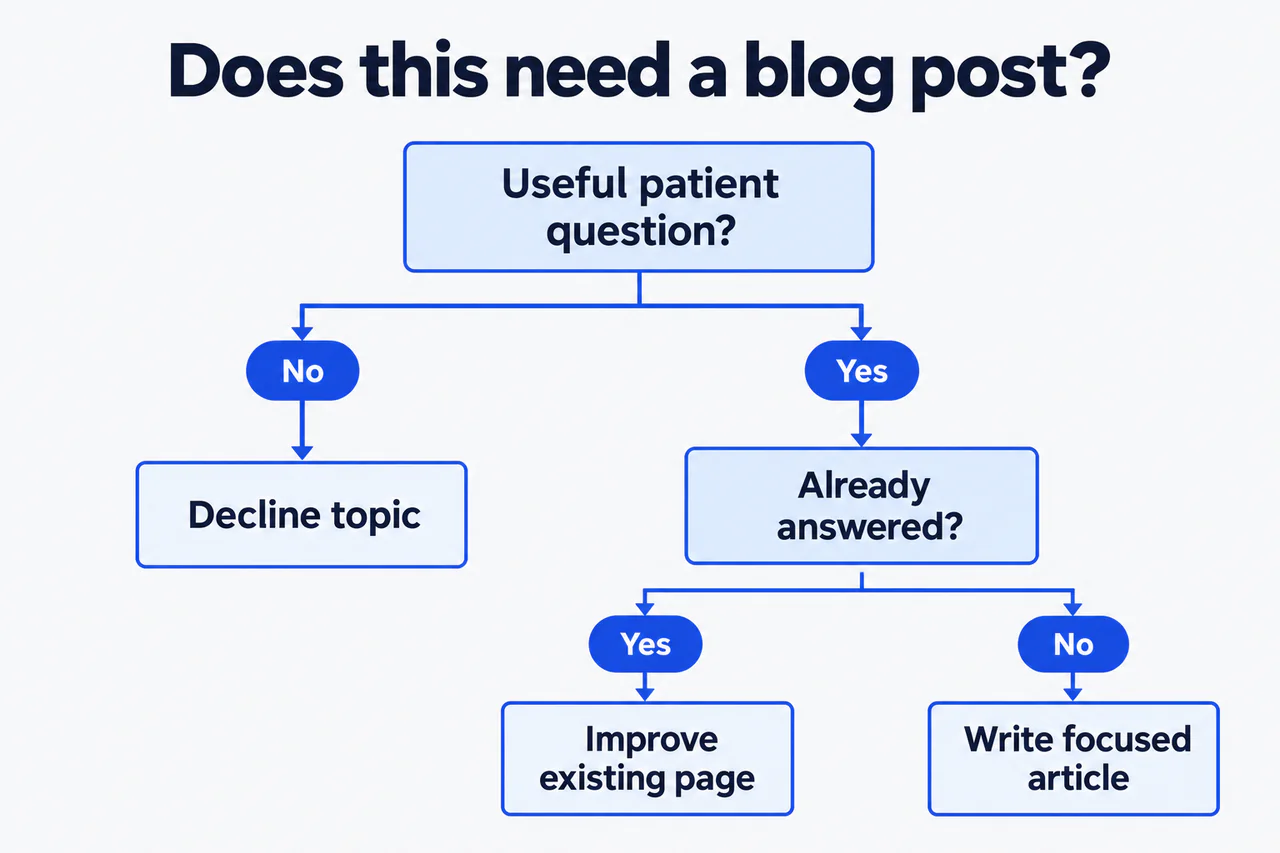
Illustrative editorial decision tree. Decline topics without a useful patient question. Improve an existing answer when one exists; create a focused article when a worthwhile question needs its own page.
View full-size diagram (opens in a new tab)Build the topic list from real questions
Ask consultation coordinators and clinicians which questions repeatedly arise before an appointment. Record categories and wording without exporting identifiable patient messages. Public search results and community discussions can suggest additional questions, but they should not become sources for unverified medical claims.
Separate curiosity from decision value. A celebrity-related topic may attract attention but offer little relevance to the practice's services. A practical explanation of how a consultation works may have a smaller audience and be much more useful to the people considering contact.
Prioritize topics where the practice has something specific and accurate to add. That might be an explanation of its consultation sequence, how it prepares patients to ask questions, or how it distinguishes general information from individualized assessment. Originality does not require a sensational claim.
Keep a question backlog with intended audience, page destination, clinical reviewer, supporting evidence, and priority. Include a reason to decline topics that are outside scope. This prevents a content calendar from becoming an obligation to publish whatever a keyword tool suggests.
Practical check. Ask the intake team whether the proposed article would reduce a real misunderstanding. If it would only increase traffic from people the practice cannot help, reconsider it.
Use writers and clinicians for different responsibilities
A writer can research search intent, interview the surgeon, organize the explanation, and make the language easier to understand. The qualified clinician should review medical claims, meaningful limitations, and whether the overall explanation could mislead a reader.
Prepare interviews around decisions rather than broad prompts. Instead of asking “Tell us about this procedure,” ask which misconceptions matter, what a consultation can and cannot establish, and which questions require an individualized answer. The writer should verify what can be published and avoid turning a nuanced explanation into an absolute promise.
Record authorship accurately. If a marketing writer drafted the piece and a surgeon reviewed clinical content, say so where appropriate. Do not assign a surgeon byline merely to borrow credibility from someone who did not meaningfully contribute or review the text.
Hamza Esh's role in this library is SEO education. His more than a decade of general SEO experience does not make him a medical reviewer. Our about page should maintain that distinction as the agency develops its surgeon specialization.
Practical check. Keep the clinical approval record with the draft, including the version reviewed and any conditions on publication.
Make the article useful before optimizing its packaging
Answer the main question early, then add the detail needed to understand the answer. Use headings that reflect the reader's questions, not a sequence of keyword permutations. Include examples only when they are accurate or explicitly illustrative.
Link to the relevant procedure, clinician, or location where the connection helps the reader. Avoid pushing a consultation request into every paragraph. Some readers need education first, and a useful next step may be another explanation rather than a sales action.
Google's helpful-content guidance is a useful reference for evaluating substance. An article should add value through clarity, accuracy, and relevant detail rather than merely summarize what other websites already say.
FAQs can resolve remaining questions, but they should not repeat the entire article. Do not justify an FAQ section with an outdated promise of a Google FAQ rich result. Google's documentation records that feature's deprecation in May 2026; a clear answer is still useful to readers without that enhancement.
Practical check. Remove the title and branding, then ask what information remains that a reader could actually use. If little remains beyond familiar generalities, the draft needs better source material.
Use AI as assistance, not as an evidence generator
AI can help organize notes, identify unclear passages, or suggest an outline. It should not invent surgeon experience, patient stories, medical citations, credentials, or case outcomes. A fluent paragraph is not evidence that its claims are correct.
Do not upload patient-identifiable information into a general writing tool without an approved legal and security basis. A de-identified question category is usually more useful to a content writer than a raw consultation transcript anyway.
Large-scale publication creates a maintenance obligation. If the practice cannot clinically review and maintain the output, increasing production may increase risk rather than value. Google's spam policies address scaled content created primarily to manipulate rankings, regardless of how it is produced.
Use a review checklist covering factual accuracy, originality, clinical approval, privacy, image rights, internal links, and the next step. Our content workflow within the SEO process should make those responsibilities explicit.
Practical check. Ask the writer which claims were verified and which information came directly from the practice. “The tool generated it” is not an acceptable source note.
Publish at a pace you can maintain
Choose a cadence based on useful topics, reviewer availability, implementation capacity, and the time needed to update existing pages. One strong article may be more valuable than several rushed ones, but even that is not a universal monthly quota.
After publication, review relevant search queries, readership patterns where lawfully measured, and feedback from the intake team. Do not judge every article by immediate consultation requests. Some answer early-stage questions, while others support a decision closer to contact.
Maintain an update register. Record the article's responsible reviewer, review date, major claims, and next review trigger. Changes in services, clinical guidance, staff, or consultation arrangements may justify an earlier review than the calendar suggests.
If an article overlaps with a better page or no longer serves the practice, evaluate updating, consolidating, or retiring it with appropriate technical handling. The objective is a useful library, not an ever-increasing post count.
Practical check. Before adding five new topics, inspect five older pages. If nobody owns their accuracy, solve that governance problem first.
Frequently asked questions
How many blog posts should a surgeon publish each month?
There is no universal number. Choose a pace that supports distinct useful topics, qualified review, and maintenance. A fixed quota should not force the practice to publish thin or repetitive articles.
Can a writer without medical training draft an article?
Yes, when the process includes appropriate research and qualified review of medical information. The writer should not make independent clinical judgments or imply credentials they do not hold.
Should we write about procedures we do not offer?
Only when there is a clear, responsible educational reason and the page does not misrepresent the practice's services. Do not build a large content library around unrelated demand simply to increase traffic.
Can we reuse the same article across several practice websites?
Consider rights, relevance, and whether each audience receives anything useful and specific. Copying generic text across sites can create maintenance and differentiation problems. Tailor content to real differences rather than changing names mechanically.
What should a blog article link to?
Link to the page that helps the reader take the next sensible step: a service explanation, clinician biography, location detail, or related guide. The relationship should be clear from the surrounding sentence.
Make the library earn its maintenance cost
Every article should have a purpose, an accountable reviewer, and a place in the website. Explore the SurgeonSEO guide library to see the intended separation of questions. If your current blog is large but unfocused, request a content audit before commissioning another batch.