Monthly plastic surgery SEO services should provide prioritized improvements, reliable maintenance, and evidence that the agreed work was implemented. A recurring report is useful, but it is not the service itself. The practice should be able to see what changed, why it mattered, and what happens next.
The right monthly scope depends on the starting point. A practice resolving a migration problem needs different work from one expanding a useful content library. An agency should explain that difference rather than assigning every client the same number of posts and links.
Monthly plastic surgery SEO services need three workstreams
Separate recurring checks, prioritized projects, and outcome review. Recurring checks look for material issues and maintain accurate information. Projects improve the site or local presence. Outcome review examines whether the work is helping the intended audience and business objective.
| Workstream | Example output | Acceptance evidence |
|---|---|---|
| Monitoring and maintenance | Investigated indexing issue or corrected office information | Issue record and verified live correction |
| Improvement project | Revised procedure page or repaired navigation | Approved page, implementation date, and quality checks |
| Performance review | Analysis of relevant search and inquiry trends | Definitions, source data, explanation, and next decision |
These categories make the retainer easier to understand. A month with a substantial technical project may reasonably contain less new content. The provider should explain the tradeoff in advance rather than quietly changing the promise.
Practical check. Ask the agency to divide its proposed scope into these three categories and identify which work is included, conditional, or separately charged.
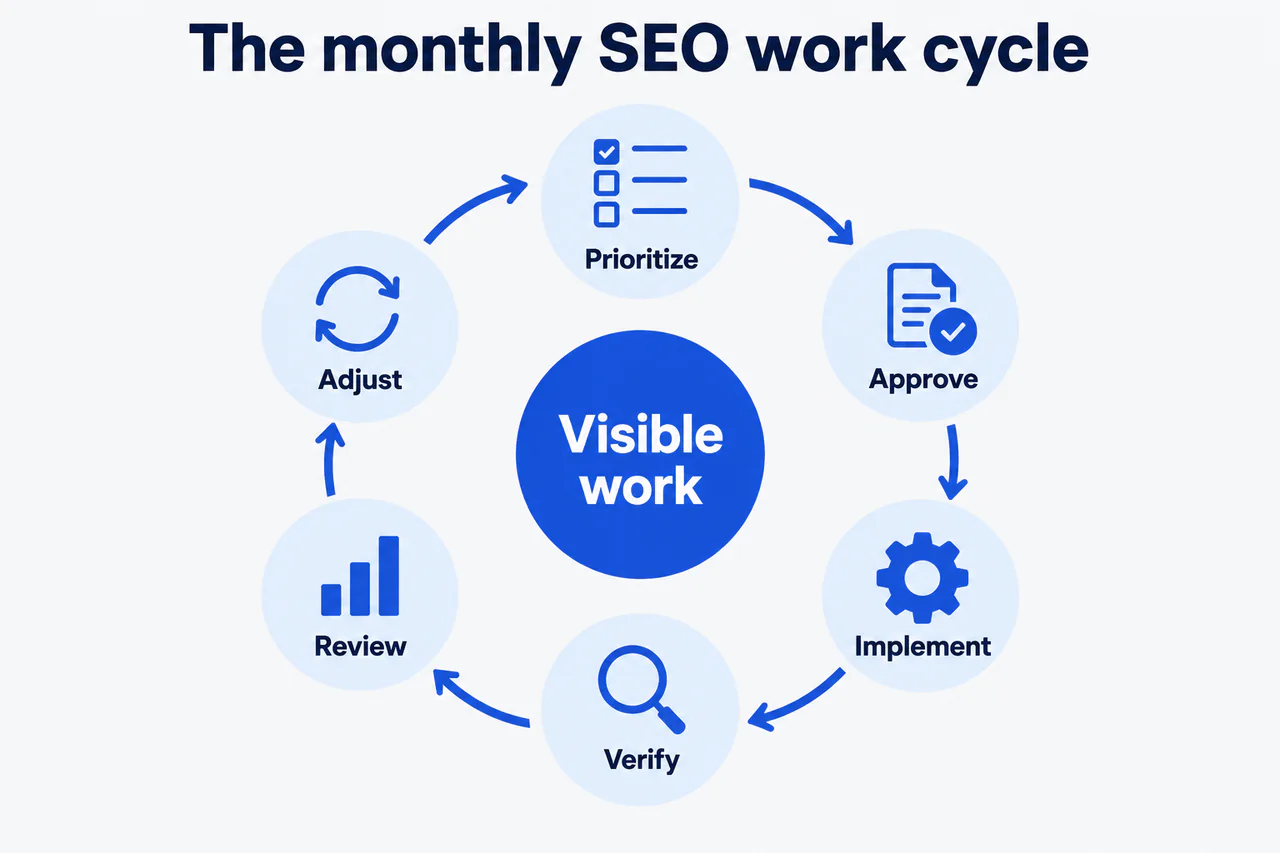
Illustrative monthly cycle. Prioritize and approve work, implement it, verify the result, then review and adjust the next set of priorities.
View full-size diagram (opens in a new tab)Expect a prioritized backlog, not an endless task list
A backlog should name the issue or opportunity, affected asset, expected benefit, effort, dependencies, and owner. It should distinguish critical corrections from worthwhile experiments and low-priority ideas.
The agency should explain why a task comes next. For example, correcting the wrong consultation location on a high-traffic page may be more urgent than publishing another broad educational article. Improving an inaccessible form may matter more than adding another dashboard widget.
Avoid treating volume as value. Ten small edits can be less important than one well-executed correction. A large list of automated recommendations can also create noise if nobody assesses their relevance to the practice.
The practice-owner SEO guide provides a framework for these priorities. The monthly plan should translate that framework into the practice's actual services, pages, and constraints.
Practical check. Ask what was deliberately deferred and why. Prioritization is incomplete if every task is described as equally urgent.
Require implementation and verification evidence
For each completed task, the report should show what changed and how it was checked. A content recommendation is not the same as a published page. A developer ticket is not the same as a verified fix. A draft business-profile edit may not yet be live.
Use a concise task log with the relevant URL or asset, status, implementation date, approver, and verification note. Screenshots can help, but they should be dated and should not expose private information. Links to live changes are often more useful than decorative before-and-after slides.
If another team implements the work, the agency should say so. Identify who writes specifications, who deploys changes, and who checks the result. Otherwise, an agency can report that it “completed” a task while the practice assumes the live website has changed.
Our SEO process should make this handoff visible. A final proposal needs to specify whether implementation is included and how additional development work is approved.
Practical check. Choose a completed task at random and ask someone with appropriate access to reproduce the verification.
Build clinical and privacy review into the schedule
Content about procedures needs qualified review of medical statements. The agency can organize drafts and improve clarity, but it should not invent clinical details or treat a surgeon's silence as approval.
Set a manageable review queue. Give the clinician the purpose of the page, the changes requiring review, and a clear way to approve or correct them. Repeatedly sending large batches without prioritization can create avoidable delays.
Patient photographs, testimonials, analytics, call tracking, and forms may require additional authorization or privacy review. Those decisions should not be hidden inside a general “content optimization” task. The practice needs to know when an implementation changes what data is collected or where it is sent.
Record blocked work honestly. If a page is awaiting clinical approval, label it that way. The report should distinguish agency execution delays from practice dependencies without using either as an excuse to avoid planning.
Practical check. Keep a short list of approvals needed from the practice, with the reason and consequence of delay. This is more useful than a vague note saying “waiting on client.”
Ask for a report that leads to decisions
A monthly review should answer what was done, what changed in relevant performance, what remains uncertain, and what the next priority is. Charts should support those answers rather than replace them.
Separate branded and nonbranded search where the data permits. Review priority pages and locations rather than only the whole-site total. Keep visibility metrics distinct from unique inquiries, attended consultations, and later outcomes.
Google's Search Console performance documentation is a reference for what search reporting measures. It does not turn impressions or clicks into proof of patient acquisition. The practice and provider need agreed definitions for downstream metrics.
Include limitations: incomplete attribution, low volume, tracking changes, seasonality, or concurrent campaigns. An honest explanation of uncertainty is more valuable than a precise-looking ROI number built on incompatible inputs.
Practical check. End the meeting with decisions and owners. If the only outcome is that everyone has seen the dashboard, the review is unfinished.
Distinguish maintenance from unnecessary recurring production
Some work genuinely recurs: monitoring important assets, updating business facts, reviewing performance, and maintaining a prioritized plan. Other work should be commissioned because a need exists, not because a monthly package requires it.
Do not assume that a practice needs a new article every week or a fixed number of links every month. Content should answer distinct questions, and outreach should have a legitimate purpose. Google's spam policies are relevant when recurring production is mainly designed to manufacture ranking signals.
Ask how the scope changes once foundational issues are resolved. The provider should be able to shift from correction to improvement and maintenance without inventing new problems to justify the retainer.
Review SurgeonSEO's pricing against the written scope, not an assumed output quota. A good service agreement should explain the delivery model and what happens when priorities or resource needs change.
Practical check. Ask whether the agency would recommend the same task if it were not part of a package. The answer should refer to the practice's needs.
Keep commercial accountability separate from metric selection
Agree on the review period and the meaning of success before work begins. Do not allow a provider to redefine the goal after seeing the results. If a refund or performance commitment is offered, its terms should specify the baseline, metric, data source, and covered fees.
The guarantee explanation should be read with the final agreement. A recurring service report can document evidence, but it should not quietly create contractual terms that were never agreed.
Also review access and exit provisions. The practice should retain its assets and historical records even if the monthly relationship ends. Good documentation benefits both the current engagement and any future handover.
Practical check. Keep a signed scope and measurement definition beside the monthly report. That makes it easier to distinguish a disappointing outcome from an unfulfilled deliverable.
Frequently asked questions
Should an agency guarantee a number of blog posts every month?
It can contract for a quantity, but quantity alone does not establish usefulness. Ask how topics are selected, reviewed, and connected to real service needs. A flexible priority model may be more appropriate than a rigid quota.
Is a monthly rankings report enough?
No. It should be accompanied by implementation evidence, relevant context, and next decisions. Rankings alone do not explain the work or establish consultation outcomes.
What if our developer must implement the recommendations?
Make that responsibility explicit and include specifications, deadlines, and verification. Otherwise, the practice may pay for advice that never reaches the live website. The agency should report recommendations and implemented changes separately.
Can a quiet month still provide value?
Yes, if meaningful maintenance, investigation, or a substantial project is taking place. The provider should show the work and explain the priorities. “Quiet” should not mean undocumented inactivity.
When should we challenge the retainer?
Ask questions when work is unclear, accounts are inaccessible, priorities do not match the practice, or reporting repeatedly avoids the agreed objective. Review the evidence and scope before deciding whether to adjust or end the relationship.
Make the monthly service inspectable
You should not need to be an SEO expert to understand what you are buying. If the current work is difficult to evaluate, request an independent SEO assessment and bring the scope, task logs, and reports. The goal is to identify useful work and unresolved gaps, not merely replace one vendor's dashboard with another.