Plastic surgery SEO reports should explain what work was completed, whether relevant search visibility changed, and what evidence exists about inquiries and consultations. A report is not useful merely because it contains many charts. It should help the practice make a decision.
Read the report in that order: work, visibility, acquisition, and later outcomes. Each layer answers a different question. Combining them too quickly can make ordinary fluctuations look like success or hide a real operational problem behind rising traffic.
Plastic surgery SEO reports need a clear reporting contract
Before interpreting numbers, check the period, source, scope, and definitions. Is the report comparing equal-length periods? Does it include the same pages and locations? Did a tracking change alter what is counted? Are preliminary or incomplete days being compared with complete data?
Each important metric should have a definition card: name, source, numerator, denominator if applicable, exclusions, and known limitations. This can be a short note, not a complicated technical appendix.
| Metric | Useful question | Common overinterpretation |
|---|---|---|
| Search impressions | Are relevant pages being shown? | Every impression is a prospective patient |
| Search clicks | Are people choosing a result? | Every click is a unique person or new inquiry |
| Website interaction | Did a recorded action occur? | Every event is a qualified lead |
| Unique inquiry | Did a new contact reach the practice? | Every contact is clinically suitable |
| Attended consultation | Did the scheduled conversation happen? | Every consultation becomes a procedure |
Practical check. Ask the provider to define one headline number without using the same word in the definition. “Leads are leads” is not a measurement specification.
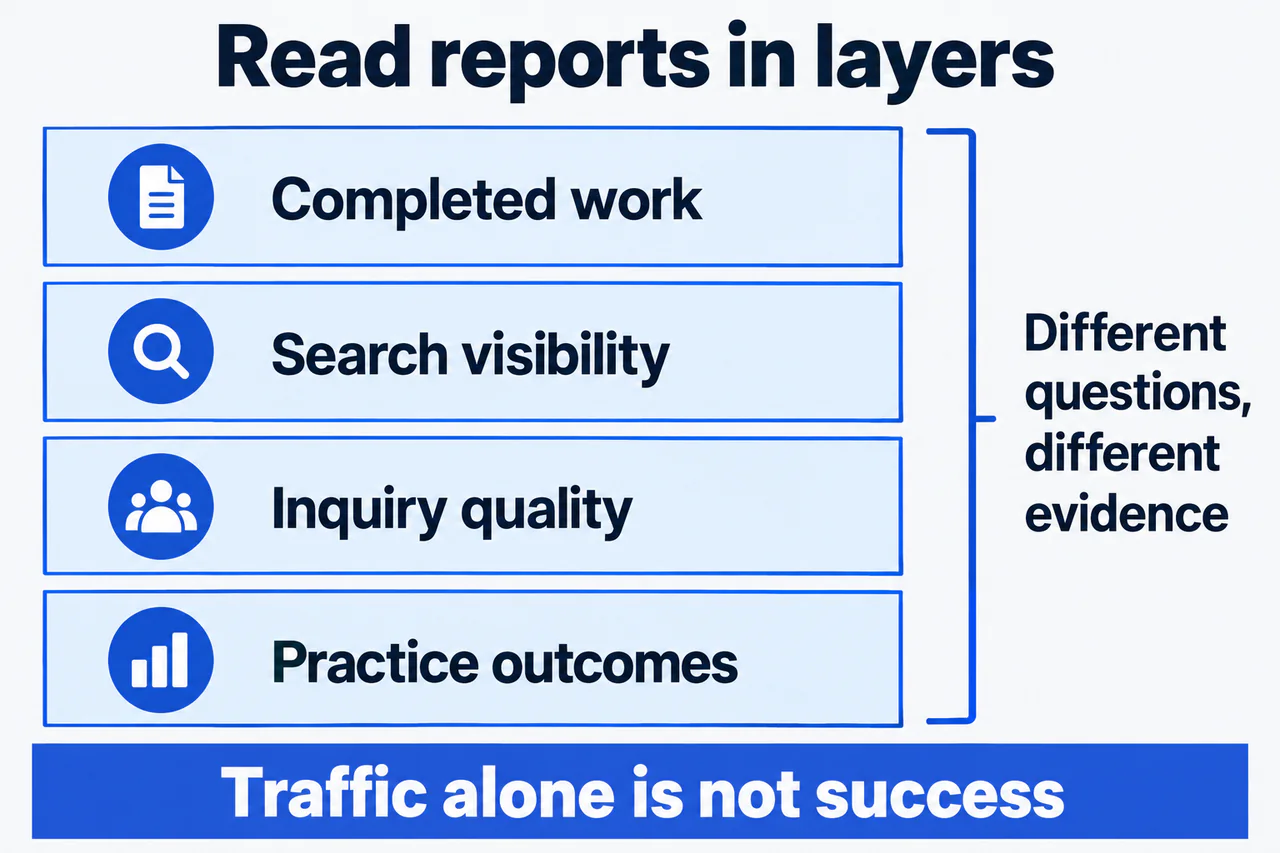
Illustrative report-reading framework. Completed work, search visibility, inquiry quality, and practice outcomes answer different questions and need different evidence.
View full-size diagram (opens in a new tab)Start with the work that actually reached the live site
Review completed changes before the performance charts. Look for affected URLs or profiles, implementation dates, approvals, and verification. Distinguish a recommendation from a deployed correction and a draft from a published page.
Ask what was blocked and why. A content item waiting for clinical approval is not the same as an agency task that has not been started. A technical ticket waiting on an outside developer needs an owner and a next action, not a permanent “in progress” label.
Then connect work to the intended hypothesis. If the agency improved a procedure page, what question was it trying to answer better? If it corrected local information, what confusion was it resolving? This prevents the report from becoming a list of tasks with no relation to the practice's priorities.
Our SEO process describes this implementation-and-review loop. The report should show how it was applied to your assets, not merely repeat the process diagram.
Practical check. Open one completed change during the meeting. If the practice cannot see what changed, ask for a clearer record.
Read search visibility by intent and page group
Whole-site growth can hide important differences. Separate branded searches from nonbranded searches where feasible, and review the pages related to priority procedures and locations. A popular educational article may increase total clicks without changing demand for the services the practice wants to grow.
Google's Search Console metric definitions explain clicks, impressions, and average position. Average position is an aggregate, not a universal rank seen by every person. Query and page views also have reporting limitations, so totals may not reconcile exactly in every export.
Do not panic when a broader set of queries lowers the average position. An illustrative example: a page previously appeared for a small number of strong branded searches, then began appearing for many additional nonbranded searches at lower positions. The aggregate average may decline while the range of relevant visibility expands.
Conversely, a better average can result from losing low-ranking impressions rather than gaining valuable visibility. Always inspect the underlying query and page changes before celebrating the headline.
Practical check. Ask which query groups and pages explain most of the change. A report should be able to move from the summary to the contributing evidence.
Understand click-through rate without chasing a universal benchmark
Click-through rate is clicks divided by impressions for the selected scope. If a page receives 40 clicks from 1,000 impressions, its CTR is 4%. That arithmetic does not establish whether 4% is good for the particular result type, query mix, position, and search context.
Compare like with like. A branded query near the top of results differs from a broad informational query surrounded by several search features. Changes in the mix can move CTR even when the page itself is unchanged.
If impressions rise but clicks do not, investigate relevance, result presentation, position, and the search page's layout. Do not automatically rewrite every title. A title should accurately communicate the page, not lure clicks with a claim the content cannot support.
AI-search reporting should be identified separately by its actual product and metric. Google introduced dedicated generative AI controls and insights in 2026; a report should use current definitions rather than repeat an outdated claim that no dedicated data exists.
Practical check. Compare a stable query group over an appropriate period before drawing conclusions from sitewide CTR.
Connect inquiries to operations without exposing patient data
Agree on what counts as a new inquiry and how duplicates, spam, existing-patient administration, and wrong-service contacts are excluded. A phone click is not the same as a connected call, and a form event is not necessarily a successfully delivered message.
Use approved systems to summarize inquiry quality and consultation progression. The marketing report generally needs meaningful aggregate categories, not unrestricted access to patient records or call transcripts. Privacy review should determine the appropriate data flow.
Keep clinical suitability separate from marketing qualification. Staff can classify whether an inquiry concerns an offered service or the correct geography, but a marketing dashboard should not imply that someone is clinically eligible for surgery.
Review response and attendance patterns. If relevant inquiries increase while attended consultations do not, the next investigation may concern scheduling, follow-up, expectations, or capacity rather than rankings. The practice SEO guide explains these connected stages.
Practical check. Ask whether the inquiry count can be reconciled with an approved operational summary. If not, mark it as a tracking estimate rather than a verified business total.
Expect different systems to disagree for understandable reasons
Search Console, website analytics, call systems, and practice-management tools observe different events. Google's guide to Analytics and Search Console explains why search clicks and site activity need not match exactly.
Differences can also arise from consent settings, blockers, time zones, duplicate events, forwarding behavior, and attribution rules. The provider should investigate material discrepancies, but perfect equality between systems is not the correct expectation.
Keep a change log for measurement. A new event definition or repaired form integration can change the report without changing patient demand. Comparisons across that date should be annotated.
Avoid combining all channels' claimed conversions into a total. Several platforms may claim credit for the same person. Use a deduplicated practice-level total where appropriate and show channel attribution as a separate analytical view.
Practical check. If two numbers disagree, ask what each system counts before asking which one is wrong.
Finish the report with a decision
A useful monthly meeting can be short: review the implemented work, examine the most important change, discuss uncertainty, and agree on the next priority. Include the practice-side approvals needed and the evidence expected at the next review.
Do not let the provider switch the success metric whenever the agreed one disappoints. It can propose a better measure, but the change should be explicit and justified. The guarantee page and any written agreement should use stable definitions where commercial outcomes depend on them.
The report should also identify when data is too sparse to support a confident conclusion. “We need more observation” is acceptable when paired with a reason and a defined next review, not when used indefinitely to avoid accountability.
Practical check. Write a one-sentence decision at the end of the meeting. If you cannot, the report may need less data and more interpretation.
Frequently asked questions
Are rankings the most important SEO metric?
They are one visibility indicator, not the complete business outcome. Review relevant search exposure, clicks, appropriate inquiries, and later outcomes with consistent definitions. A ranking screenshot cannot substitute for that sequence.
Why do clicks and sessions differ?
They measure different events and use different methods. Consent, technical behavior, and reporting settings can also affect totals. Investigate large unexplained discrepancies without expecting exact equality.
Is more traffic always a good result?
No. The audience and page purpose matter. Traffic for irrelevant services or distant markets may not support the practice's priorities, and relevant traffic can still encounter a broken inquiry route.
Should the agency show every patient in its report?
Not by default. Reporting should use an approved data design and the minimum necessary information for the decision. Aggregate outcomes can often answer marketing questions without exposing patient-level details.
What should I ask when a report looks impressive but feels unclear?
Ask what changed, what caused the provider to believe the work contributed, and what decision follows. Then trace one headline metric to its source and definition. Clarity should improve under questioning.
Make reporting a management tool
The report should help you direct the work and understand its limits. If the current dashboard cannot do that, request a reporting and SEO audit with the original metric definitions and implementation log. The aim is a clearer decision, not another set of decorative charts.