Plastic surgery SEO ROI compares the financial contribution associated with SEO against the full cost of the work, while accounting for timing and attribution limits. Revenue divided by an agency fee is not, by itself, a profit-based return calculation.
The model does not need to be complicated to be useful. It does need consistent definitions, a sensible observation period, and an honest distinction between outcomes attributed to organic search and outcomes caused incrementally by the SEO work.
This article explains a management framework, not accounting or financial advice. Use the practice's own finance definitions and an approved data-handling process.
Plastic surgery SEO ROI starts with the endpoint
Choose what you are measuring. Cost per inquiry, cost per attended consultation, revenue attribution, and contribution-based ROI are different measures. Each can support a decision, but they should not share the same label.
| Measure | Basic calculation | Main limitation |
|---|---|---|
| Cost per qualified inquiry | Relevant marketing cost divided by qualified inquiries | Does not show attendance or completed cases |
| Cost per attended consultation | Relevant marketing cost divided by attended consultations | Does not show later financial contribution |
| Attributed revenue multiple | Collected attributed revenue divided by marketing cost | Ignores the costs of delivering care |
| Contribution-based attributed ROI | Attributed contribution minus marketing cost, divided by marketing cost | Attribution is not proof of incrementality |
If the denominator is zero, the ratio is undefined rather than an impressive infinite return. If the cohort has not matured, label the result provisional. The model should expose uncertainty, not hide it in a percentage.
Practical check. Ask the team to state the endpoint before showing the calculation. A report that switches endpoints midstream is not comparable.
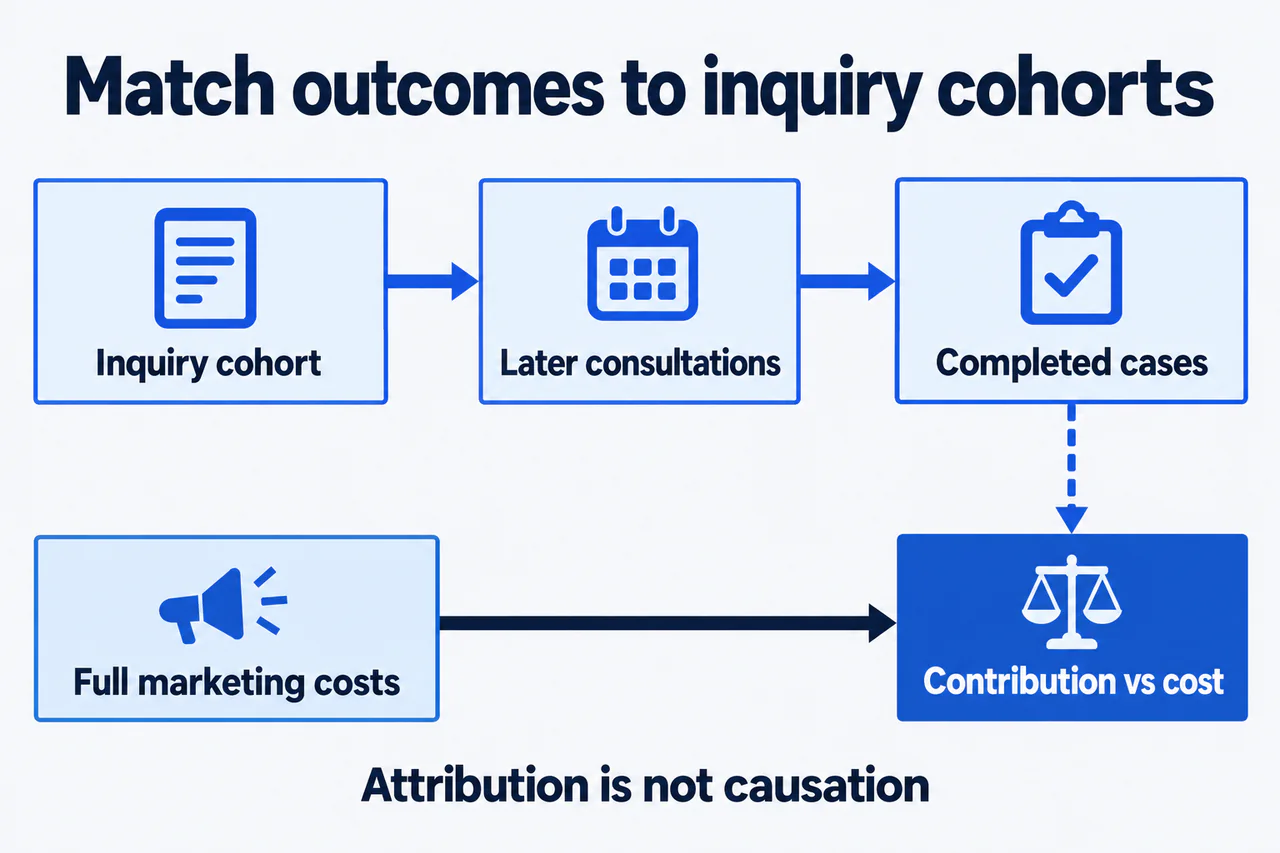
Illustrative cohort model. Follow inquiries into later consultations and completed cases, then compare contribution with full marketing costs. Attribution alone does not establish causation.
View full-size diagram (opens in a new tab)Include the costs that belong to the decision
Start with agency or consultant fees, content production, development, and relevant tools. Add internal time where it is material and measurable. If a website project supports several channels, choose and document a reasonable allocation rather than charging the full cost to every channel or omitting it everywhere.
Separate one-time investments from recurring costs, but do not pretend that setup work is free because it occurred before the reporting period. A campaign-level model may include it directly; an ongoing management model may allocate it over a defined period. Use a consistent convention approved by the finance team.
For the benefit side, distinguish collected revenue from quoted or booked revenue. Cancellations, refunds, financing arrangements, and timing can affect what the practice actually receives. Use the operational and financial records appropriate to your chosen definition.
Define contribution carefully. In this guide, contribution means collected revenue less the variable delivery costs the practice has chosen to include. It is not automatically net profit after every overhead expense. State the included cost categories so the result cannot be mistaken for a broader profit measure.
Practical check. Put the cost definition beside the formula. A precise calculation with an incomplete cost base is still misleading.
Follow inquiry cohorts through the decision period
A cohort groups inquiries by a common starting period, such as the month of first recorded contact. Follow that group to attended consultations and later completed cases. This helps avoid comparing this month's spend with procedures arising from much older demand.
Define how returning contacts and multiple inquiries are handled. One person may call, submit a form, and later book. Counting those as three acquisitions inflates the funnel. Use an approved operational process to deduplicate where appropriate.
Allow time for outcomes to mature. An early cohort may have completed more of its decision journey than a recent one. Comparing them without noting that difference can make the latest campaign look worse simply because its outcomes are unfinished.
Marketing reports should use the minimum information necessary and approved by the practice's privacy advisers. The SEO provider does not automatically need identifiable clinical records to understand aggregate cohort outcomes. The SEO process should specify how measurement responsibilities are divided.
Practical check. Label each cohort with its age and the date outcomes were last updated. This makes immature comparisons visible.
Work through an illustrative calculation
Suppose a defined campaign period costs $18,000 in total. After sufficient follow-up, the practice attributes eight completed cases to a deduplicated organic-search inquiry cohort. Assume each case contributes $4,000 under the practice's defined contribution method.
The attributed contribution is 8 multiplied by $4,000, or $32,000. Subtract the $18,000 marketing cost to obtain $14,000. Divide $14,000 by $18,000 to obtain an attributed contribution-based ROI of approximately 77.8%.
These figures are hypothetical. They are not SurgeonSEO client results, typical surgeon economics, or a forecast. The example only demonstrates the arithmetic and the importance of definitions.
The break-even point under these assumptions is $18,000 divided by $4,000, or 4.5 cases. Because cases are counted as whole events in this simplified model, five completed cases would exceed the modeled break-even cost. Real cases may have different contribution amounts, so a practice-level model should use actual values or a justified mix.
Practical check. Recalculate with the practice's own costs and contribution definitions before drawing any conclusion about affordability.
Test sensitivity instead of presenting one optimistic answer
Change the assumptions to see how fragile the result is. With the same $18,000 cost, five cases at $4,000 contribution produce $20,000 contribution and roughly 11.1% attributed ROI. Eight cases at $2,500 contribution also produce $20,000 and the same 11.1% result.
| Illustrative scenario | Contribution | Marketing cost | Attributed ROI |
|---|---|---|---|
| Eight cases at $4,000 | $32,000 | $18,000 | 77.8% |
| Five cases at $4,000 | $20,000 | $18,000 | 11.1% |
| Eight cases at $2,500 | $20,000 | $18,000 | 11.1% |
| Four cases at $4,000 | $16,000 | $18,000 | -11.1% |
The table shows why revenue headlines are insufficient. Changes in case mix, conversion, and delivery cost can materially change the economic conclusion even when traffic appears strong.
Use conservative, central, and optimistic scenarios only when their assumptions are explicit. Do not assign probabilities without evidence. A scenario is a planning tool, not a statistical forecast.
Practical check. Ask whether the practice can tolerate the conservative scenario's cash-flow effect before increasing the budget.
Separate attribution from incrementality
Attribution assigns credit according to a rule. Incrementality asks what would have happened without the SEO work. A person who was already referred to the surgeon may later use Google to find the phone number. Organic search helped the journey, but it may not have created the demand.
Keep branded and nonbranded evidence separate where feasible, and acknowledge that even nonbranded discovery can involve other influences. First-touch and last-touch models answer different questions. Neither is a complete causal account.
Google's Analytics and Search Console guidance helps explain why search and website measurements differ. Neither system independently establishes completed-case profit or the counterfactual result without SEO.
Where volume and circumstances permit, a carefully designed comparison or controlled test may improve causal understanding. Many small practices cannot produce a strong experiment, and that limitation should be stated. Do not rename attributed ROI as incremental ROI simply because the latter sounds more persuasive.
Practical check. Put the word “attributed” in the report title unless the analysis genuinely supports an incremental claim.
Use the model to make a bounded decision
The useful output is a decision about continuing, adjusting, or testing the work. If visibility is improving but inquiries are unsuitable, investigate targeting and page clarity. If inquiries are suitable but attendance is weak, inspect intake and expectations. If completed cases are increasing but contribution is low, review the service mix and costs with the finance team.
Compare the model with SurgeonSEO's pricing scope only after identifying which costs the proposal includes. Review any commercial guarantee using its own agreed metric; an illustrative ROI model does not create or replace contractual terms.
Practical check. Identify the one assumption that would most change the decision and prioritize improving that evidence next.
Frequently asked questions
Is revenue divided by SEO fees the ROI?
It is a revenue multiple, not a contribution-based return calculation. A useful financial model accounts for relevant marketing costs and the costs of delivering the associated services. Label the measure accurately.
Can we calculate ROI after one month?
You can calculate early indicators, but later outcomes may not have matured. Use cohort age and provisional labels. Do not compare incomplete recent outcomes with fully matured older periods as though they were equivalent.
Should all branded-search patients count as SEO acquisitions?
Not automatically. Branded searches may reflect referrals or other marketing. Organic search can support the journey without being the original source of demand, so explain the attribution rule.
What if we cannot identify every patient's source?
Use the evidence available through an approved process and report the unknown share. Do not fill missing data with assumptions presented as facts. Sensitivity analysis can show how uncertainty affects the decision.
Can an agency guarantee a particular ROI?
An agency cannot control every factor affecting practice revenue, costs, capacity, or patient decisions. It can agree on work and commercial terms. Evaluate any financial promise against explicit definitions and realistic control boundaries.
Build a model the practice can reproduce
A transparent calculation is more useful than a spectacular unexplained number. If your current report cannot connect costs, cohorts, and outcomes clearly, request an SEO measurement review. Bring the definitions and aggregate evidence, not unnecessary patient-level records.