SEO vs Google Ads for surgeons is a choice about timing, control, and the practice's next growth constraint, not a contest with one permanent winner. Paid search can provide access to advertising placements once campaigns are approved and active. SEO improves a website's ability to compete for unpaid visibility over time. Neither guarantees appropriate patients or profitable procedures.
A new practice with open consultation capacity may need a different mix from an established surgeon whose branded demand is strong but whose priority procedure is difficult to find. Before choosing a channel, establish what you want to grow, what you can afford to test, and whether the practice can respond effectively to additional inquiries.
SEO vs Google Ads for surgeons at a glance
| Decision factor | SEO | Google Ads |
|---|---|---|
| Access to visibility | Depends on discovery, relevance, and competition | Depends on campaign eligibility, auction conditions, and budget |
| Timing | Improvements and reassessment may take time | Campaigns can start delivering after setup and approval, without a lead guarantee |
| Direct spending | Research, content, development, and ongoing work | Media spend plus management, creative, and landing-page work |
| Control | You influence the website, not organic positions | More direct controls over campaign settings, within platform rules |
| After spending stops | Useful website assets remain, but performance can change | Paid delivery depends on active spending and campaign status |
| Main evaluation | Relevant organic demand and downstream outcomes | Incremental paid demand and downstream outcomes |
The comparison should include total costs. SEO is not free because the click carries no media charge. Advertising is not simply the amount paid to Google. Both require accurate information, functioning contact routes, and measurement that respects patient privacy.
Practical check. Ask each vendor to show the complete cost of its proposal, including implementation, landing pages, reporting, and any tools that become your responsibility later.
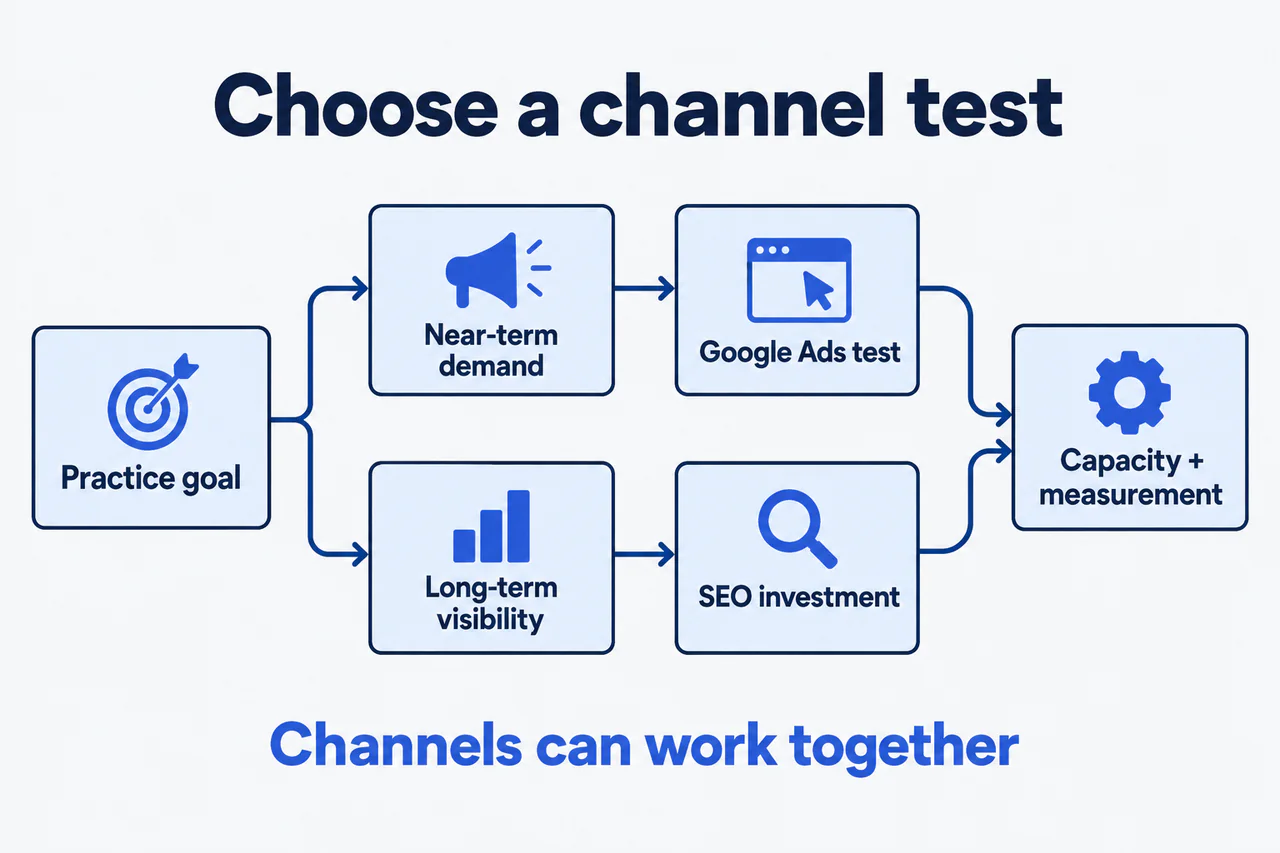
Illustrative decision framework. Urgency can influence which channel to test, but both paid search and SEO need available practice capacity and useful measurement. The channels can work together.
View full-size diagram (opens in a new tab)Start with the constraint, not the channel preference
Consider three distinct situations. In the first, suitable people cannot find the practice. In the second, the website attracts attention but does not explain the offering clearly. In the third, inquiries arrive but are not answered or converted into attended consultations. Only the first is primarily a visibility problem.
Increasing ad spend or publishing more content may worsen the economics of the other two situations by sending more people into the same friction. Test the phone, form, booking route, and staff handoff before you conclude that the practice needs more traffic.
Also consider consultation capacity and scheduling delays. If the next suitable appointment is far away, the immediate business need may be better communication or a different service priority. Marketing should not promise access that the practice cannot provide.
An illustrative example: a practice receives enough inquiries for its main procedure but wants to introduce a newly offered service. A tightly scoped paid campaign may help investigate that service's demand while its core website page is developed. The conclusion depends on budget, ad policies, clinical scope, and intake readiness, not on a universal claim that paid search is best for new services.
Practical check. Finish the sentence “The next additional marketing dollar should solve…” before deciding where to spend it.
Understand what paid search can and cannot tell you
Paid search can offer a comparatively direct way to test a defined query group, location, message, and landing page. That makes it useful for learning, but only if the campaign distinguishes relevant inquiries from spam, existing-patient calls, employment inquiries, and services the practice does not provide.
An inexpensive lead is not automatically an efficient acquisition. A campaign generating many inquiries with little intent to consult may look attractive in a dashboard while consuming staff time. Conversely, a more expensive inquiry may be valuable if it represents a suitable prospective patient who attends a consultation. Clinical suitability remains a clinician's decision, not a marketing score.
Separate branded and nonbranded campaigns when interpreting acquisition. Someone searching the surgeon's name may already have been referred by a patient, another clinician, or an offline advertisement. Paid visibility can help capture that search, but the ad should not automatically receive credit for creating the underlying demand.
Do not assume that every procedure, audience, claim, or tracking configuration is permitted. Ask the advertising provider to check current healthcare advertising and personalized-advertising policies for the actual campaign. Marketing and privacy review should happen before sensitive audience or conversion data is uploaded.
Practical check. Review a small, appropriately de-identified sample of inquiry categories with the intake team. Compare what the campaign calls a conversion with what the practice considers a useful new contact.
Understand what SEO builds and what it leaves uncertain
SEO work can improve the practice's page structure, local information, technical accessibility, and educational content. Those assets can continue to help visitors outside the exact month in which the work was done. That is a reason to maintain a useful website, not a promise of permanent rankings.
Organic performance still depends on competition, demand, search-system changes, and the quality of the underlying offering. A practice that stops maintaining its information can lose relevance even if it once ranked well. A redesign can also undo useful work if URLs, content, or internal links are handled carelessly.
SEO is particularly relevant when the practice has meaningful service information that is difficult to find, weak local representation, or a fragmented website. It may be a less immediate answer to a short-term scheduling gap, especially when the site is new and the market is competitive.
Google's guidance on hiring an SEO distinguishes organic work from paid advertising and warns against ranking guarantees. Our SEO service overview describes the kind of work an organic engagement can include; the individual scope should still follow an audit.
Practical check. Request examples of the assets and corrections you will own after the engagement, not only a forecast chart.
Compare economics using the same endpoint
If one channel is measured by form submissions and the other by completed procedures, the comparison is invalid. Choose a shared endpoint such as qualified inquiries, attended consultations, or collected contribution, and allow enough time for each cohort to mature.
Use a simple planning model before relying on a sophisticated dashboard. Suppose, purely illustratively, that a completed case contributes $4,000 after the variable costs the practice chooses to include. If 10% of new inquiries eventually become completed cases, the expected contribution per inquiry is $400. That is not a recommended acquisition cost: overhead, uncertainty, and the desired return still have to be considered.
Now test sensitivity. At a 5% completion rate, the expected contribution becomes $200 per inquiry. If the marketing decision only works under the optimistic assumption, the budget needs more caution. These numbers are examples for calculation, not industry averages or a projection for your practice.
For SEO, include agency fees, content, development, and internal time where material. For ads, include media, management, landing pages, and tracking costs. Avoid counting the same shared cost twice, but do not omit it from both channels.
Our pricing information can be one input when considering an SEO engagement. Compare any quoted fee with the actual scope and your own economics, not with an unrelated agency's headline price.
Practical check. Recalculate the model with a lower conversion rate and a longer decision period. If the practice cannot tolerate that scenario, reduce the initial test or change the plan.
Use combined channels without claiming duplicate wins
A patient may first discover a practice through an article, return through a branded search, click an ad, and later call directly. Several systems may claim credit. Adding those claims together does not create several patients.
Choose a reporting convention and retain its limitations. First-touch attribution emphasizes discovery. Last-touch attribution emphasizes the recorded contact immediately before conversion. Neither is the complete story. A practice-level view should deduplicate contacts and review aggregate outcomes in an approved environment.
Google explains why Search Console and Analytics can differ. Search clicks and website sessions describe different events, and neither alone proves incremental revenue. An increase in recorded conversions after a tracking change can also reflect measurement changes rather than new demand.
Where useful and feasible, design a controlled test, such as changing a campaign in a defined service area or time window while monitoring other changes. Small practices may not have enough volume for strong causal conclusions. In that case, state the uncertainty rather than dressing up a before-and-after chart as proof.
Practical check. In a combined report, include one deduplicated total and separate channel views. Never sum incompatible conversion definitions.
Choose a starting mix and a review rule
If the practice needs near-term visibility and has a working intake process, a bounded paid-search test may be appropriate while foundational website work proceeds. If the website has important technical or service-information problems, fix those regardless of which channel receives the larger budget.
If the practice already has strong organic demand, consider whether paid search is adding new opportunities or mostly intercepting existing branded searches. If paid acquisition is expensive, investigate query quality, landing-page relevance, and consultation progression before assuming SEO will automatically be cheaper.
Set a review rule in advance. Define the budget, the questions being tested, the minimum implementation work, the outcomes to examine, and the conditions for continuing, adjusting, or stopping. The SurgeonSEO process offers a framework for reviewing organic work, but a paid campaign requires its own specific plan.
Practical check. Require every recommendation to include what would change the recommendation. A strategy that cannot respond to contrary evidence is not a useful strategy.
Frequently asked questions
Is SEO cheaper than Google Ads?
Not automatically. SEO and ads have different cost structures, and the relevant comparison is the cost of an appropriate downstream outcome. Use your own margins, conversion rates, and full implementation costs.
Can ads help a brand-new practice while SEO develops?
They can provide a separate route to paid visibility if the campaign is eligible and the practice is ready to handle inquiries. Set a bounded test and avoid assuming that early lead volume predicts profitable procedures. The website still needs credible service information.
Should we stop ads once organic rankings improve?
Review whether ads add incremental value for the specific searches and locations involved. Organic and paid results do not reach exactly the same circumstances. Test a change carefully rather than making a sitewide decision from one ranking screenshot.
Can Google Ads improve organic rankings directly?
Paying for ads does not purchase organic ranking advantages. The channels can share useful research and landing-page improvements, but that is different from a direct ranking benefit from ad spend.
What if we cannot track every completed procedure to a channel?
Use the best privacy-approved aggregate evidence available and disclose the gaps. An imperfect but honest measurement model is better than an apparently precise model built from unsafe data sharing or duplicate attribution.
Make the next investment explainable
Choose the channel mix that addresses the practice's current constraint and survives conservative financial assumptions. If the organic opportunity is unclear, request an SEO audit before committing to a larger program. Bring your service priorities, current inquiry definitions, and the limits of your existing data.