A plastic surgery SEO timeline should distinguish completed work, search-system response, relevant inquiries, and eventual practice outcomes. Those stages do not move on the same schedule, and no universal month-by-month forecast can reliably predict when an individual practice will gain a particular ranking or number of consultations.
That does not mean an agency can ask you to wait indefinitely without evidence. You should expect a baseline, a prioritized plan, visible implementation, and a clear explanation of what is being learned. Patience and accountability are compatible.
Plastic surgery SEO timeline milestones are not interchangeable
Use four categories to evaluate progress.
| Milestone | Example evidence | What it does not establish |
|---|---|---|
| Work completed | A corrected page, implemented redirect, or approved profile update | That Google has reassessed it |
| Search response | Recrawling, indexing, or relevant visibility changes | That visitors became inquiries |
| Acquisition response | Appropriate new inquiries through an approved measurement process | That consultations were attended |
| Practice outcome | Attended consultations and later completed cases | That SEO alone caused the outcome |
A report should say which category a result belongs to. Publishing ten pages is an output. Growth in relevant nonbranded impressions is a visibility signal. An attended consultation is a downstream event. Each matters, but none should be substituted for another without explanation.
Practical check. Ask the agency to label every milestone as work, visibility, acquisition, or practice outcome. This makes vague progress claims easier to examine.
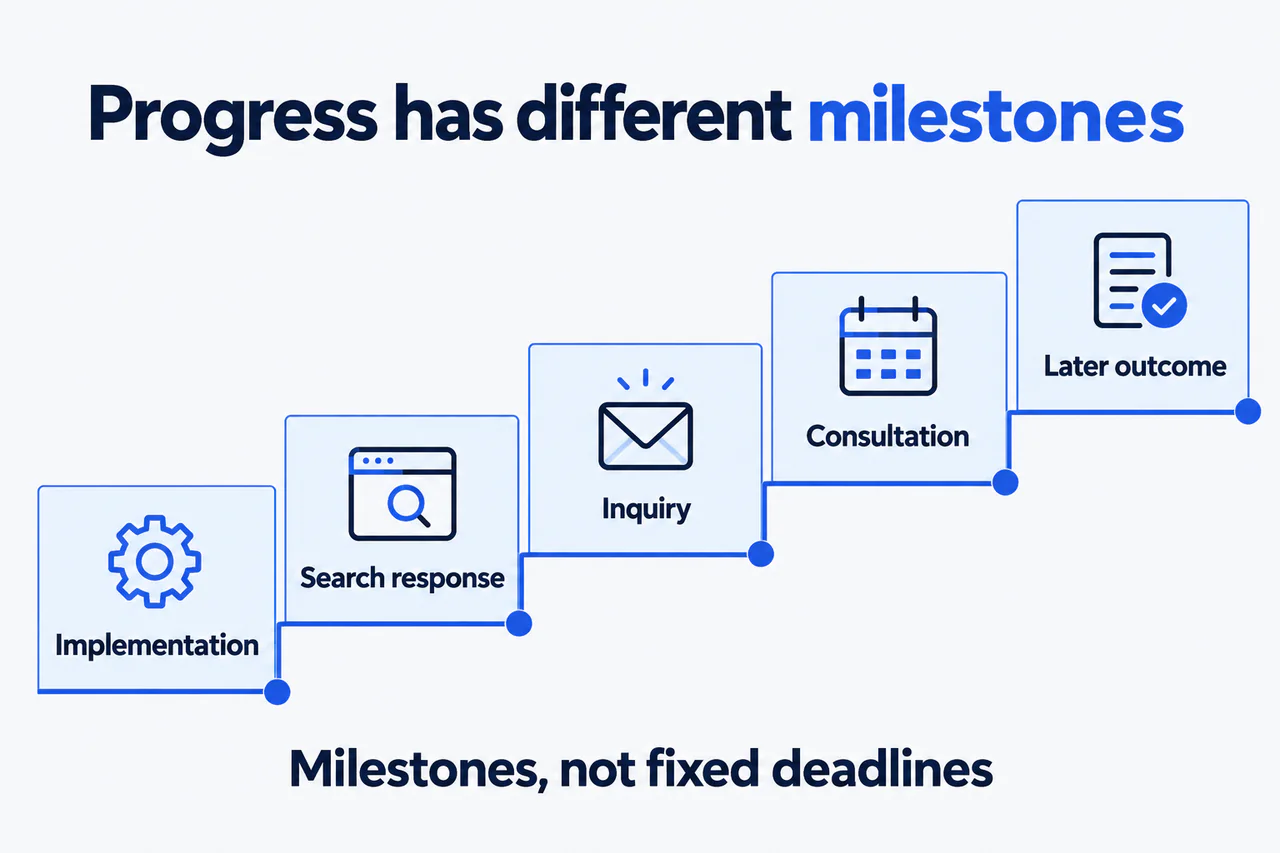
Illustrative milestones, not a delivery promise. Completed implementation, a search response, an inquiry, an attended consultation, and a later outcome can happen on different schedules.
View full-size diagram (opens in a new tab)Establish the baseline before the clock starts
Record the current website, priority services, relevant locations, account access, technical issues, and measurement definitions. Save the date range used for comparison and note unusual events such as a move, website outage, campaign launch, or clinician departure.
Separate branded demand from searches that do not name the practice or surgeon. A rise in branded searches may reflect referrals, publicity, or other marketing rather than new discovery created by SEO. Both are useful to understand, but they answer different questions.
If tracking is being repaired, record that explicitly. A sudden increase in measured inquiries after a form event is fixed may reflect better recording rather than more actual inquiries. Do not use an unreliable baseline to support a dramatic growth claim.
Also document approval and implementation responsibilities. If the agency can recommend changes but cannot deploy them, the timeline depends on another team. If medical content waits for clinical review, that dependency should be visible rather than silently counted as completed agency work.
Practical check. Before approving a forecast, ask whether the underlying data can be reproduced by someone with access to the original systems.
Understand why practices progress differently
A technically healthy established site with a clear service focus starts from a different position than a new domain with little content. A simple indexing error differs from a competitive relevance problem. A one-location practice differs from a group with conflicting profiles and duplicated pages.
Market competition, available source material, development capacity, and the practice's ability to approve and maintain information all affect the work. Search systems also need time to discover and reassess changes, and that response is not controlled by the agency.
Business outcomes add another delay. A person may research a procedure, contact the practice later, attend a consultation, and decide over a longer period. Comparing this month's completed cases only with this month's SEO work can misrepresent the relationship.
Google's guidance on choosing an SEO encourages realistic expectations and warns against ranking guarantees. Use that as a boundary, then ask for a practice-specific plan rather than a generic promise.
Practical check. Ask which three conditions most affect your timeline and what the provider will do if those conditions change.
Use the first review period to test execution and direction
A useful early plan can proceed in phases without claiming that every practice will achieve the same outcome on the same day. First establish access, priorities, and baselines. Then correct material blockers and improve the most important pages or profiles. Finally, review the initial evidence and adjust the next set of work.
The actual sequence should follow the diagnosis. If the website is inaccessible to search engines, fixing that may come before content expansion. If service pages are accurate but inquiry handling is broken, more traffic may not be the immediate priority.
At an early review, expect to see completed work with URLs or other evidence, unresolved dependencies, relevant performance trends, and an explanation of uncertainty. “SEO takes time” is not a substitute for showing what has been done.
Our SEO process describes the structure of an engagement. The individual plan should specify the responsibilities and review points that fit your practice rather than treating the process page as a forecast.
Practical check. For every task marked complete, ask what changed in the live asset and how completion was verified.
Treat a three-month refund commitment as a commercial agreement
A refund promise is different from a guarantee that Google will produce a ranking or that a patient will book. It defines what the agency will do financially under agreed conditions; it does not create control over external outcomes.
For any three-month offer, the written terms should define the start date, baseline, result being measured, data source, review date, and fees covered. They should also explain required cooperation, how disputes are handled, and the claim process. Ambiguity benefits neither side.
Do not accept a definition of “results” that can be satisfied by any trivial increase in an unrelated metric. Equally, do not assume that a general sales phrase necessarily covers advertising spend, third-party costs, or work outside the agreement. Read the actual terms before making a commitment.
Review SurgeonSEO's guarantee page alongside the final written agreement and pricing scope. If the terms are incomplete or unclear, resolve them before signing rather than relying on an article to supply missing contractual details.
Practical check. Both parties should be able to calculate the result independently from the same source data. If they cannot, the success definition is not ready.
Decide whether to continue, adjust, or stop
At a review, examine execution quality and outcome evidence separately. Good implementation with limited early visibility may call for continued observation or a changed hypothesis. Missing implementation, unexplained delays, or inaccessible accounts indicate a different problem.
Ask what the evidence supports now. Are the intended pages appearing for more relevant searches? Are inquiries appropriate to the services? Is the intake team able to respond? Are later outcomes still too immature to interpret?
Choose a next action that follows the answer. Continue work that remains well-supported, adjust a weak hypothesis, or stop a tactic that lacks a defensible rationale. Do not continue solely because money has already been spent, and do not abandon a coherent plan because of one noisy weekly ranking report.
Practical check. Write the decision and the evidence that would cause you to revisit it. This prevents the next meeting from becoming the same discussion with a new chart.
Frequently asked questions
Can SEO produce results in three months?
Some practices may see useful changes within that period, but the type and scale of change depend on the starting point and work. Define whether you mean implementation, visibility, inquiries, or completed cases. Do not turn a possible early improvement into a universal promise.
Does a new website always take longer?
A new site has a different starting point, but “always” is too strong. The relevant factors include technical readiness, content quality, competition, and the practice's existing identity and demand. Assess those conditions rather than relying only on domain age.
Is an increase in impressions enough to call the campaign successful?
It can be an early signal, but it is not the same as useful inquiries or practice outcomes. Check relevance, page groups, and downstream evidence. Success should follow the agreed objective.
Should we stop if rankings fluctuate?
Not based on fluctuation alone. Review the affected searches, locations, pages, and time period, then compare with implementation and broader demand. A single position snapshot is a weak basis for a major decision.
How can we hold an agency accountable without demanding impossible guarantees?
Agree on scope, ownership, implementation evidence, reporting definitions, review dates, and commercial terms. Ask for honest forecasts with assumptions. Accountability is strongest when the work and the uncertainty are both explicit.
Replace vague waiting with a reviewable plan
The right timeline explains what happens next and how you will judge it. If your current proposal lacks a defensible baseline or milestone structure, request an SEO assessment before committing to a long engagement. A clear plan should make both progress and problems easier to see.