Choosing a plastic surgery SEO agency means evaluating its evidence, proposed work, and accountability, not simply its familiarity with surgical terminology. A good provider should explain what it can improve, what it needs from the practice, how progress will be measured, and what remains uncertain.
Start with your own priorities: procedures, locations, available consultation capacity, existing website problems, and budget constraints. Without that brief, agencies may sell different solutions to different problems, making their proposals difficult to compare.
Choosing a plastic surgery SEO agency starts with evidence
Ask for relevant work examples and enough context to interpret them. A case study should identify the period, starting point, work performed, metric definitions, and other material changes. A large percentage increase from a tiny baseline can be technically true while conveying little about your likely outcome.
Separate surgeon-specific experience from general SEO experience. Both can be useful, but they are not interchangeable. Cross-industry results can demonstrate technical or analytical competence without proving knowledge of surgical practice operations.
SurgeonSEO is newly specializing in surgeons. Hamza Esh brings more than a decade of general SEO experience, and his prior client results come from other industries. We should be evaluated on that evidence as such, not presented as an established surgeon-case-study portfolio. The about page should reflect the same distinction.
Practical check. Ask what the case study does not prove. A provider willing to explain limitations is easier to evaluate than one who treats every chart as a prediction.
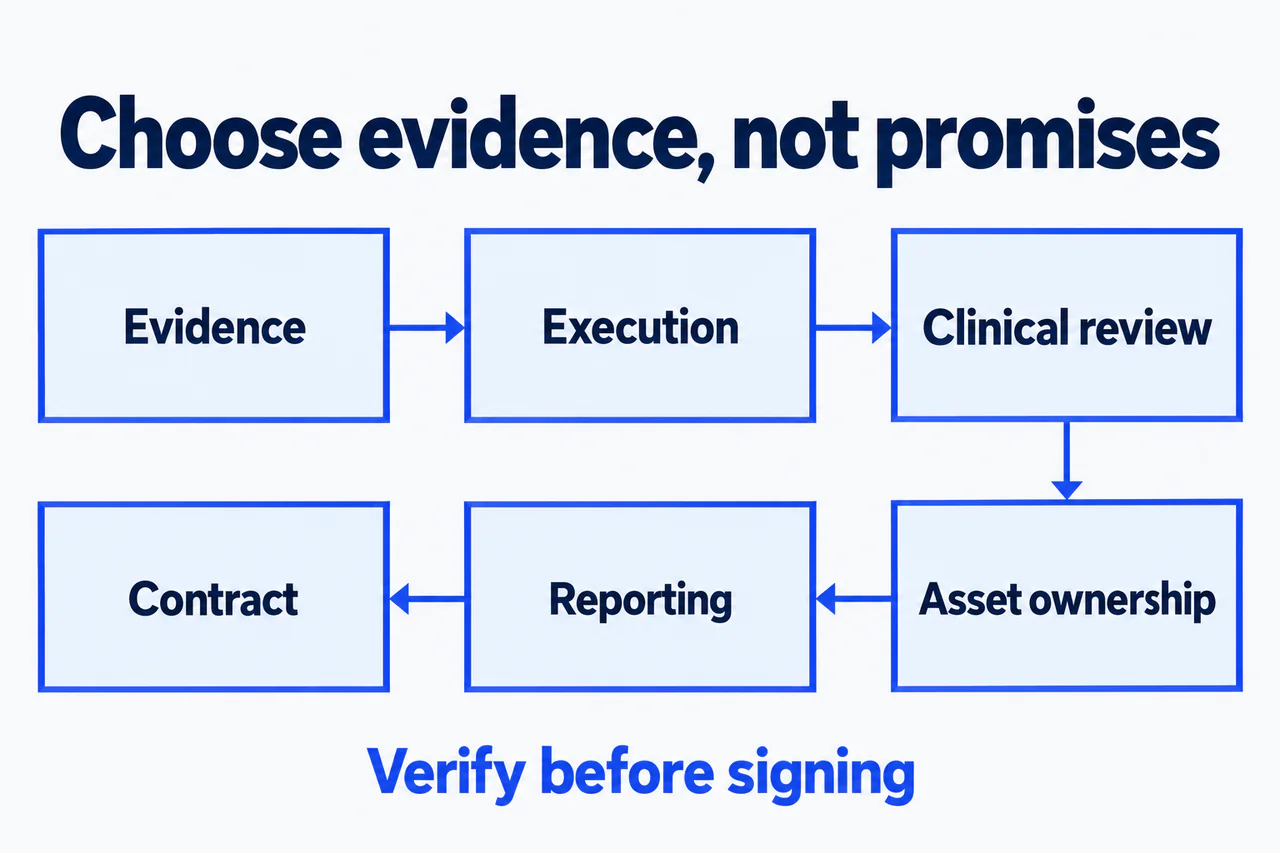
Illustrative buyer checklist. Verify evidence, execution, clinical review, asset ownership, reporting, and contract terms before selecting an agency.
View full-size diagram (opens in a new tab)Ask the agency to explain its first decisions
Request a proposed diagnostic sequence, not a generic promise to optimize everything. Which pages and profiles will it inspect? What data does it need? What would make it prioritize technical work over content, or local accuracy over outreach?
The provider should be able to name plausible problems without pretending to diagnose your entire practice before seeing the evidence. A useful preliminary discussion distinguishes observations from hypotheses and explains what an audit would establish.
Ask how it prevents overlapping pages. A proposal that creates separate URLs for every keyword variation may increase volume without improving usefulness. The agency should explain how service pages, biographies, locations, and articles fit together.
Our SEO process is the kind of public framework you can compare with a written proposal. The contract still needs specific deliverables and responsibilities.
Practical check. Ask “What might you recommend not doing?” A provider that cannot identify nonpriorities may be selling activity rather than judgment.
Verify who implements and who approves
Find out who will make website changes, write drafts, manage profiles, and verify completion. Determine whether implementation is included or whether the practice must hire a developer separately. Ask how out-of-scope work is estimated and approved.
Clinical content needs an explicit review route. The agency should not claim that SEO experience qualifies it to approve medical statements. Identify the clinician who reviews the content, the version they approve, and what happens when a page changes later.
Patient images, testimonials, forms, tracking, and call recording require additional boundaries. Ask which decisions go to the practice's privacy or legal advisers. A generic “HIPAA-compliant marketing” label is not enough to establish that every tool and configuration is appropriate.
Google's guidance on hiring an SEO provides useful due-diligence questions. Use them to examine the actual team and process, not only the salesperson's expertise.
Practical check. Put one example task through the proposed workflow. Who drafts it, who approves it, who publishes it, and who checks it afterward?
Keep ownership and access explicit
The practice should understand and retain appropriate control over its domain, hosting, CMS, Search Console, analytics, business profiles, and advertising accounts. Access should be granted through suitable permissions rather than shared credentials whenever possible.
Review ownership of copy, design, code, photographs, and licensed components. Some assets may be licensed only while a subscription continues. That may be commercially acceptable, but it must be understood before the relationship begins.
Ask for an exit process: notice period, exports, backups, account transfer, license changes, and removal of agency permissions. A smooth exit is part of a healthy agreement, not evidence that you expect the relationship to fail.
For data systems, identify where information is stored and who can access it. Do not accept a reporting arrangement that requires uncontrolled sharing of patient information simply because the dashboard looks detailed.
Practical check. Ask whether you could move to another provider without losing your domain, content, historical data, or essential contact routes. Require a specific answer for each asset.
Inspect the reporting definitions
A report should connect work performed with relevant visibility and business evidence while acknowledging attribution limits. Ask for a sample that shows page groups, branded versus nonbranded demand where feasible, implemented work, and next decisions.
Define an inquiry, a qualified inquiry, an attended consultation, and a completed case separately. Do not allow every form event or phone click to be called a patient. Ask how spam, duplicate contacts, existing-patient administration, and wrong-service inquiries are handled.
Rankings should have context: query, location, device, date, and result type. A handpicked screenshot is not a complete performance report. Third-party traffic estimates should not be presented as verified analytics.
Ask what happens when the numbers move in the wrong direction. A useful provider should investigate and adjust rather than substitute a different metric without explaining why.
Practical check. Choose one number in the sample report and ask to trace it back to its source and definition.
Review tactics and commercial promises together
Ask how the agency obtains links, selects content topics, and manages local profiles. Opaque link networks, keyword-filled business names, fake reviews, or mass-produced city pages create risks that a refund clause does not eliminate. Google's spam policies provide a useful boundary.
Review any guarantee carefully. A commercial refund promise can define a remedy, but it cannot guarantee Google's decisions. The agreement should state the result, baseline, period, data source, fees covered, cooperation requirements, and claim process.
For SurgeonSEO, read the guarantee explanation and pricing scope with the final agreement. Do not fill gaps in the terms with assumptions from a sales conversation.
Also ask about conflicts. Does the provider work with nearby competing practices? If it offers exclusivity, how are geography, procedure scope, duration, and exceptions defined? Do not assume exclusivity from the word “specialist.”
Practical check. Put every material promise into a written comparison sheet. If a promise disappears from the contract, resolve the difference before signing.
Use a short selection scorecard
Compare agencies on evidence quality, implementation capacity, review process, account control, reporting clarity, and commercial fit. Use “demonstrated,” “partly demonstrated,” and “not yet demonstrated” rather than inventing a precise numerical ranking from a sales call.
Apply hard gates where appropriate. An agency that refuses practice ownership of critical assets or cannot explain how it protects patient information may be unsuitable even if its design work is attractive.
Request references with permission and ask about the working relationship, responsiveness, and implementation quality. Do not demand confidential patient data or assume that another client's outcome predicts yours.
Practical check. Have a second decision-maker review the evidence sheet without the sales presentation. If the choice becomes unclear, the presentation may have been doing more work than the evidence.
Frequently asked questions
Must an agency already have plastic surgery case studies?
Relevant case studies can reduce uncertainty, but examine their quality and the proposed team. A new specialist can be considered if it accurately labels its experience and has a credible process. Do not treat cross-industry results as surgeon-specific proof.
Is a number-one ranking guarantee a good sign?
No provider controls every Google ranking. Ask instead for accountable work, transparent reporting, and clearly defined commercial terms. Confidence is not evidence of control.
Should we buy the cheapest proposal?
Compare equivalent scope and total cost first. A lower fee may omit implementation, content review, or technical support. A higher fee is not automatically better either; inspect what it buys.
Can we ask for a trial project?
A bounded paid assessment or implementation project can help evaluate working quality. Define the deliverable and acceptance criteria. It should test useful work, not promise a complete SEO outcome in an unrealistically short period.
What is the most important contract question?
Ask who owns the assets and how the work will be verified. Then examine scope, approvals, data handling, fees, and exit terms together. No single clause substitutes for a coherent agreement.
Choose a relationship you can audit
The right provider should make its work easier to understand, not harder to question. If you want to evaluate SurgeonSEO, request an audit and ask the same questions you would ask any other agency. The decision should rest on evidence, scope, and fit.