SEO agency vs consultant is not simply a choice between a larger team and an individual expert. The important question is who will diagnose problems, implement changes, obtain clinical approval, and remain accountable for the work. An in-house team is a third option, but it also needs the right skills and management support.
A practice can make any of these arrangements work when responsibilities are clear. It can also struggle with any of them when strategy is separated from execution or when nobody owns the handoff between marketing, development, and clinical review.
Choose the operating model that fills the practice's actual gaps, not the one with the most reassuring label.
SEO agency vs consultant at a glance
| Model | Often useful when | Main question to resolve |
|---|---|---|
| Agency | The practice needs several execution skills coordinated | Which work is included and who actually performs it? |
| Consultant | The practice has implementers but needs diagnosis or direction | Who will turn recommendations into live changes? |
| In-house | The practice has sustained workload and management capacity | Can the role cover the required skills without unrealistic expectations? |
| Hybrid | Internal ownership exists but specialist capacity is missing | Where are the boundaries and approval responsibilities? |
These are tendencies, not guarantees. Some consultants implement extensively. Some agencies mainly advise. An in-house employee may be an excellent strategist but need outside development or writing support. Evaluate the actual people and scope.
Practical check. Ask each option to walk through one concrete task, from discovering an issue to verifying the live correction. The gaps become visible quickly.
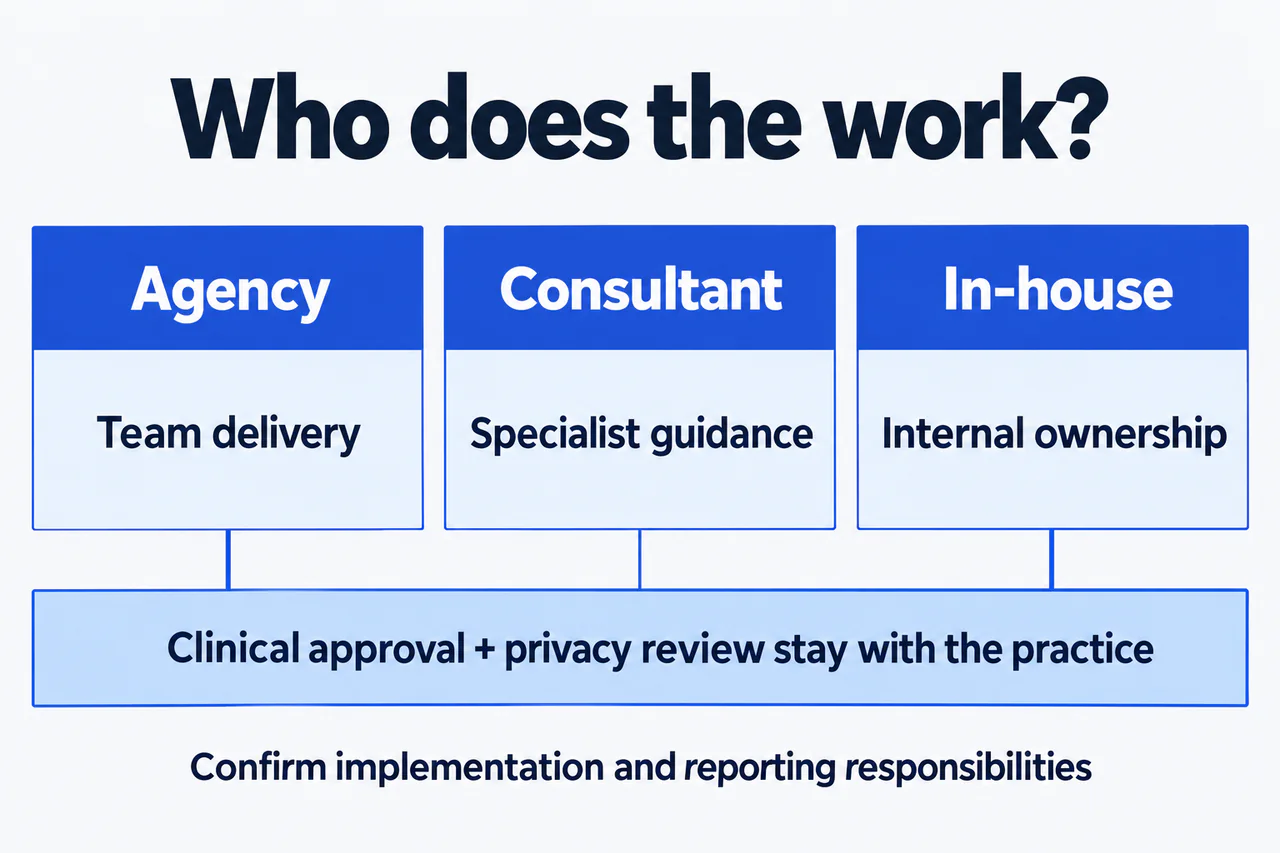
Illustrative team-model comparison. Agency delivery, specialist consulting, and an internal team organize work differently. Agree who implements and reports; the practice retains clinical and privacy approval responsibilities.
View full-size diagram (opens in a new tab)Identify the capabilities the practice needs
Start with the work, not the job title. A practice may need technical diagnosis, website development, content research, writing, local-profile management, measurement design, and project coordination. Clinical review and privacy approval remain separate responsibilities even when a marketing provider offers a broad service.
Make an inventory of capabilities already available. Perhaps the practice has a reliable developer and a marketing manager but lacks search strategy. A consultant may fit that gap. Another practice may have no implementation resources and need a coordinated agency team. A larger group may have enough recurring work to justify internal ownership supported by specialists.
Also assess decision-making capacity. If every content approval waits indefinitely for the surgeon, adding more writers may increase the backlog rather than output. If nobody can authorize website changes, a detailed audit may remain unused regardless of who wrote it.
The practice-owner SEO guide outlines the work categories. Use it to define the missing capabilities before requesting proposals.
Practical check. For each capability, name the current owner or write “unassigned.” Unassigned work is a more useful buying signal than a general feeling that the website needs SEO.
When an agency is the practical fit
An agency can be useful when several disciplines need to work together and the practice wants one coordinated delivery relationship. The value depends on whether the agency actually provides the needed execution, not simply whether it has a large team page.
Ask who performs strategy, writing, development, and reporting. Determine whether those people are employees, contractors, or partner vendors, and how quality is managed. Outsourcing is not automatically a problem, but undisclosed responsibility makes accountability harder.
Review the implementation boundary. Does the agency edit the existing website, require a rebuild, or send recommendations to another developer? Are technical fixes included? What happens when a task exceeds the monthly scope? Who approves medical information and patient-media use?
An agency may reduce coordination work, but it should not remove practice oversight. The practice still needs to supply accurate information, approve clinical claims, and retain control of essential accounts. Our SEO process explains the kind of workflow a provider should make visible.
Practical check. Request a sample task log with completed work, owners, and verification evidence. A polished dashboard alone does not show how the work gets done.
When a consultant is the practical fit
A consultant is often useful when the practice already has capable implementers but needs independent diagnosis, prioritization, or specialist oversight. This can work well for a redesign, a complex traffic decline, or a team that needs a focused strategy rather than another full-service vendor.
The risk is an implementation gap. A technically sound recommendation has limited value if nobody has the time or skills to apply it. Define whether the consultant will produce specifications, review completed work, train the team, or directly make changes.
Ask about availability and continuity. A highly capable individual may have limited capacity or planned absences. The agreement should explain response expectations, documentation, and what happens if the engagement ends before the project is complete.
Avoid assuming that a consultant is always cheaper. A lower advisory fee can be offset by development, writing, and internal project-management costs. Compare the complete operating model rather than the consultant's invoice alone.
Practical check. For every recommendation in the proposed scope, identify the implementer and approval route before the consultant begins.
When an in-house role makes sense
An internal marketer can develop detailed knowledge of the practice, coordinate approvals, and maintain continuity across channels. This can be valuable for a group with substantial recurring work and enough management capacity to support the role.
Do not write a job description that expects one person to be an expert developer, medical writer, analyst, designer, paid-media specialist, and local SEO lead. A broad role may coordinate those capabilities, but coordination is different from personally delivering each at a specialist level.
Include the cost of recruitment, onboarding, management, tools, training, and outside support. Also consider continuity if the employee leaves. The practice needs documentation and shared institutional access rather than a collection of assets controlled by one person's accounts.
Clinical review still needs an authorized clinician. An internal marketer's proximity to the surgeons does not make them qualified to approve medical claims. Likewise, analytics and call-tracking choices need the appropriate privacy and security review.
Practical check. Draft the first quarter's actual task list before writing the job description. This reveals whether you need a specialist, a coordinator, or a team.
Consider a hybrid model with a clear decision owner
A hybrid arrangement can combine internal practice knowledge with outside specialist execution. For example, an internal manager may own priorities and approvals while an agency handles technical and content work. A consultant may periodically review an internal team's strategy.
The challenge is avoiding duplicate work and contradictory instructions. Establish who decides priorities, who can change the website, who signs off clinical content, and who reports results. Keep one shared task record rather than several incompatible plans.
Use explicit handoffs. A content draft should move to a named reviewer with a defined question, not disappear into a general inbox. A technical recommendation should include a reproducible issue and acceptance test. A report should explain which team performed the work being discussed.
Practical check. Choose one accountable practice-side owner. Shared participation can be useful; shared ambiguity is not.
Consider an illustrative group with an internal marketing manager, an external website developer, and two surgeons who review different procedures. A consultant could set priorities and supply acceptance tests, the manager could coordinate approvals, and the developer could implement the changes. That model fails if the developer's contract does not include the work or if the manager lacks authority to schedule it. The solution is not automatically another agency. First resolve the missing capacity or decision right, then decide whether external coordination would genuinely help. This is an operating example, not a client case study.
Compare total cost and ownership on equal terms
Request a scope-normalized comparison. Include strategy, implementation, content, technical support, tools, reporting, and the practice's own time. Identify one-time work separately from ongoing maintenance. Do not compare a consultant's advisory retainer with an agency's full execution fee as though they buy the same thing.
Review ownership and exit terms. The practice should understand who controls the domain, hosting, CMS, Search Console, business profiles, content, and licensed assets. Some licenses may not transfer, and that should be disclosed before purchase.
Google's SEO hiring guidance offers useful questions about methods and evidence. Apply them to every model. A prestigious employer name or a large agency roster does not eliminate the need to inspect the proposed work.
Our pricing page is one commercial reference, not a market-wide benchmark. Compare it with the final written scope and the capabilities you still need to supply internally.
Practical check. Ask what work will remain on the practice's desk after the contract is signed. That is often where the real cost difference appears.
Choose the model with a small practical test
Before committing to a long relationship, consider a bounded assessment or project with a clear deliverable. The test should reveal the provider's reasoning, communication, and ability to work with your team, not simply produce a sales-oriented score.
Evaluate whether the output names specific problems, prioritizes them, explains uncertainty, and provides a credible implementation route. Observe how the provider handles missing information and clinical boundaries. A willingness to say “we need the surgeon to confirm this” is a sign of appropriate role clarity.
Do not demand unpaid strategy work that amounts to a full campaign plan. A fair, scoped evaluation can give both sides useful information without pretending that a sales call proves delivery quality.
Practical check. Agree in advance what a successful first project looks like and who will judge it.
Frequently asked questions
Is a specialist agency always better than a general agency?
Specialization can improve context, but it is not proof of execution quality. Ask for relevant evidence, methods, and the actual team. A specialist label should be supported by a credible operating process.
Can one in-house marketer handle all SEO?
That depends on workload, skills, and outside support. Many roles need development, writing, or specialist assistance. Avoid judging the model by an unrealistic all-in-one job description.
Can we hire a consultant to supervise our agency?
Yes, if responsibilities and access are clear. The arrangement should provide useful independent review rather than competing instructions. Decide who makes the final priority decisions.
Which option is cheapest?
There is no universal answer. Compare total delivery cost, including implementation and internal time, for equivalent work. The lowest retainer can be expensive if important tasks remain unassigned.
What should the practice always keep internally?
Keep accountability for business priorities, clinical approval, privacy decisions, and control of critical assets. Execution can be delegated, but those responsibilities should not disappear into a vendor relationship.
Choose the missing capability
The best model is the one that can reliably turn the practice's priorities into reviewed, implemented work. If you are unsure where the gap lies, request an SEO assessment before selecting a staffing model. Ask for a capability map, not just a recommendation to buy the provider's preferred package.