Website traffic but no consultations can indicate the wrong audience, unclear information, a broken contact route, an intake problem, or misleading measurement. More visitors will not necessarily solve any of those issues. Find the first stage where the journey stops working.
Begin by clarifying what “no consultations” means. Are there no form submissions or calls? Are inquiries arriving but not being scheduled? Are appointments booked but not attended? Those are different symptoms, and each belongs to a different part of the practice's operating system.
Website traffic but no consultations requires a stage-by-stage check
Trace the journey from the landing page through contact and attendance. Use aggregate, privacy-approved evidence and synthetic tests where appropriate.
| Stage | Diagnostic question | First evidence to inspect |
|---|---|---|
| Audience | Are visitors interested in an offered service and relevant location? | Landing pages and query groups |
| Understanding | Can they identify the clinician, service, location, and next step? | Page review and usability testing |
| Contact | Does the form or phone route work? | End-to-end synthetic tests |
| Intake | Are appropriate inquiries handled consistently? | Approved operational summaries |
| Attendance | Are scheduled consultations actually attended? | Cohort-based attendance counts |
Do not skip directly to button colors or a new website. A contact form that never reaches the practice is a more urgent problem than a stylistic preference. A page attracting people who want a service you do not offer needs a different correction again.
Practical check. Name the earliest stage with evidence of failure. If you cannot, gather that evidence before commissioning a redesign.
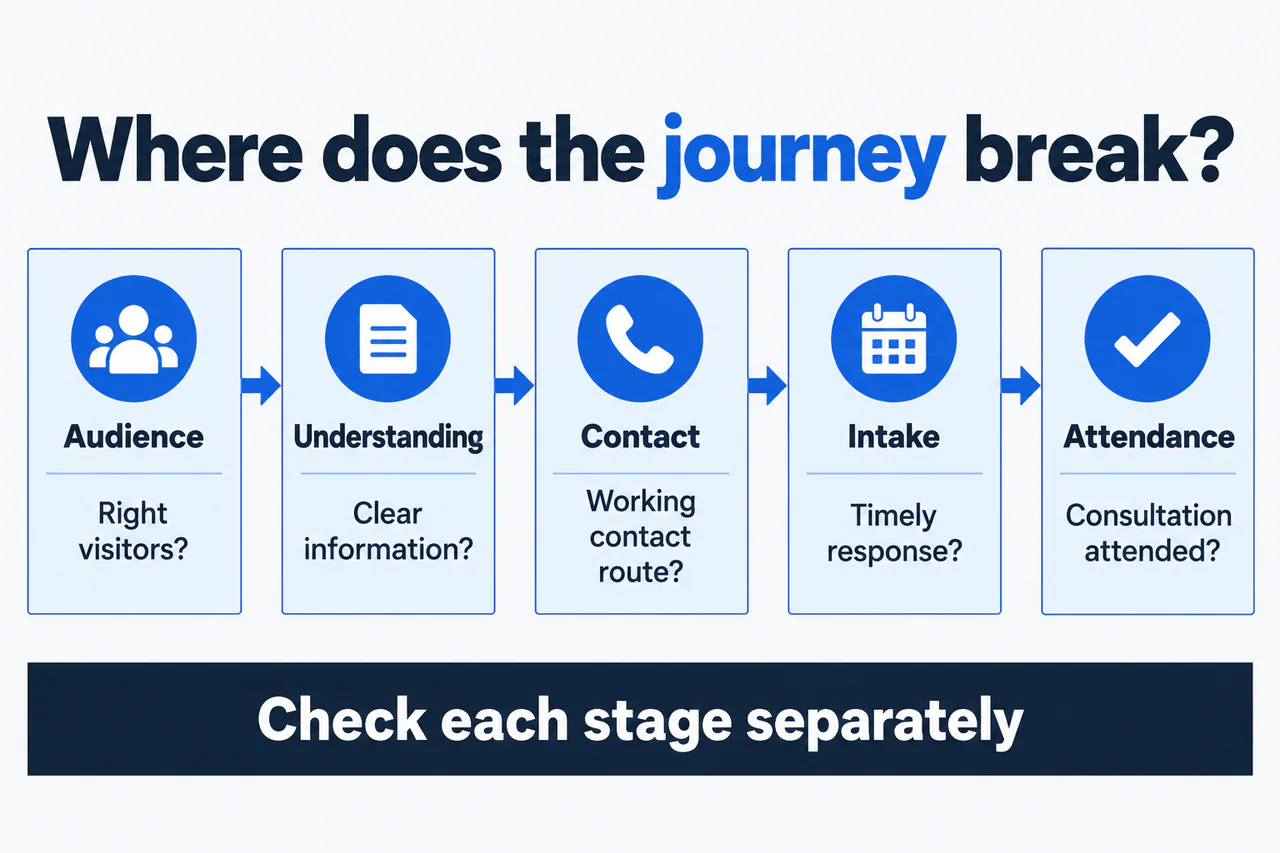
Illustrative diagnostic journey. Check the audience, clarity of information, contact route, intake response, and consultation attendance separately to locate the loss between visits and consultations.
View full-size diagram (opens in a new tab)Check whether the traffic belongs to the practice's market
Review the pages and searches contributing to growth. A broadly popular article can attract readers from outside the service area or people seeking general information rather than a consultation. That traffic is not automatically worthless, but it should not be interpreted as ready-to-book local demand.
Separate branded searches, priority procedure searches, and informational topics where the data allows. Also check whether the practice is attracting inquiries for services it no longer offers, a different clinician, or a different location.
Avoid judging audience quality only from a city field in analytics. Location estimates can be imperfect, and some practices legitimately serve traveling patients. Combine search intent, page purpose, and actual inquiry categories through an approved process.
The practice-owner SEO guide explains why page structure should follow real services and decisions. If a content program is producing attention unrelated to those priorities, revise the plan rather than celebrating total sessions.
Practical check. Identify the five landing pages driving the largest increase and write down what each visitor is likely trying to accomplish.
Check whether the page resolves the decision questions
A visitor should understand what the practice offers, who provides it, where the consultation occurs, and what happens after contact. General claims about excellence do not answer those practical questions.
Review the page on a phone. Is the main explanation visible without dismissing several overlays? Can the visitor find the surgeon biography and relevant gallery? Does the call to action use understandable language? Is the contact route appropriate to the page's stage of intent?
Avoid treating uncertainty as something to overcome with pressure. Surgery is a consequential decision. Clear information and an honest next step are more appropriate than countdown timers, fabricated scarcity, or promises of guaranteed outcomes.
If fees or consultation arrangements repeatedly cause confusion, consider adding accurate context. The practice should approve the details and any qualification needed. Do not publish a misleading low starting price simply to increase form submissions.
Practical check. Ask someone unfamiliar with the practice to explain the next step after reading the page. Their uncertainty is useful evidence, not a failure to appreciate the design.
Test forms and phone routes before changing the copy
Submit a clearly marked synthetic inquiry and follow it through delivery, notification, and staff receipt. Test required fields, validation errors, confirmation messages, and mobile behavior. Check whether spam filtering or an integration is silently dropping messages.
Use clear form labels and understandable error messages. The W3C form guidance explains why labels must be properly associated with controls. A placeholder that disappears while typing is not a complete substitute for a usable label.
Test phone links and forwarding numbers at appropriate times with practice coordination. Confirm that calls reach the correct office and that voicemail or after-hours handling is accurate. A tracking number can remain visible after its forwarding configuration stops working.
Review the information requested. An initial inquiry form should not collect detailed clinical information simply because a template makes it easy. Privacy and clinical workflows should determine what is needed and where it belongs.
Practical check. Keep the test result, time, device, destination, and responsible staff confirmation. “The button works” is not the same as “the practice received the inquiry.”
Investigate intake without blaming staff or inventing sales rules
If appropriate inquiries arrive but do not become appointments, review the process with the people handling them. Ask how inquiries are assigned, how unanswered contacts are followed up, and how service or scheduling questions are resolved.
Do not impose a universal response-time benchmark without considering staffing and operating hours. Set a clear, realistic service standard and examine whether the practice follows it. The useful question is where people are being lost or confused, not whether staff can meet an arbitrary marketing slogan.
Separate operational qualification from clinical assessment. Staff can identify wrong-service inquiries, duplicate contacts, or scheduling constraints. They should not use an SEO lead score as a determination that someone is medically suitable for surgery.
Review scripts for accuracy and tone. The goal is a helpful explanation of the next step, not pressure to book regardless of appropriateness. If capacity is limited, communicate that honestly and reconsider which services marketing should prioritize.
Practical check. Discuss aggregate reasons for nonbooking with the intake team. Do not give the marketing agency unrestricted access to patient conversations when a less intrusive summary can answer the question.
Check whether the apparent problem is measurement
A form event may fire when someone clicks submit even if the submission fails. A phone-click event may record intent to call without a connected conversation. Conversely, a real inquiry may arrive through a route that the dashboard does not capture.
Google's Analytics and Search Console explanation is useful context for differences between search and website metrics. Neither system independently proves that an attended consultation occurred.
Reconcile the marketing view with an approved operational summary. Deduplicate repeated contacts and distinguish new inquiries from existing-patient administration. Mark unknown source information rather than assigning it to whichever channel looks strongest.
Any change to tracking, call recording, or patient-data integration should go through qualified privacy review. A conversion problem is not permission to collect everything. The SEO process should make measurement changes visible and approved.
Practical check. Choose one synthetic test and verify how every relevant system records it. This often reveals mismatched definitions before a larger analysis is needed.
Run one useful experiment at a time
Once the likely constraint is identified, choose a change that addresses it. Examples include clarifying a consultation location, repairing form delivery, simplifying a confusing next step, or improving the relevance of the landing page. Record the hypothesis and the measure that would support it.
Avoid changing the page, traffic source, form, and intake script simultaneously unless an urgent correction requires it. Too many concurrent changes make it difficult to learn what helped. Small practices may not have enough volume for formal statistical testing, so use cautious interpretation rather than claiming certainty from a few extra inquiries.
Compare equivalent cohorts and allow time for attendance. A new booking today may not become an attended consultation until later. Keep the measurement stage aligned with the question being tested.
The local SEO overview is relevant if the issue begins with wrong-location information, while the wider website journey may need a separate content or technical review.
Practical check. Define what you will do if the experiment produces no useful change. A test should have a decision rule, not just a launch date.
Frequently asked questions
Should we buy more traffic if inquiries are low?
Only after checking audience relevance and the contact journey. More traffic can help a genuine visibility shortage, but it can also amplify a broken form or unclear offering. Diagnose the stage first.
Is a low conversion rate proof that the website design is bad?
No. The denominator may contain early-stage or irrelevant visitors, and the tracking definition may be incomplete. Review intent, page clarity, contact behavior, and intake before blaming visual design.
Should we shorten every form?
Collect only information needed for the approved purpose, but do not assume the shortest form is always the best. Usability, privacy, routing, and operational needs all matter. Test the actual journey rather than following a universal field-count rule.
Can call recordings help identify the issue?
They may provide information, but recording, access, transcription, and retention require appropriate review. Consider whether aggregate staff summaries or less intrusive measures can answer the question first.
What if inquiries are strong but attendance is weak?
Investigate scheduling, expectations, follow-up, and cohort timing. That is not automatically an SEO visibility failure. Work with the practice team to identify the reason while keeping clinical and personal information protected.
Fix the first broken handoff
The most useful conversion improvement is often a specific correction, not a new campaign. If you need help tracing the journey, request a website and inquiry-path audit with your metric definitions and aggregate counts. The aim is to locate the constraint before spending more to feed it.