SEO tracking and patient privacy should be reviewed together before a surgical practice installs analytics, call tracking, chat, session replay, or advertising tags. The useful question is not whether a tool is popular in healthcare. It is what information the actual configuration collects, where it sends that information, and whether the practice is permitted to use it that way.
This article is a briefing for conversations with qualified US legal, privacy, and technical advisers. It is not legal advice, a compliance certification, or an instruction to use a particular tracking product. Requirements depend on the entity, data, purpose, jurisdiction, and implementation.
SEO tracking and patient privacy begin with a data-flow map
List the pages and systems involved in the patient journey. Include public educational pages, consultation forms, scheduling tools, authenticated portals, call systems, chat, email integrations, and reporting dashboards. Then identify the vendors receiving information from each step.
Do not stop at visible form fields. Page URLs, query parameters, event names, free-text messages, referrers, recordings, and browser identifiers may also carry sensitive information. The review needs to examine what is transmitted, not just what a vendor says it intends to collect.
| System | Questions to ask before approval |
|---|---|
| Website analytics | Which pages and events are collected, and what fields are transmitted? |
| Consultation form | Where do submissions go, and can marketing tags read the contents? |
| Call tracking | Are calls recorded or transcribed, and who can access them? |
| Chat or session replay | What conversations or on-screen behavior are captured? |
| Reporting platform | Is patient-level information necessary, and which users can see it? |
Practical check. Ask the technical team to demonstrate an actual synthetic test submission and the resulting network or vendor records in an approved environment.
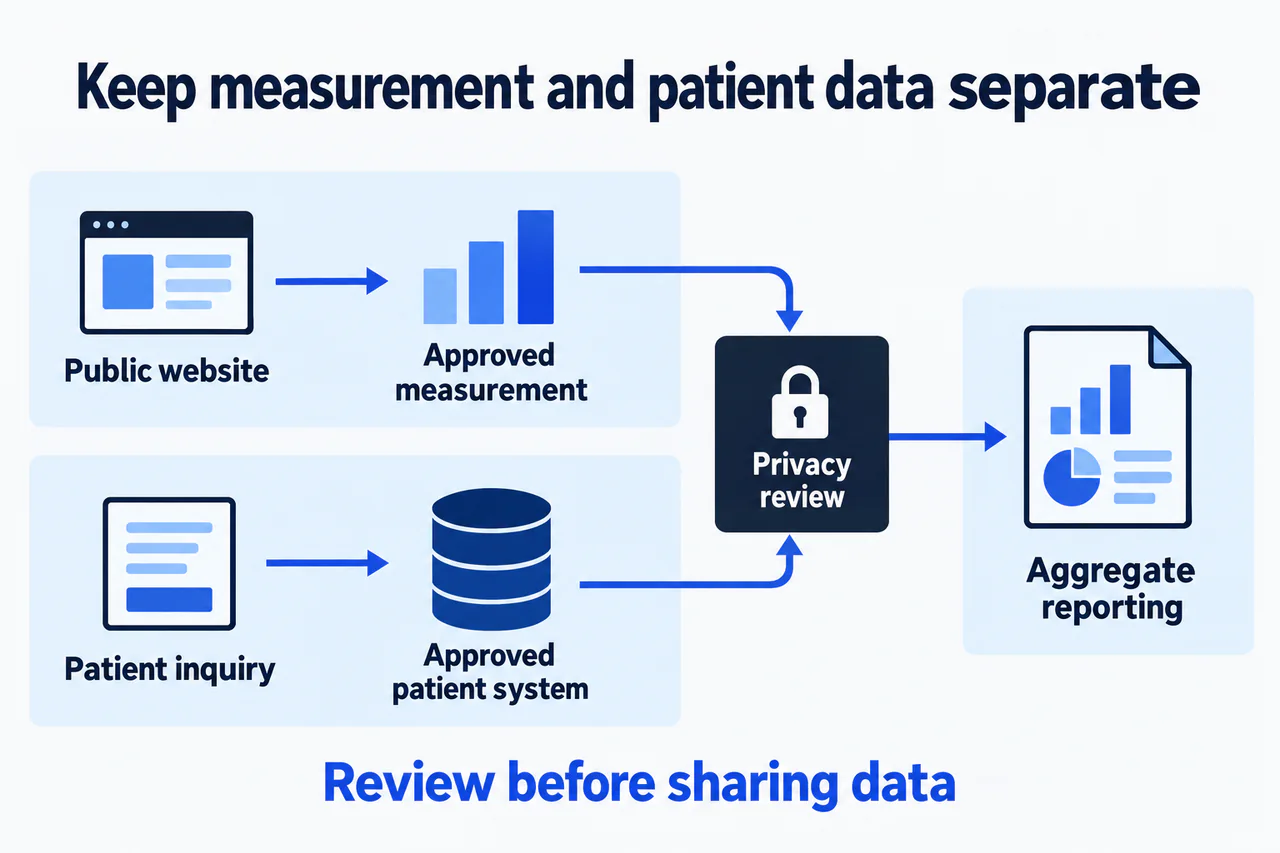
Illustrative data-flow boundaries, not a compliance certification. Keep public-site measurement separate from patient systems, and review what may be shared before producing aggregate reports.
View full-size diagram (opens in a new tab)Understand the current HHS guidance and its limitation
The HHS tracking-technology bulletin discusses obligations when tracking involves protected health information. It also records a June 2024 court decision vacating the part that treated an IP address combined with a visit to an unauthenticated public health-related page as sufficient to trigger the described HIPAA obligations.
That limitation matters. It is inaccurate to claim that every anonymous visit to every public procedure page automatically establishes the same legal conclusion. It is equally unsafe to treat the court decision as permission for every analytics or advertising configuration. Forms, authenticated areas, known patient interactions, and other data combinations require their own assessment.
Have counsel evaluate the current legal position and the practice's specific circumstances. Other privacy, consumer-protection, contractual, and communications requirements may also be relevant. An SEO article cannot resolve those questions for every US practice.
Practical check. Ask the adviser to identify which data flows have been assessed, under which rules, and which remain unresolved. Avoid a blanket label covering systems nobody has inspected.
Do not assume Google Analytics is a HIPAA solution
Google's Analytics guidance on HIPAA states that Google Analytics does not offer a business associate agreement and makes no representation that the service satisfies HIPAA requirements. PHI must not be sent to it.
This means the practice cannot solve a sensitive-data issue by assuming that a general Google account, a cookie banner, or an agency's certification covers Analytics. The actual page types, event payloads, integrations, and permitted uses need review before deployment.
Avoid sending names, email addresses, phone numbers, appointment details, medical descriptions, or unrestricted form text into general analytics events. Also investigate less obvious paths, such as a confirmation URL containing a person's information or a tag reading fields before submission.
The appropriate configuration may differ between a public informational site and systems used for patient interactions. A qualified review should determine what is permitted, necessary, and technically enforceable. This article does not prescribe a universal allowlist of pages or events.
Practical check. Ask the implementer to show the complete event payload, not merely a dashboard screenshot with friendly event labels.
Review call tracking beyond the phone number
Call tracking may involve number substitution, forwarding, caller information, recordings, transcriptions, automated analysis, and integrations with other platforms. Each feature changes the data flow and should be evaluated separately.
Ask whether recording is necessary for the business objective. If the goal is aggregate inquiry counts, a more intrusive configuration may not be justified. If recording or transcription is proposed, obtain appropriate review of consent requirements, access, retention, vendor relationships, and how sensitive information is handled.
An AI-generated call summary does not become nonsensitive merely because it is shorter than the recording. It may still contain identifiable health information. The same care applies when summaries are copied into dashboards, project tools, or training systems.
Keep staff training and clinical records separate from marketing curiosity. An agency does not automatically need access to every conversation to assess SEO performance. Define the minimum useful information and the approved route for receiving it.
Practical check. Ask the vendor to map every destination for a call, recording, transcript, and summary. Include downstream integrations and subcontractors, not only the first platform.
Treat agreements and de-identification as substantive work
A business associate agreement can be required in an applicable relationship, but it is not a universal permission slip for any disclosure or purpose. The legal relationship, permitted use, configuration, and safeguards still need to be appropriate.
Likewise, hashing an email address or removing a name does not automatically establish that a dataset meets HIPAA de-identification requirements. HHS describes specific de-identification approaches, and the appropriate method needs qualified assessment. A marketing team should not declare data anonymous because it no longer looks readable.
Ask when any transformation occurs. If a vendor receives sensitive information first and promises to remove it later, that is a different flow from preventing an unauthorized disclosure in the first place. The review should follow the data through each stage.
Aggregation can reduce the need for patient-level reporting, but small groups and combinations of attributes may still require care. A monthly total is not automatically safe in every context. Have the practice's advisers define an appropriate reporting design.
Practical check. Replace the phrase “we anonymize it” with a written description of the method, timing, responsible party, and validation.
Give the marketing team a usable approval boundary
Create an inventory of approved tools and configurations, including the pages or events covered, access roles, retention settings, and review date. A vendor's approval should not silently extend to every future feature it releases.
Require change review for new tags, form fields, call-recording features, session replay, chat integrations, or data exports. The website's tag manager is an important change surface; access should match responsibility and be reviewed when vendors change.
Use synthetic data for testing, and keep debugging records in approved systems. A screenshot intended to prove that tracking works can itself reveal information if the test uses a real patient interaction.
The SurgeonSEO process should include this approval boundary. The agency service overview is not a replacement for the practice's legal, privacy, or security governance.
Practical check. Ask whether an agency can add a new tracking tag without anyone at the practice knowing. If the answer is yes, revise the change-control arrangement.
Measure business value with less unnecessary data
The practice can often make useful decisions from aggregate counts: relevant search visibility, new inquiry categories, attended consultations, and later outcomes summarized through approved systems. The exact design needs review, but the business question should determine the data requested.
Do not export a full patient list merely because a dashboard supports it. Begin with the decision you need to make, then ask what minimum information can support that decision lawfully and reliably.
Document attribution limits. A privacy-conscious report may not connect every individual across every device and channel. That limitation should be stated honestly rather than “solved” through uncontrolled tracking.
The practice-owner SEO guide explains the distinction between visibility and downstream outcomes. A useful reporting model can preserve that distinction without giving every marketing vendor access to clinical detail.
Practical check. For every requested field, ask which decision would become impossible without it. Remove fields with no defensible purpose, subject to the approved design.
Frequently asked questions
Does a cookie banner make tracking HIPAA-compliant?
No general banner establishes that every disclosure or use is lawful. The practice needs review of the data, purpose, vendor relationship, and applicable requirements. Consent language and technical behavior must be evaluated together.
Is every public-page visitor's IP address automatically PHI?
Do not make that blanket claim. The HHS bulletin records a court limitation concerning the public-page IP-address inference. The legal assessment still depends on the actual context and data flow.
Can we send hashed patient emails to an advertising platform?
Do not assume hashing makes the data de-identified or the disclosure permitted. Obtain qualified review of the proposed use, platform terms, and applicable law before uploading patient-derived information.
Is a signed BAA enough to approve a tracking vendor?
Not by itself. The relationship, permitted purpose, configuration, safeguards, and actual disclosures need review. An agreement does not replace technical testing or appropriate operational controls.
Can an SEO agency certify the whole setup?
An agency can document its implementation and cooperate with review, but SEO expertise is not a substitute for qualified legal and security assessment. Be cautious with broad compliance claims that do not identify the systems and configurations examined.
Ask for the data-flow review before the dashboard
Bring the proposed tools, event definitions, and vendor agreements to the qualified people responsible for the practice. You can request an SEO measurement assessment to identify marketing questions and technical dependencies, but legal and privacy approval must remain with the appropriate advisers.