Patient reviews and local SEO are connected through public reputation and local discovery, but a review program must protect patient privacy and avoid manipulation. The aim is an authentic, responsibly managed record of feedback, not a manufactured rating or a promise that a certain review count will produce a certain ranking.
For a surgical practice, the risks are more specific than in many local businesses. A reply can reveal a treatment relationship. A request can feel coercive. A staff member trying to correct an unfair accusation can accidentally disclose information that should remain private.
Build the process before sending more requests. This guide is operational education, not a substitute for legal or privacy advice.
Patient reviews and local SEO need separate success measures
Reviews can help prospective patients evaluate a practice, and Google includes reputation-related signals in its explanation of local prominence. That does not mean review volume is the only reason a listing appears, or that a practice can calculate an exact number needed to beat a competitor.
Track the integrity of the process as well as public outcomes. Are eligible requests sent neutrally? Are responses reviewed appropriately? Are complaints routed to someone who can handle them privately? Are the listings and contact routes accurate?
Do not evaluate staff only by the number of five-star reviews they obtain. That incentive can distort behavior even when the written policy sounds neutral. A better operational measure is whether the approved process was followed consistently and concerns were escalated correctly.
Practical check. Remove the star-rating target from the staff instructions and see whether the review process still has a clear purpose.
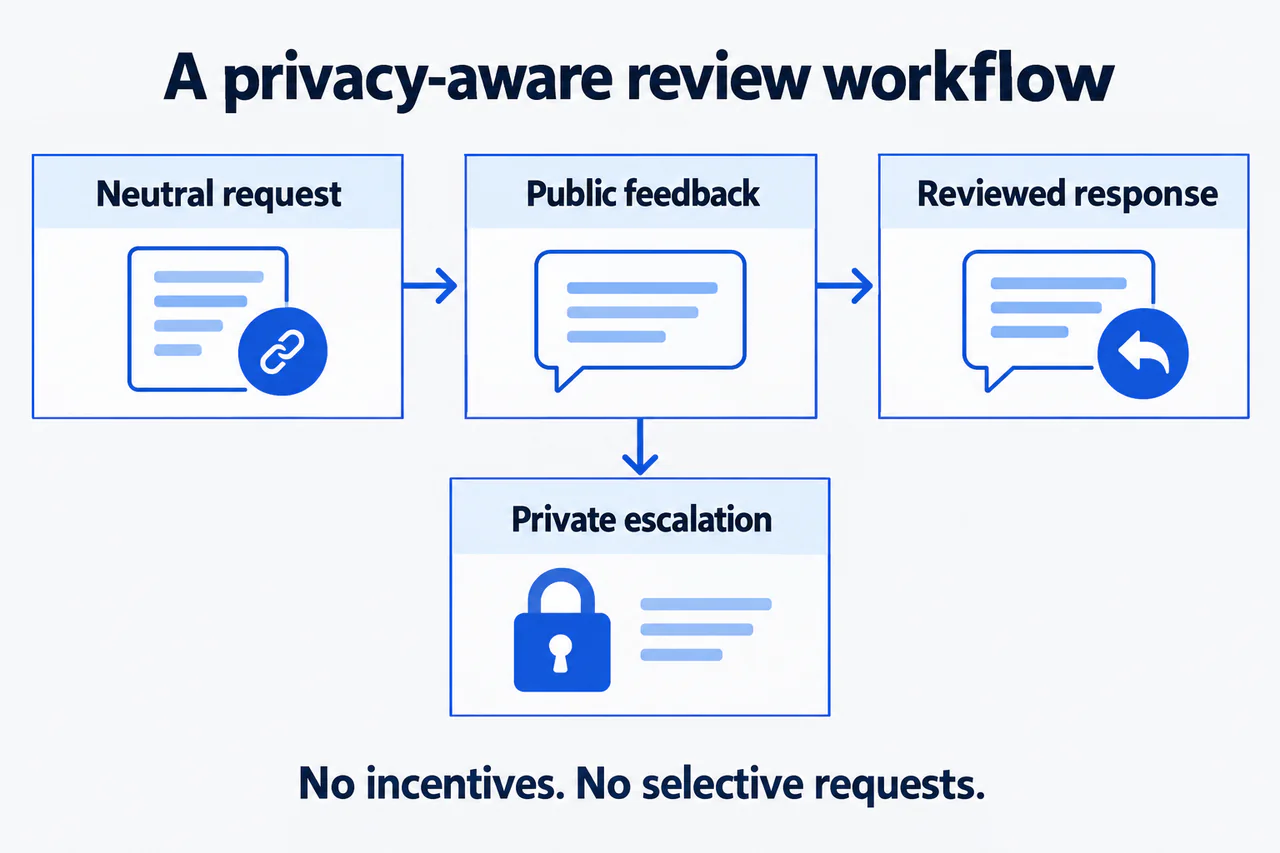
Illustrative review workflow. Use neutral requests, review public responses for privacy, and move sensitive concerns into an appropriate private channel. Avoid incentives and selective requests.
View full-size diagram (opens in a new tab)Ask for feedback without filtering for positive sentiment
Use a neutral request that invites an honest review without suggesting a desired rating. Avoid selecting recipients based on who seems happiest, sending satisfied patients to Google while diverting dissatisfied patients into a private-only route, or offering an incentive for a review.
Google's review guidance prohibits incentives and selective positive-review solicitation. The FTC's review-rule guidance addresses deceptive review practices, including compensation conditioned on sentiment. Platform policies can be stricter than a particular legal rule, so satisfying one does not automatically satisfy the other.
Private feedback can still be valuable, but it should not function as a gate that determines who receives access to a public review option. Keep the channels and their purpose clear.
The timing and recipient criteria should be approved by the practice. Avoid using clinical pressure, implying that future care depends on participation, or repeatedly contacting someone who has declined. Any automation should follow the practice's communication and privacy requirements.
Practical check. Read the request as a patient who had a disappointing experience. Does it genuinely invite honest feedback, or subtly tell them that only praise belongs in public?
Establish a privacy-first response policy
Public replies should not confirm a person's patient status, discuss treatment details, or disclose internal records. The fact that the reviewer mentioned care does not give the practice blanket permission to add information.
HHS has taken enforcement action involving disclosures in responses to online reviews. That is a reason to treat replies as a controlled communication channel, not a task delegated casually to whoever manages social media.
Use approved principles rather than a single robotic template. A response can acknowledge feedback in general terms, state that the practice takes concerns seriously, and offer an appropriate private contact route without confirming a treatment relationship. The exact language should be reviewed for the practice's circumstances.
Do not paste identifiable reviews, internal notes, or patient records into an unapproved AI tool to generate a “HIPAA-safe” reply. The tool's confident wording does not establish that the input handling or output is lawful.
Practical check. Before posting, ask whether the reply adds any information about the person's relationship with the practice. If it does, stop and obtain appropriate review.
Separate public moderation from private resolution
A public review can involve a service complaint, a clinical concern, a billing issue, an apparent policy violation, or a statement the practice cannot verify. Each requires a different internal route. The marketing agency should not investigate clinical records to win a public argument.
Create an escalation matrix with the issue category, responsible role, public-response authority, and private follow-up process. Keep clinical and identifying details in approved practice systems rather than in the public-review management dashboard.
| Review issue | Appropriate internal owner | Public handling principle |
|---|---|---|
| General service feedback | Designated practice manager | Acknowledge without exposing private facts |
| Possible clinical concern | Qualified clinical team | Move assessment to an appropriate private channel |
| Billing dispute | Authorized billing team | Avoid publishing account details |
| Apparent platform-policy violation | Profile manager with practice oversight | Use the platform reporting process |
| Threat or serious safety concern | Practice leadership and appropriate advisers | Follow the practice's safety and legal procedures |
Reporting a review does not guarantee removal. Disagreement alone is not proof that a platform rule was violated. Preserve relevant records appropriately and avoid threats or pressure intended to suppress legitimate feedback.
Practical check. Staff should know whom to contact before a difficult review arrives. A crisis is a poor time to invent access permissions and approval rules.
Keep agency access and practice accountability clear
An agency can help monitor reviews, draft proposed responses, and maintain an issue log, but the practice should define what the agency may publish without approval. Sensitive situations need a clear escalation boundary.
Keep profile ownership and account recovery under appropriate practice control. Review permissions when staff or agencies change. A vendor should not retain the only access to the practice's public reputation channel.
The local SEO service overview explains where profile management sits within a broader engagement. The SEO process should identify whether review monitoring is included, who approves responses, and how exceptions are handled.
Do not treat a response quota as an SEO ranking requirement. Thoughtful management is useful, but claims that every reply directly increases rankings need evidence. The patient-facing purpose and privacy constraints come first.
Practical check. Ask the agency to show its escalation rule for a review mentioning treatment details. If the answer is simply “our AI handles it,” require a more accountable process.
Report what the review program can actually show
A sensible report can include new reviews, rating distribution, response status, unresolved issues, and process compliance. It should not expose patient identities unnecessarily or present every new review as a newly acquired patient.
Compare local visibility and inquiries separately. A change in reviews may occur alongside website improvements, seasonal demand, or a practice move. A before-and-after chart alone does not isolate the effect of reviews on ranking or revenue.
Look for operational learning in aggregate themes. Repeated confusion about parking, scheduling, or response times can suggest practical improvements. Those changes may help patients regardless of whether they alter search visibility.
The broader practice SEO guide places reputation alongside website quality and measurement. Reviews are one part of that system, not a substitute for accurate services, useful content, or a functioning intake process.
Practical check. End each review meeting with an operational lesson, not just a celebration of the average rating.
Frequently asked questions
Can we offer a discount for an honest Google review?
Google's policy prohibits incentives for reviews, even when the request says the review should be honest. Do not assume that an incentive is acceptable because it is not explicitly tied to five stars. Check both platform policy and applicable law.
Can we ask only patients who say they are happy?
Selectively requesting positive reviews is not an appropriate Google review strategy. Use a neutral, consistently applied process approved by the practice. Private feedback should not become a gate that excludes dissatisfied people from public options.
Can we correct a false claim with the patient's record?
Do not publish private clinical or account information to rebut a review. Route the issue through authorized internal and legal processes. A public accusation does not remove the practice's confidentiality obligations.
Should every review receive a response?
The practice can set a response policy, but privacy and appropriateness should govern it. Some reviews need escalation before any reply. Do not sacrifice judgment to a response-rate target.
Can reviews guarantee a top Maps position?
No. Local results depend on several factors and the searcher's context. A legitimate review program supports reputation, but no fixed count or rating establishes a guaranteed position.
Improve the process before increasing the volume
Start with neutral requests, accountable access, and an approved escalation policy. If you need help assessing how reviews and profiles are currently managed, request a local SEO audit. Keep legal and privacy approval with the qualified people responsible for the practice.