Backlinks for plastic surgeons are links from other websites to the practice's pages. A useful link can help a person discover or verify the practice and may contribute to search visibility. Its value is not established by a high third-party authority score or a vendor's promise to deliver a large quantity.
Start with legitimate relationships and accurate public information. Professional affiliations, relevant institutions, local organizations, and genuinely useful educational contributions are more defensible starting points than anonymous link packages.
The question is not simply “Can we get a link?” It is “Why would this source reasonably mention this practice, and what would a visitor learn by following it?”
Backlinks for plastic surgeons need a source-quality test
Evaluate a proposed link through four lenses: relevance, provenance, audience value, and terms. Relevance asks whether the source has a meaningful connection to the practice or topic. Provenance asks who operates the site and how the placement is obtained. Audience value asks whether a reader benefits. Terms ask whether money, products, or other consideration is involved.
| Proposed source | Useful reason to consider it | Question to resolve |
|---|---|---|
| Professional membership directory | Verifies a real affiliation | Is membership current and accurately described? |
| Hospital or facility profile | Clarifies a genuine relationship | Does the profile reflect the actual role? |
| Local organization | Connects the practice to real community activity | Is the involvement substantive and public? |
| Editorial article | Adds relevant expertise or reporting | Is the contribution accurate and independently selected? |
| Paid sponsorship | Supports a real promotional objective | Are the commercial terms and link treatment appropriate? |
These are categories to assess, not guaranteed ranking assets. A link from a relevant source may still send little traffic, and a valuable relationship should not be reduced to a single SEO metric.
Practical check. Ask the vendor to name the site and explain the placement process before approving it. “High authority network” is not adequate disclosure.
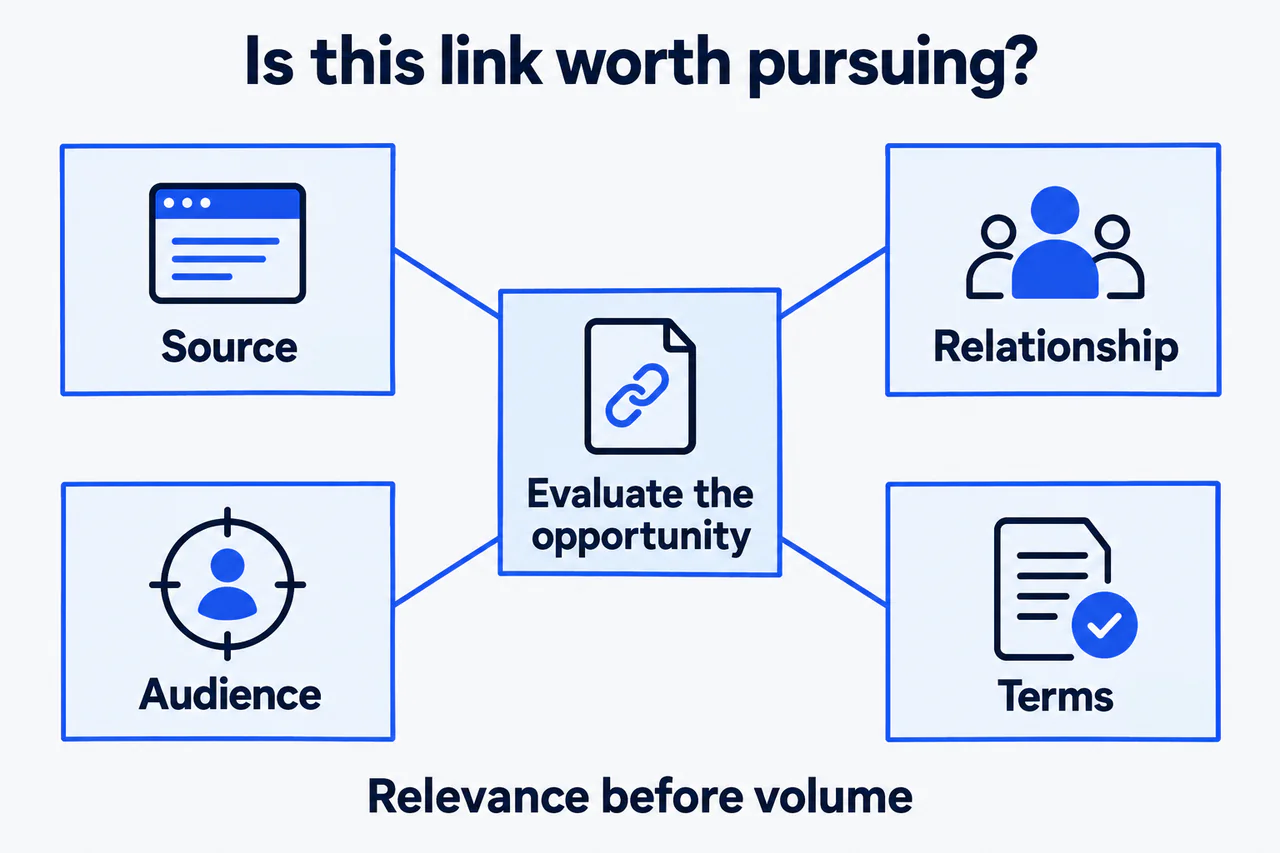
Illustrative link evaluation. Examine who publishes the link, the underlying relationship, the relevant audience, and the terms before deciding whether an opportunity is worthwhile.
View full-size diagram (opens in a new tab)Correct the relationships that already exist
Review professional and institutional profiles the practice is genuinely entitled to maintain. Check names, credentials, locations, contact details, and website destinations. An outdated profile can confuse a prospective patient even when it has no measurable ranking effect.
Distinguish a directory citation from an endorsement. A listing may simply record business information. Do not describe it on your website as an award, accreditation, or clinical recommendation unless that is what it actually represents.
For organizations with multiple surgeons, confirm whether a profile belongs to the individual clinician or the practice. The linked page should fit that identity. A surgeon-specific professional profile may be better served by a substantive biography than by a generic promotion.
Keep a record of account ownership and renewal requirements where relevant. A directory becomes a maintenance obligation if its data can become outdated. The local SEO overview explains how these identity checks complement business-profile work.
Practical check. Before paying for new submissions, inspect the five most important existing profiles for factual errors and broken links.
Pursue contributions that are useful without the link
A practice may have legitimate opportunities to contribute to community education, professional events, or editorial reporting. The contribution should be accurate, appropriate to the clinician's expertise, and reviewed before publication.
Do not manufacture a medical opinion merely to satisfy an outreach request. A request for a quotation can introduce clinical, reputational, and legal considerations. The surgeon should know where the comment will appear and whether it may be edited or placed in a context they would not endorse.
Useful original material can also support outreach: a clearly explained practice process, an educational resource, or a properly conducted and appropriately reported project. Do not call a casual marketing survey a clinical study or invent data to make a press pitch more attractive.
An SEO provider can research opportunities, coordinate outreach, and track responses. It should not guarantee independent editorial coverage or pretend that a purchased placement was earned journalism. The SurgeonSEO process should specify what outreach work means and which approvals are required.
Practical check. Ask whether the practice would be comfortable with the contribution if the publisher removed the link. If not, the proposal may be driven more by manipulation than genuine usefulness.
Recognize risky link packages
Be cautious with offers promising hundreds of links, exact-match anchor text at scale, undisclosed private networks, or guaranteed ranking improvements. Low prices are not the only warning sign; expensive packages can be equally opaque.
Google's spam policies address links created primarily to manipulate rankings. Paid advertising and sponsorship can be legitimate, but link qualification and the purpose of the placement matter. Do not confuse buying exposure with buying ranking credit.
Ask whether content will be published on sites with a real editorial purpose or on pages that exist mainly to sell placements. Review neighboring content and whether the proposed article makes sense for that site's audience. A polished domain metric does not answer those questions.
Avoid requiring every link to use the same commercial phrase. Natural descriptions depend on context. A named practice, surgeon, resource, or relevant page title may be appropriate; an anchor-text formula should not override the publisher's useful explanation.
Practical check. Make undisclosed sources and methods a contractual concern. The practice should not discover after payment that its reputation has been attached to a network it would never have approved.
Evaluate existing links without panic
An unfamiliar link in a report is not automatically a crisis. Public websites can receive links they did not request, and third-party tools may label them with alarming scores. Investigate context before paying for a large cleanup project.
Ask the analyst to distinguish links the practice or its vendors created from unsolicited links, and to explain why a particular pattern is material. A blanket “toxic link” label is not enough to justify removing legitimate references or taking advanced remedial steps.
If the site has a documented history of manipulative link building or a relevant Search Console issue, obtain a careful, evidence-based assessment. Do not use a disavow file as routine housekeeping without understanding the situation and current official guidance.
Keep any remediation separate from an ordinary content plan. The evidence, risks, and verification steps should be documented. Our practice SEO guide places links within a broader system that also includes useful pages, technical access, and local accuracy.
Practical check. Ask what observable problem the proposed cleanup is expected to solve and what evidence supports that expectation.
Measure the work beyond a count of placements
A useful report identifies the source URL, destination URL, relationship, placement date, commercial terms where relevant, and current status. It should distinguish outreach attempts from live placements and avoid counting the same site repeatedly as though each link were an independent endorsement.
Review whether visitors from relevant sources engage with appropriate content, where measurement is lawful and meaningful. Also examine whether the work improves the accuracy and discoverability of the practice's public identity. Not every valuable relationship produces a large traffic number.
Do not attribute every organic improvement to the latest links. Content changes, demand, technical fixes, and other factors may have changed at the same time. A responsible report explains the contribution hypothesis and its limits.
Practical check. Replace the question “How many links did we get?” with “Which credible relationships and useful references did we establish or improve?”
Frequently asked questions
Is a high authority score proof that a link is good?
No. Third-party scores are tool-specific estimates, not Google's internal measures or a clinical endorsement. Inspect the source, audience, and placement process directly.
Should every surgeon join every directory?
No. Prioritize relevant, legitimate sources where the information can be accurate and maintained. A large submission count can create more outdated listings without providing meaningful value.
Can we sponsor a local event and receive a link?
A genuine sponsorship may have promotional value, but the commercial relationship and link treatment need to be appropriate. Do not buy sponsorship solely as a disguised way to manipulate rankings. Ask the provider to explain its approach against current search policies.
Do nofollow or sponsored links have no value?
They can still help people discover the practice or understand a legitimate relationship. Do not judge a placement only by whether it might pass ranking signals. Audience relevance and honest disclosure remain useful.
Should we remove every link a tool marks as toxic?
No. Treat automated labels as prompts for investigation, not instructions. Advanced remediation should follow a specific diagnosis and current official guidance rather than a blanket score.
Buy transparency before buying outreach
If a proposal includes link building, ask to see the source criteria, approval process, and reporting format. You can request an SEO audit to assess existing issues before committing to new placements. A provider should be able to explain the work without hiding behind proprietary scores.