A surgeon Google Business Profile can represent an eligible public-facing practitioner, while a separate profile may represent the practice at a real location. The correct arrangement depends on how the business operates. It is not a choice between whichever format seems likely to rank better.
Start by identifying the entities: the organization, the individual surgeon, and the physical location where that surgeon can be contacted during the stated hours. Then apply Google's rules to those facts. Creating extra listings first and sorting out eligibility later can produce duplication, verification problems, and confused patients.
Surgeon Google Business Profile eligibility comes first
Google's business representation guidelines describe individual practitioners as public-facing professionals. Eligible practitioners must be contactable directly at the verified location during their stated hours. Support staff should not create practitioner profiles, and a practitioner should not create multiple profiles simply to cover different specializations.
For multiple public-facing practitioners at one location, Google's guidance distinguishes the organization's profile from the practitioners' profiles. Practitioner names should not be expanded with the organization name. For a sole public-facing practitioner representing a branded organization at a location, Google recommends a shared profile using the brand and practitioner naming format described in its guidance.
These rules should be applied to the actual arrangement, not reduced to “every doctor gets a listing.” Multiple offices, shared facilities, changing schedules, and institutional affiliations can require closer review.
Practical check. Before creating a profile, write down who it represents, where that person or organization operates, and how a member of the public can contact it there.
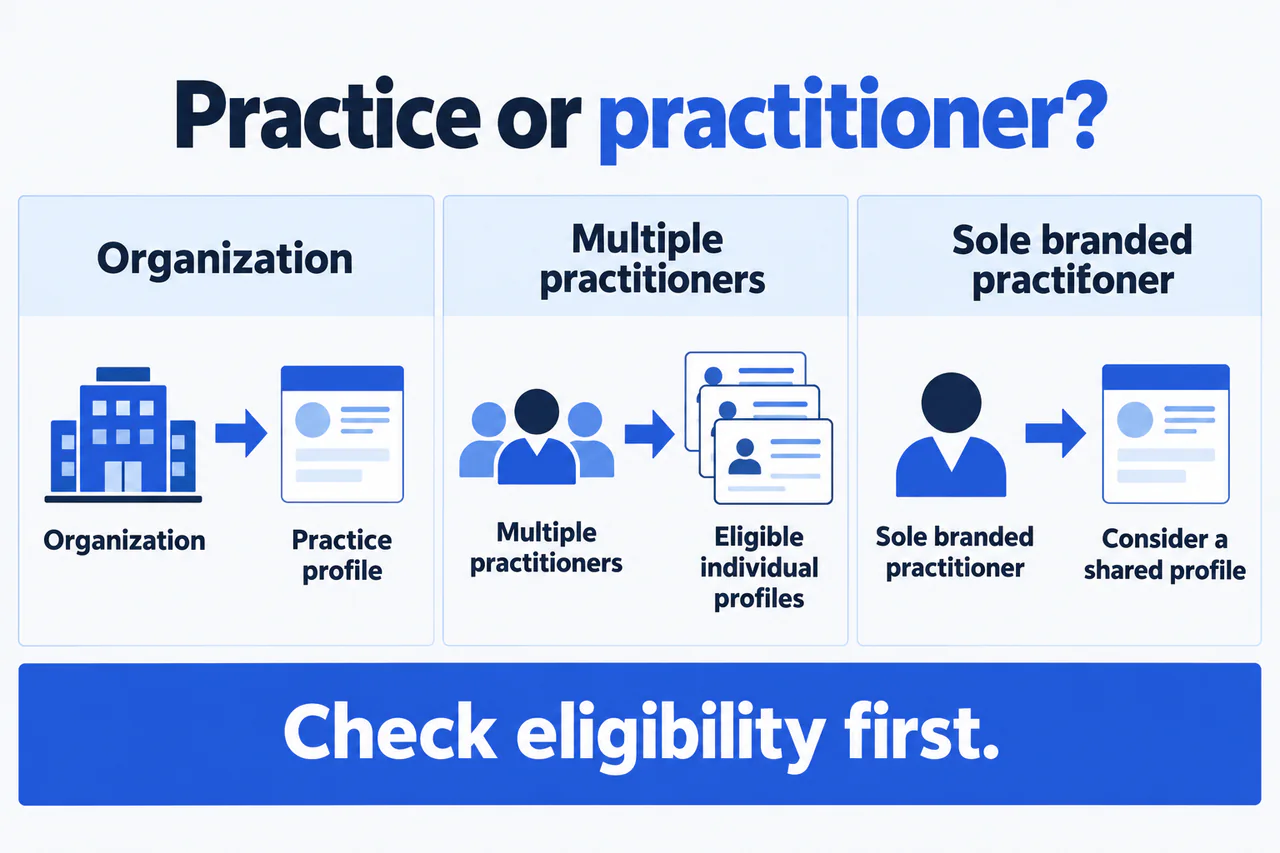
Illustrative profile scenarios. Check eligibility and current platform rules before choosing practice, practitioner, or shared-profile arrangements; do not create duplicates for every possible combination.
View full-size diagram (opens in a new tab)Use a profile inventory before making changes
Create one record for each existing or proposed profile. Include its public URL, represented entity, location, owner, managers, verification status, website destination, phone number, and any unresolved issue.
| Situation | Main question | Next action |
|---|---|---|
| Several surgeons share one practice location | Which organization and practitioners meet the rules? | Review each entity and document the correct arrangement |
| One surgeon represents a branded practice | Does the sole-practitioner guidance apply? | Assess a shared profile before creating separate versions |
| A surgeon attends several offices | Is the surgeon directly contactable at each stated location and time? | Verify the actual operating arrangement before adding profiles |
| Two similar listings already exist | Are they duplicates or different eligible entities? | Investigate ownership and history before merging or removing |
| A surgeon leaves the practice | Which information and permissions need to change? | Coordinate an accurate transition without reassigning identity |
Do not treat this table as permission to create a listing. It is a set of questions to resolve. The difference matters because a neat organizational chart does not establish real-world eligibility.
Practical check. Have one practice representative approve the inventory. This prevents an agency, office manager, and individual surgeon from making conflicting edits independently.
Keep names, categories, and destinations accurate
Use the real-world business or practitioner name according to the applicable rule. Do not append promotional claims, procedure lists, or city keywords merely to influence search. A competitor's naming behavior is not evidence that the same approach is acceptable.
Choose categories that accurately describe the entity. Review available options in the product at the time of setup, because categories can change. Avoid copying a competitor's category without checking whether it fits the practice's actual services and profile type.
The linked website should help the visitor understand the represented entity. A practitioner profile may sensibly lead to a useful surgeon biography when that page contains accurate contact and practice information. A location profile may lead to a location page that explains the relevant office. Do not send every profile to an unrelated promotional landing page.
Appointment links and phone numbers need practical testing. A profile that appears correctly but routes a patient to the wrong office is not a successful local-search setup. Our local SEO service page explains the operational work behind profile maintenance.
Practical check. Follow every public link and phone route in the inventory as if you were a new patient. Record where the experience diverges from the listing.
Make ownership independent of the agency relationship
The practice should have appropriate owner access and a documented recovery route for organizational profiles. Practitioner ownership and access should be handled through an agreed arrangement that reflects the clinician's identity and the practice relationship.
Grant vendors the permissions needed to do their work rather than relying on shared passwords. Record who can edit information, respond to reviews, and manage users. When staff or vendors change, review access as part of offboarding.
Ownership transfer is a specific product operation, not an informal promise that an agency will “give you the listing later.” Google's ownership-transfer guidance should be checked when carrying out a transition, including any restrictions affecting newly added owners or managers.
Keep a change log for material edits. If a profile is suspended or information changes unexpectedly, the practice needs to know what was altered and by whom. Repeated simultaneous edits can make troubleshooting more difficult.
Practical check. Ask whether the practice could continue maintaining its profile tomorrow if the current vendor became unavailable. If not, fix governance before adding more listings.
Handle moves and departures as identity changes
A surgeon's departure can affect biographies, location information, appointment routes, reviews, and profile access. Do not simply rename a departed surgeon's profile after a replacement surgeon. Those are different people, and the public record should remain accurate.
Similarly, do not assume that reviews belonging to one entity can be freely moved to another. Review the applicable Google process and the facts of the change. Where a profile needs support intervention, preserve records and use the relevant support route rather than creating duplicate listings to bypass the issue.
For an office move, coordinate website updates, public contact information, signage, and profile changes. Make sure staff can explain the new arrangements and that old pages do not continue directing patients to a closed location.
The broader SEO process should include these business changes because local search is not a one-time setup exercise. The practice-owner guide explains how profiles and website pages support different parts of the same journey.
Practical check. Add profile and website responsibilities to the practice's clinician-joining and clinician-leaving checklists, not only its marketing calendar.
Measure visibility without creating unnecessary profiles
More listings do not automatically mean more useful visibility. Profiles can overlap in the searches they appear for, and results vary with geography. Compare the performance of eligible entities in their actual context rather than chasing a fixed citywide ranking.
Keep local visibility measures separate from website outcomes and attended consultations. A profile interaction is not the same thing as a new patient. Use an approved measurement setup and a consistent definition of inquiry quality.
Reviews and public responses deserve their own operating policy. Staff should not disclose patient information while trying to make a profile appear active. Neutral review requests, accurate information, and useful responses are more defensible than posting merely to meet an arbitrary activity quota.
Practical check. If a vendor proposes a new profile, ask which eligible real-world entity it represents and which patient problem it solves. “More chances to rank” is not enough.
Frequently asked questions
Can every surgeon in a group have a profile?
Potentially, if each practitioner meets Google's eligibility requirements. Group membership alone is not the test. Confirm the public-facing role, verified location, direct contact arrangements, and appropriate naming.
Should a solo surgeon have both a practice and practitioner profile?
Do not assume so. Google's sole-practitioner guidance recommends a shared profile in the specified branded-organization situation. Review the actual business structure before creating separate versions.
Can we create profiles for procedures or specialties?
A practitioner should not create multiple profiles simply for different specializations. A procedure is not automatically a distinct eligible business. Focus on accurate profiles and useful website pages for the services.
Can an agency own the practice's profile?
A vendor may have management permissions, but the practice should preserve appropriate ownership and recovery control. The arrangement should be documented and should not depend on continuing to pay the same agency.
Will adding service areas make us rank throughout a city?
Do not treat a service-area setting as a way to erase distance or expand a storefront practice's physical presence. Represent how the business actually operates. Local results remain dependent on the search context and other factors.
Resolve the structure before optimizing it
An accurate profile inventory is the starting point. If the practice has overlapping listings, several clinicians, or a pending move, request a local-profile audit before making broad changes. The aim is a representation that patients can trust and the practice can control.