Multi location SEO for surgeons organizes a practice's people, places, and services so that patients can find the correct clinician and office. The starting point is a factual operating model, not a plan to create every possible combination of procedure and city keywords.
A group may have three surgeons, two consultation offices, and a separate surgical facility. That does not automatically justify six biographies, dozens of procedure-location pages, or a business profile for every combination. The website should reflect the relationships that actually exist.
Multi location SEO for surgeons begins with a service matrix
Create a shared record showing which surgeon offers each service, where consultations occur, where procedures occur when appropriate to state, and which contact route handles the inquiry. Include availability limitations and the person responsible for keeping the information current.
| Entity | Core question | Website role |
|---|---|---|
| Surgeon | Who provides care and what is their verified background? | Biography |
| Location | Where can a person attend, and what happens there? | Location page |
| Procedure | What service is offered and what should a reader understand? | Procedure page |
| Practice | How do these people and places belong together? | Homepage and organizational information |
This model prevents a common error: assuming that because a procedure exists somewhere in the group, it is available from every clinician at every office. That mistake can create both misleading pages and wasted inquiries.
Practical check. Have the practice manager and clinical leadership approve the matrix before an SEO provider converts it into a URL plan.
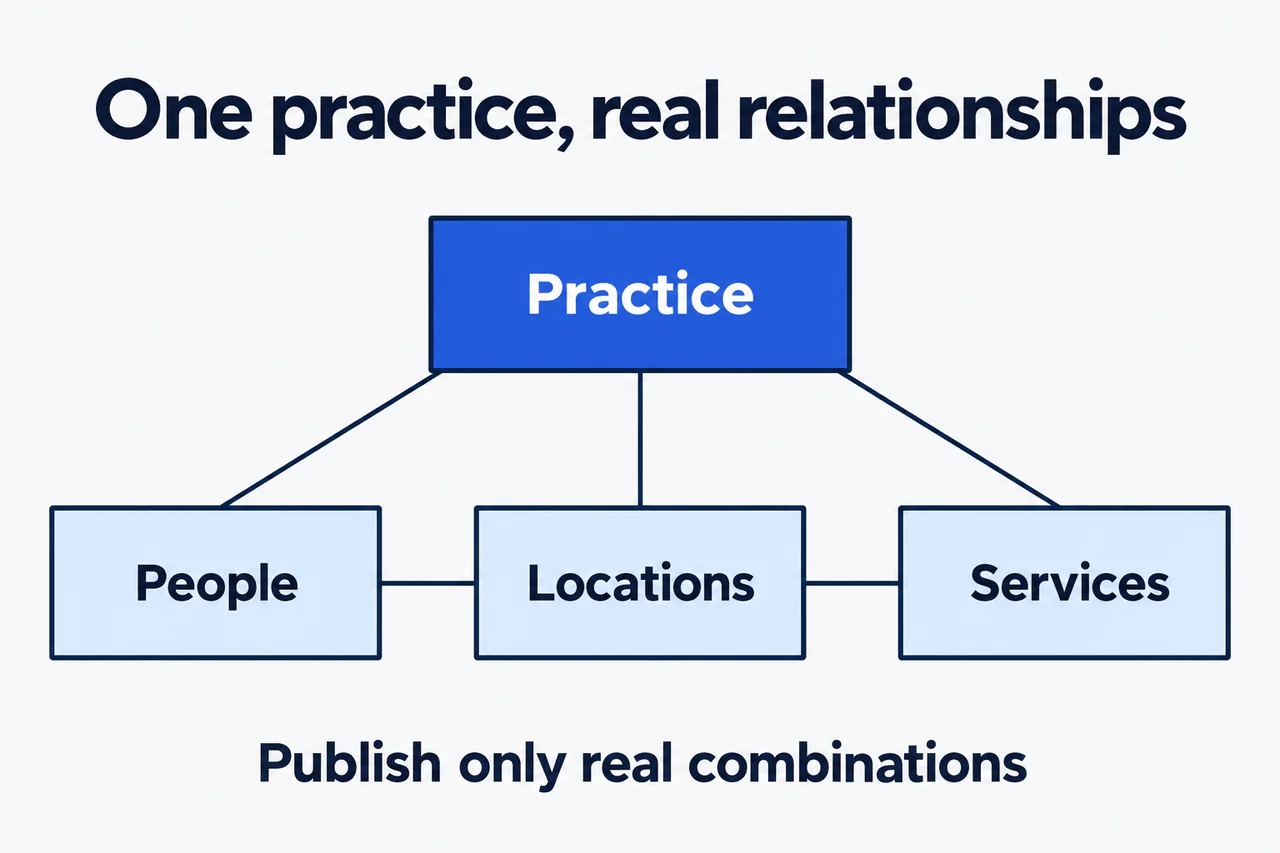
Illustrative relationship map. Connect people, locations, and services to one practice identity, while publishing only combinations that reflect how the practice actually operates.
View full-size diagram (opens in a new tab)Give each location a useful, distinct page
A location page should explain the real office: address, contact information, hours, relevant clinicians, available services, practical access information, and the consultation or treatment role of that site. The details should help someone arrive at the correct place and understand what to expect.
Avoid generic city paragraphs that could describe any practice. Local landmarks and travel information are useful only when accurate and relevant to visiting the office. A page does not become distinctive because it names several neighborhoods.
If surgery occurs at a separate facility, explain the relationship accurately without implying ownership or accreditation the practice does not hold. Keep facility claims and affiliations verifiable.
Connect the location page to the surgeons and procedures genuinely associated with it. A visitor should not have to return to the homepage to discover which clinician is available there. Our local SEO overview explains how these pages support accurate local representation.
Practical check. Ask staff at each office to review its page independently. They will often notice operational errors that a central marketing team misses.
Keep biographies about people, not keyword territories
A surgeon biography should have one clear identity and a stable location in the website unless there is a compelling structural reason otherwise. It can list the offices where the surgeon sees patients and link to relevant services without being copied into a separate page for each city.
Include verified credentials, areas of practice, relevant affiliations, and a clear consultation route. Distinguish the surgeon's experience from the history of the current organization. Do not imply that all group outcomes belong to every clinician.
If a surgeon works at different offices on different days, publish arrangements the practice can maintain. Avoid overly detailed schedules that become inaccurate unless there is a reliable update owner. An accurate appointment route may be more useful than a stale weekly timetable.
When a clinician leaves, review the biography, procedure references, location pages, gallery attribution, and profile access together. Do not automatically redirect the former surgeon's page to a replacement clinician as though they were the same person. Decide the appropriate content and technical handling based on the actual relationship and legal requirements.
Practical check. Search the site for one surgeon's name and verify every claim about where they practice and which services they provide.
Decide when a procedure-location page is genuinely needed
Start with a strong core procedure page. A separate location-specific version may be useful when the offering, clinicians, process, or patient logistics differ materially and there is a distinct audience need. It should not exist merely because a keyword tool lists a city modifier.
Ask what information would change between the two pages. If the answer is only the city name, the page plan needs reconsideration. If the answer includes different service availability, clinicians, facilities, or consultation arrangements, a distinct page may be defensible.
Do not use canonical tags as a substitute for deciding which pages should exist. Canonicalization addresses preferred versions; it does not make a collection of redundant pages useful. Similarly, a noindex instruction can control search eligibility but does not repair confusing navigation.
Google's spam policies are relevant to plans built around near-identical pages intended mainly to capture similar searches. The safer editorial question is whether each page has a distinct, honest purpose for a visitor.
Practical check. Require a difference statement in every location-specific content brief: “This page exists separately because…”
Align profiles with the real-world entities
Business and practitioner profiles should follow eligibility and naming rules, not simply mirror the website's number of pages. An organization profile represents a business at a location; a practitioner profile represents an eligible individual. Those are related but different entities.
Document profile URLs, owners, managers, contact details, and destination pages. Check that the website link helps someone understand the represented person or office. Avoid sending a profile to a page that implies services unavailable at that location.
For complex arrangements, review the current Google guidance before creating or merging listings. Shared offices and clinicians with several locations require fact-specific assessment. More profiles are not inherently a better strategy.
The practice-owner SEO guide provides the broader context, while profile governance should be assigned to a named owner in the ongoing SEO process.
Practical check. Compare the approved service matrix with the public profiles. Any mismatch should be resolved before the agency reports the local setup as complete.
Build maintenance into the architecture
A multi-location website changes when clinicians join, services move, hours change, or an office closes. Establish one source of approved operational facts and a change-request process that reaches both the website and external profiles.
Use a page inventory to identify affected URLs. A new surgeon may require updates to a biography, several service pages, location pages, navigation, and approved galleries. A change is not complete when only the homepage announcement is live.
Measure performance by relevant location and service groups where the data supports it. Do not use total site growth to conceal that an important office has lost visibility or that inquiries are being routed incorrectly. At the same time, avoid treating every page as an isolated business with separate revenue attribution when the patient journey crosses several pages.
Practical check. Rehearse a hypothetical office move. If nobody can list the affected assets and owners, the architecture needs a better maintenance record.
Frequently asked questions
Do we need a separate website for each office?
Not automatically. A well-structured shared site can explain multiple real locations clearly. Separate websites create additional maintenance and governance work and should follow a genuine business reason, not an assumption that more domains mean more visibility.
Should each surgeon have a separate page for every city?
Usually the biography should represent the person once and connect to relevant locations. Separate versions need a substantive purpose. Avoid duplicating the same credentials and biography with only a city name changed.
Can every procedure page mention every office?
Only when the information is accurate. Make service availability and consultation arrangements clear. A group-wide list should not imply that every procedure is provided at every location.
What happens to pages when an office closes?
Update public information promptly and decide whether the page should explain the change, redirect to a genuinely relevant destination, or be retired. Do not automatically redirect every closed-location URL to the homepage without considering the visitor's intent.
How many location pages are too many?
The useful limit is determined by real locations and distinct audience needs, not an arbitrary count. Pages for fictional offices or repetitive city variations are not a substitute for an accurate operating footprint.
Make the structure reflect the practice
Start with the approved people-place-service matrix, then design pages and profiles around it. If the current site has overlapping location pages or unclear clinician relationships, request an architecture audit before adding more URLs. The best structure is one the practice can explain and maintain.