Plastic surgery keyword research groups the language people use to find procedures, surgeons, and answers, then maps those needs to useful website pages. Its purpose is to guide the website, not to produce the longest possible spreadsheet.
For a practice owner, a good keyword plan should answer three questions: which searches matter to the practice, which page should answer each group, and why that page deserves priority. A list of phrases and estimated volumes does not answer those questions on its own.
The clinical offering is the boundary. Do not build demand for procedures you do not provide, imply a specialty you cannot substantiate, or publish medical explanations without appropriate review.
Plastic surgery keyword research starts with the service inventory
List the procedures actually offered, the surgeons who provide them, the locations involved, and the services the practice wants to grow. Add operational constraints such as limited consultation availability or a service that is being phased out.
Next, collect patient language from safe, appropriate sources: general questions staff hear, public search suggestions, existing Search Console data, and public competitor pages. Staff should summarize question categories rather than export identifiable patient messages into keyword tools.
Include professional and everyday terms where they describe the same service. A prospective patient may use a common phrase while the practice uses a clinical term. The page can explain both naturally. Do not assume that the more technical phrase is always the better primary target.
Practical check. For each candidate keyword group, identify the actual service owner at the practice. If nobody can confirm the offering, pause the content brief.
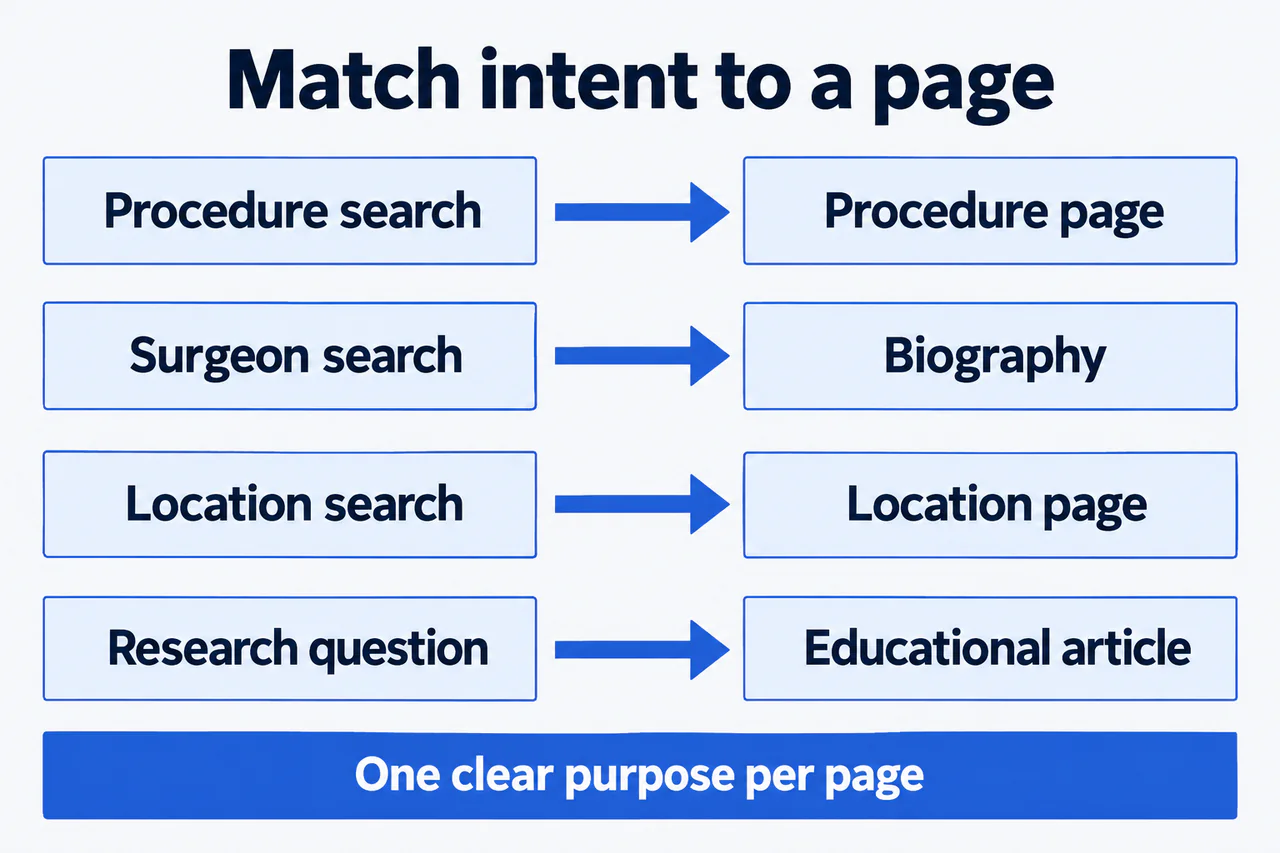
Illustrative keyword map. Match the searcher's intent to the page that can answer it: a procedure page, surgeon biography, location page, or educational article.
View full-size diagram (opens in a new tab)Group searches by the decision behind them
Intent is the job the searcher is trying to complete. Someone looking for a provider in a city needs a different answer from someone researching what to ask during a consultation. A surgeon-name search is different again.
| Query pattern | Likely need | Candidate page type |
|---|---|---|
| Procedure plus location | Find a relevant provider | Procedure page with accurate local context |
| Surgeon name | Verify a known clinician | Surgeon biography |
| Practice name plus address | Find or contact a known business | Location or contact page |
| Procedure plus a specific question | Understand an issue | Procedure section or a focused article |
| Two services compared | Understand differences | Clinically reviewed comparison when appropriate |
These are starting hypotheses, not automatic rules. Inspect the current search results to see which page types appear and whether the query has mixed intent. A phrase that looks commercial may produce mostly educational results in a particular context.
Keep the keyword map at the cluster level. “Nose surgery” and “rhinoplasty” do not necessarily require separate service pages. A page should own a coherent patient need, not a single spelling variation. Our SEO foundation guide explains this relationship between page purpose and site structure.
Practical check. Ask whether two proposed pages would give substantially different answers. If not, investigate combining the terms into one stronger page.
Treat search volume as an estimate, not a business case
Keyword tools can help compare demand, but their estimates depend on the tool, geography, period, and grouping method. A high-volume national phrase may be less useful to a local practice than a smaller query that clearly matches its service area and offering.
Do not add together every close variant as though each represents a separate audience. Tools may group or model related queries, and one person may search several times. A spreadsheet total is not a count of unique prospective patients.
Add qualitative dimensions: relevance to the practice, likely decision stage, current page coverage, competitive difficulty, and operational capacity. A low-volume phrase can still matter when it answers a question that blocks an appropriate consultation. An apparently high-volume term can be a poor target if most searches have a different meaning or geography.
Use a simple priority note rather than false precision. “High priority because this is a core service, the page is incomplete, and current impressions show relevant demand” is more defensible than a proprietary score nobody can explain.
Practical check. Remove volume from the spreadsheet temporarily. If the team cannot explain why a phrase matters without it, the business reasoning needs work.
Build a keyword-to-page map with explicit exclusions
For each cluster, record its main question, primary page, supporting terms, next action, and status. Include whether a suitable page already exists. This prevents a writer from creating a new article when the right task is to improve an existing service page.
Add an exclusion column. Reasons might include a service not offered, a different country, employment intent, a competing brand name, or a term whose meaning does not fit the practice. Exclusions are evidence of a thoughtful plan, not missed opportunities.
Distinguish the practice's patient-facing terms from agency-service terms. “SEO for surgeons” belongs to an agency helping surgeons, not a surgeon trying to attract patients. Mixing those audiences creates content that may rank for the wrong business need.
For a multi-location practice, do not automatically multiply every procedure by every city. Decide whether a separate page would provide genuinely different information about availability, clinicians, facilities, or consultation logistics. Google's spam policies are relevant when a plan starts to resemble a large collection of near-identical doorway pages.
Practical check. Every proposed URL should have an owner in the map and a reason it is not redundant with another URL.
Turn the map into a useful writing brief
A writer needs more than a keyword. Supply the reader's question, the page's purpose, the practice-specific facts, the clinical reviewer, and the intended next step. Add the related pages that should be linked and the claims that require verification.
Use the primary phrase where it reads naturally, including the title and opening explanation. Related terms should help explain the topic, not appear as a mechanical list. There is no need to repeat every awkward phrase exactly or force a city name into every sentence.
The brief should also identify what the page will not cover. A procedure page can summarize a narrow issue and link to a deeper article when that genuinely helps. The article should not repeat the entire procedure page simply to include more keywords.
Clinical review needs time in the production schedule. An SEO writer can shape headings and improve clarity, but the surgeon or qualified reviewer must validate medical statements and their limitations. The SurgeonSEO process shows how research, content work, and approval should connect.
Practical check. Give the brief to someone who did not attend the planning meeting. If they cannot explain the intended reader and next step, it is not ready for writing.
Review actual queries after publication
Once pages are live and have meaningful data, compare the intended cluster with the queries and landing pages appearing in Search Console. Keep in mind that query reporting has privacy limits and does not expose every search.
Look for useful mismatches. A page may attract questions you did not anticipate, or a general page may appear where a more appropriate service page should help. Investigate whether the site structure, content, or internal links need improvement before creating another URL.
Several pages receiving impressions for related searches is not automatically a problem called cannibalization. The important question is whether the pages serve distinct purposes or whether overlapping versions confuse the experience and divide maintenance effort.
Revisit priorities when the practice changes services, adds a surgeon, opens a location, or develops a clearer picture of appropriate inquiry demand. Keyword research is a maintained decision record, not a one-time export.
Practical check. Review one priority cluster from search through landing page to inquiry category. That is more useful than celebrating an increase in the total number of tracked keywords.
Frequently asked questions
How many keywords should one page target?
A page can naturally address many related queries that share a coherent intent. The better question is whether it answers one clear need. Do not set an arbitrary keyword count as the writing goal.
Do we need exact-match wording everywhere?
No. Use clear patient language and appropriate terminology without distorting the prose. Exact phrasing can help a title communicate the topic, but repetition is not a substitute for a useful answer.
Should we target near-me searches?
People use proximity language, but the page should describe the real practice and location naturally. Accurate local information and useful service pages are more sensible than repeating “near me” in the copy.
Should recovery questions always become blog posts?
Not necessarily. Some belong as concise, clinically reviewed sections on a procedure page. A separate article is appropriate when the question needs a distinct, substantial explanation that the practice can maintain responsibly.
What if a keyword tool reports no volume?
That does not prove nobody asks the question. Consider whether it is a real patient need, whether existing data supports it, and whether the answer improves an important page. Avoid manufacturing large amounts of content solely for hypothetical queries.
Ask for a map, not just a list
A useful plan connects patient language, real services, and specific pages. You can explore the guide library for related decisions or request a keyword and page-mapping audit if you need help identifying gaps. Bring the service priorities first; the keyword tool comes second.