Plastic surgery competitor analysis is the process of comparing the pages and local listings that appear for your practice's priority searches, then identifying useful improvements you can realistically make. It should explain a gap, not encourage you to copy another surgeon's website.
The practice across the street may be a business competitor without being your main search competitor. A hospital, directory, educational publisher, or surgeon in a neighboring area may occupy the result you want. Each wins attention for a different reason and requires a different interpretation.
Start with a narrow question: for this procedure, in this search context, why might the competing result be a more useful choice? That is more productive than asking why another domain has a higher third-party score.
Plastic surgery competitor analysis starts with comparable searches
Choose a small set of priority queries representing real patient decisions. Include a provider search, a specific procedure search, and an important research question. Keep branded searches separate because people looking for a named surgeon already have a different intent.
For each search, record location, device, date, query, and result type. Distinguish paid advertisements, Maps results, ordinary website listings, and AI-generated features. Do not count a paid placement as an organic ranking or compare a map position with a website position.
Use repeated observations rather than a single screenshot. Results can vary, and a result at one point in a city does not establish a universal rank. Google's local ranking explanation is especially important when distance is part of the apparent gap.
Practical check. Ask for the precise query and landing page behind every competitor claim. “They outrank us everywhere” is not a research finding.
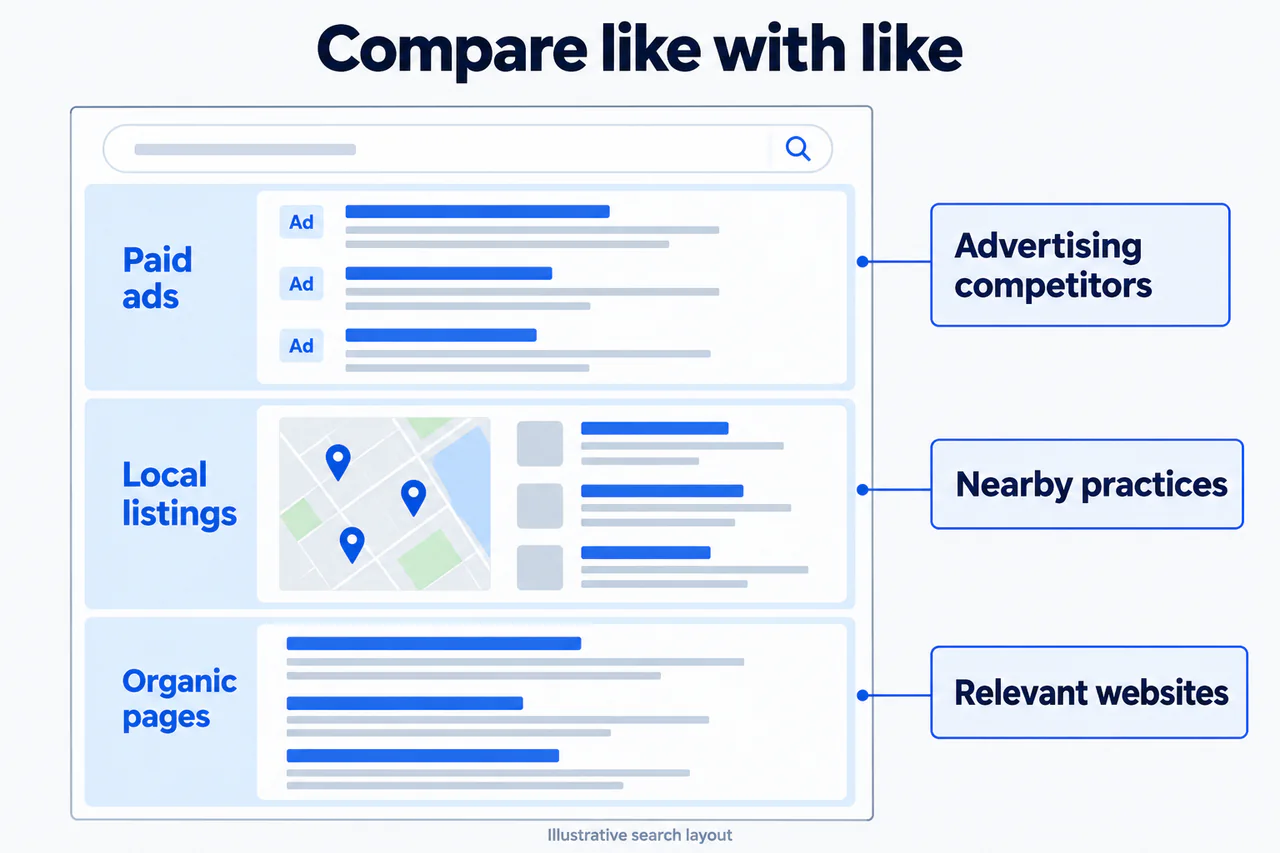
Illustrative search layout, not live rankings. Compare advertising competitors, nearby practices, and relevant organic websites within their own result types.
View full-size diagram (opens in a new tab)Compare the page that ranks, not just the website
Open the competing landing page and identify its purpose. Does it answer the procedure query directly? Does it explain who performs the procedure and where? Does it offer meaningful information about the consultation process? Is the content easy to navigate on a phone?
Then compare your corresponding page using the same questions. A beautifully designed homepage may be a poor match for a specific procedure search if the visitor must hunt for details. Conversely, a long procedure article may not answer a practical provider-selection query if it never identifies the surgeon or location.
Use a focused evidence sheet rather than a vague scorecard.
| Dimension | What to record | Useful interpretation |
|---|---|---|
| Intent match | The question the page actually answers | Whether the correct page is competing |
| Practice specificity | Named clinicians, real services, actual process | Whether visitors can distinguish the provider |
| Information quality | Clear explanations and accountable review | Whether important questions remain unanswered |
| Navigation | Links to relevant people, places, and services | Whether readers can complete the next step |
| Usability | Mobile reading, gallery behavior, contact route | Whether avoidable friction exists |
Do not infer medical quality from a ranking or a polished website. Search prominence is not a clinical credential, and this analysis is not an assessment of a surgeon's competence.
Practical check. Highlight one missing answer on your page that would genuinely help a prospective patient. That is a stronger content brief than “make it longer than the competitor.”
Separate visible evidence from speculative ranking explanations
You can observe that a competitor has an informative procedure page, a complete business profile, or links from relevant organizations. You usually cannot isolate the exact amount each factor contributes to its ranking. Avoid turning correlation into a confident causal story.
Third-party authority scores and estimated traffic can help organize research, but they are not Google's internal metrics. Treat them as tool-specific estimates. Two tools may report different values, and neither can tell you exactly how many qualified consultations a competitor receives.
Reviews require similar care. A larger review count may be relevant to local prominence and patient evaluation, but it does not reveal the quality of the practice's inquiry handling or justify an invented “reviews needed to rank” threshold.
Backlink research should identify sources and relationships, not just totals. A relevant institutional profile is different from a paid placement on an unrelated site. If a competitor appears to use questionable tactics, document the observation without copying the tactic or alleging misconduct you cannot substantiate.
Our local search service explanation places profile work in context, while the broader SEO guide explains how website structure and content contribute to the overall effort.
Practical check. Label each finding “observed,” “inferred,” or “unknown.” A useful analyst should be comfortable keeping some important questions in the unknown column.
Turn findings into a priority list the practice can execute
Evaluate each potential improvement on patient usefulness, business relevance, implementation effort, and confidence in the diagnosis. Do not use a made-up numerical score to disguise uncertainty. A short written rationale is often more useful.
For example, suppose a competing procedure page explains the consultation location clearly while your page sends visitors to a general contact page with three offices. Improving that handoff is a practical opportunity even if you cannot prove it will change rankings. It can make the page more useful and reduce confusion immediately.
Another apparent gap may not be worth pursuing. A competitor might publish daily articles on procedures you do not offer. Matching that output would make your website larger without making it more relevant to your practice. A third competitor may serve a genuinely different travel market, requiring operational capabilities you do not have.
Create three categories: corrections, experiments, and nonpriorities. Corrections address factual or technical problems. Experiments test a plausible improvement. Nonpriorities protect the practice from work that looks impressive but does not support its goals.
Give each experiment a baseline and review method. If you strengthen a procedure page, track the relevant page and query group, not only total site traffic. Record concurrent changes so that you do not attribute every movement to the most recent edit.
Practical check. Limit the first round to a few defensible changes. If the research produces forty equally urgent tasks, the prioritization is unfinished.
Know what not to imitate
Do not copy another practice's medical wording, photography, patient stories, or distinctive design. Apart from rights and accuracy concerns, copied content removes the very practice-specific detail that could help a visitor understand your offering.
Avoid imitating exaggerated outcome claims, keyword-filled business names, thin city pages, or purchased-link patterns. Google's spam policies are a better boundary than “a competitor seems to get away with it.”
Likewise, do not let a competitor's budget dictate yours. You do not know its margins, acquisition mix, referral base, or capacity. Your plan should fit the value and availability of the services you actually want to grow.
When evaluating a proposal, compare its recommended sequence with your evidence. Our SEO process explains how research should lead to implementation and review. The important question is whether the proposed work closes a meaningful gap, not whether the presentation contains the largest list of competitors.
Practical check. For every tactic you intend to copy, ask whether you would still do it if rankings were invisible. If the answer is no, examine the justification carefully.
Frequently asked questions
Why does an older competitor with a worse website rank above us?
Visual polish is only one part of the comparison. The competitor may better match the search, have a stronger established presence, or be closer to the searcher. Review the relevant page and local context before assuming design is the decisive factor.
Should we match a competitor's word count?
No fixed length establishes quality or relevance. Cover the information needed for the page's purpose, remove repetition, and add genuine practice-specific detail. A longer page can still leave the important question unanswered.
Are competitors' estimated traffic numbers reliable enough for forecasting?
Use them directionally, not as verified business results. They cannot establish the number of qualified inquiries, attended consultations, or completed procedures. Build your forecast from your own baseline and explicit assumptions.
Can we compete with a hospital or large directory?
Sometimes a more specific, useful practice page can serve a query well, but not every result type is equally contestable. Identify searches where your real services and local information are relevant. Do not assume you must outrank every large domain for every educational question.
How often should we repeat the analysis?
Review it when priorities change, an important competitor changes its offering, or performance shifts materially. Keep lighter monitoring between deeper reviews. Repeating the same screenshots without making decisions adds little value.
Use competitors to sharpen your decisions
The best output is not a dossier about other surgeons. It is a short, evidence-backed explanation of what your practice should improve and why.
If you want an independent view, request a competitive SEO assessment with your priority procedures and service area. Ask for the competing URLs, the observations, and the proposed actions so you can judge the reasoning yourself.