A surgeon not showing up on Google may have an indexing problem, an inaccurate business listing, or a website that is visible for some searches but not competitive for the search being tested. Those are different problems. Identify which one you have before paying for a remedy.
“I cannot find us” is a useful observation, but an incomplete diagnosis. Record the exact search, the location, the date, the device, and whether you expected a map listing or a website result. Also record the page or business profile you hoped to see. That small amount of detail can prevent a long, unfocused investigation.
Surgeon not showing up on Google is not one problem
Use this first-pass distinction to direct the investigation.
| What you observe | First place to investigate | What it does not prove |
|---|---|---|
| Practice absent when searched by its full name | Website indexing and business identity | That a competitor caused the problem |
| Website appears by name but not for a procedure | Relevant page, intent, and competitive context | That the whole website is unindexed |
| Website appears but Maps listing does not | Profile status, eligibility, and local context | That rewriting the homepage will fix Maps |
| Listing appears near the office but not farther away | Search location and local competition | That Google applies one citywide rank |
| A page disappeared after a redesign | Redirects, indexability, and release changes | That the new visual design is inherently bad |
An agency should be able to place the problem in one of these branches and explain what evidence could confirm or disprove its hypothesis. Be cautious when every symptom leads immediately to the same package of links and blog posts.
Practical check. Ask the person reporting the problem to send a screenshot with the query and search context, not just the statement that the practice “isn't on Google.”
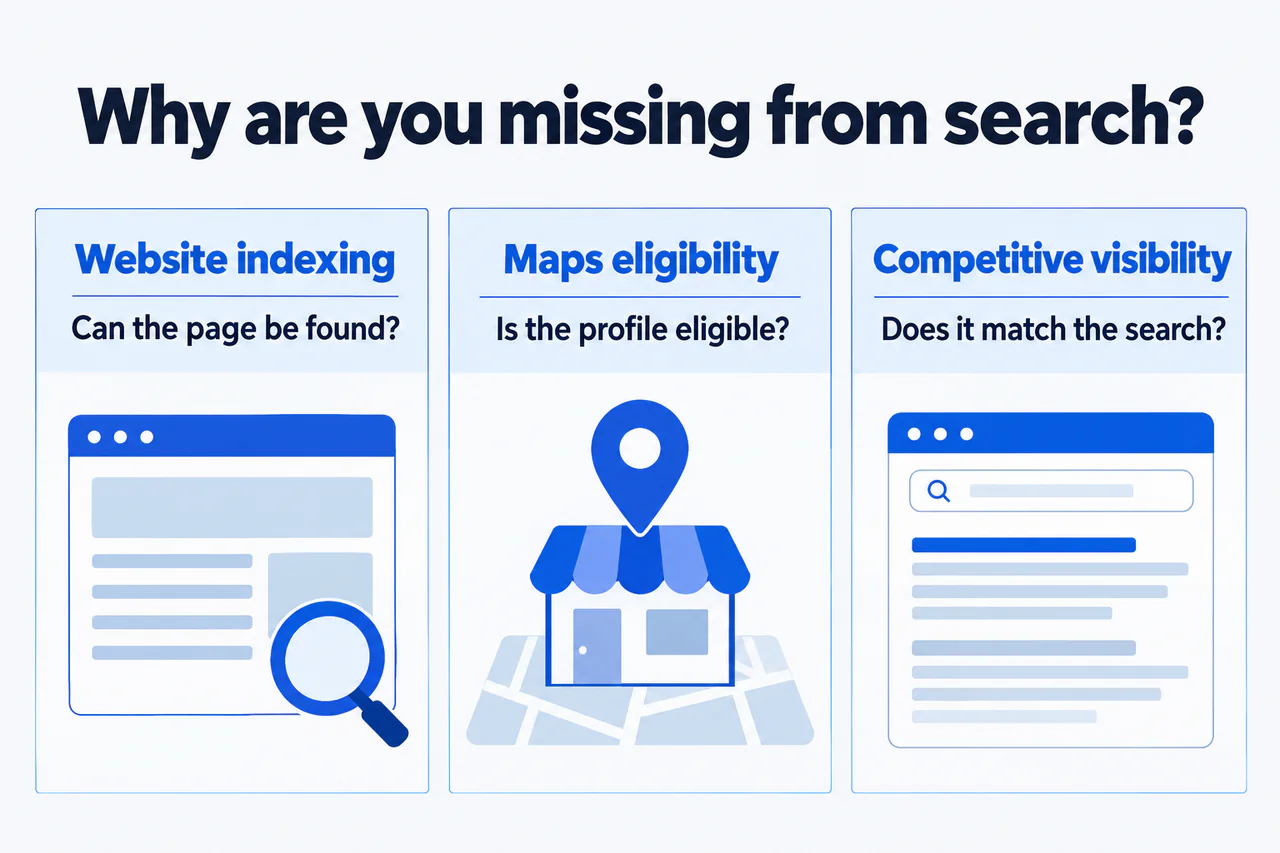
Illustrative diagnostic map. A missing website page, an ineligible Maps profile, and weak visibility for a competitive search require different investigations.
View full-size diagram (opens in a new tab)Check the website before changing its content
Start with the exact URL that should appear. Does it open successfully? Does it redirect somewhere unexpected? Is the main content visible without logging in or dismissing a consent wall? Does the page still describe the service you intended?
Next, use a practice-controlled Search Console account to inspect the URL. Ask the implementer to explain the reported indexing status, the canonical page Google selected, and any relevant crawl or indexing restriction. A canonical tells search engines which version is preferred; a mistaken canonical can point away from the page you want evaluated.
Do not confuse a robots.txt restriction with a noindex instruction. They serve different functions, and blocking crawling can prevent Google from seeing a page-level instruction. The fix should follow the actual configuration, not a generic instruction to “remove all blocks.” A developer may need to inspect server headers as well as HTML.
Check whether important pages have ordinary internal links from relevant parts of the site. A page reachable only through a complicated filter or an internal search box may be harder to discover. An XML sitemap is useful, but it does not replace a coherent navigational structure or guarantee inclusion.
Google's SEO Starter Guide explains the foundational discovery and content principles. For a practice owner, the deliverable should be a short issue log: affected URL, observed problem, proposed correction, responsible person, and verification method.
Practical check. Do not approve a sitewide rewrite until someone has inspected at least the homepage and the specific service page that is missing.
Inspect the Business Profile as a separate asset
If the problem concerns Maps or a local result, review the business profile directly. Confirm that the practice has access, that verification or suspension issues are understood, and that the profile represents an eligible real-world business or practitioner.
Check the displayed name, category, address, contact details, and website destination against the practice's actual operation. A profile may point to an outdated domain or a general corporate page when the relevant location page would help the visitor more. Do not change the name to a string of procedure keywords simply because a competitor appears to have done so.
Look for duplicate or legacy profiles, but do not delete or merge them casually. A listing may belong to a practitioner, an earlier location, or an organization with a different identity. Document ownership and the reason for any correction before requesting a change.
Local results vary by geography. Google's local ranking guidance identifies distance alongside relevance and prominence. A search performed at the office and a search performed across a metropolitan area are not equivalent tests.
Our local SEO overview distinguishes this identity and location work from general website optimization. Both may matter, but one should not be used as an unexplained substitute for the other.
Practical check. Save the profile URL and the exact issue status before editing. This preserves a baseline and helps avoid several people making conflicting changes.
If the page is indexed, investigate whether it answers the search
An indexed page is eligible to compete; it is not guaranteed a prominent position. Read the results for the exact query and ask what type of answer Google is showing. A procedure search may return service pages, while a recovery question may return educational material. A surgeon-name search may favor a biography or professional profile.
Then compare the page's purpose. Does it actually explain that service? Does it identify the relevant surgeon and consultation location? Does it answer useful questions, or mostly repeat broad claims about quality and confidence? Is the information current and clinically reviewed where necessary?
Avoid creating a second page merely because the first has not ranked. If the new page serves the same intent, you may create competing versions without adding value. Strengthen or consolidate the appropriate page after reviewing its current performance and links.
Evaluate the website's connections as well. A strong page hidden several steps away from relevant navigation may be less useful to both readers and crawlers. The practice-owner SEO guide explains how procedure, biography, and location pages should support one another.
Practical check. Write the searcher's likely question at the top of a document, paste your page underneath it, and mark where the page actually answers that question.
Use a measured recovery plan
Once the cause is plausible, choose the smallest appropriate change and record it. Fixing a mistaken indexing instruction is different from improving a weak page. Reinstating an eligible suspended profile is different from improving visibility across a wider area.
After implementation, verify the change itself before waiting for an outcome. A developer can confirm that the intended response and directives are live. The practice can confirm that profile details and contact links are correct. Search systems may then need time to recrawl or reassess the affected asset.
Set a review date and a definition of progress. “The page is now indexable and has been recrawled” is a technical milestone. “The page receives more relevant nonbranded impressions” is a visibility milestone. “The practice receives appropriate inquiries” is a business milestone. They should not be collapsed into a single success claim.
If the issue persists, revisit the hypothesis. Do not keep repeating submissions or purchasing more content simply because the original explanation sounded confident. Our working process is built around diagnosis, implementation, and review rather than a fixed list of tasks regardless of evidence.
Practical check. Keep a two-column log of observed facts and interpretations. “The page returns a 404” is a fact; “Google dislikes our brand” is an interpretation that requires much stronger evidence.
Frequently asked questions
Does a site search prove every page is indexed?
No. A search using the site operator can be a quick clue, but it is not a complete indexing audit. Use Search Console and page-level checks for a more defensible diagnosis.
Will Google Ads make the practice rank organically?
Buying ads is not a way to purchase organic rankings. Ads can provide a separate paid visibility channel, but they do not repair an indexing restriction or establish local-profile eligibility.
Should we create a new Business Profile if the old one is missing?
Not without investigating the existing profile and its status. Creating another listing may introduce duplication and ownership problems. Resolve whether the current issue is verification, eligibility, suspension, or simple search visibility first.
How quickly will a technical fix restore visibility?
There is no dependable universal deadline. First verify that the correction is live, then monitor recrawling, indexing, and relevant search performance. A fix removes an obstacle; it does not guarantee a particular ranking.
Should I change agencies immediately?
Ask the current provider for a documented diagnosis and evidence of implemented work before deciding. If it cannot explain the issue or give you account access, that is a governance concern as well as an SEO concern. Preserve access and records before any transition.
Get an answer you can verify
The right next step is the one that matches the missing evidence. If you cannot tell whether the problem is technical, local, or competitive, request a focused SEO audit and include the exact searches and URLs involved. A useful audit should narrow the problem and establish what happens next.