A plastic surgery organic traffic drop should be investigated by checking the measurement first, then the affected pages, searches, devices, and recent changes. A decline is a symptom, not a diagnosis. It does not automatically mean a Google penalty, an algorithm update, or a failed agency.
The first goal is to determine what actually fell: recorded website sessions, Search Console clicks, impressions, rankings for a specific query set, or business inquiries. Those measures can move differently, and each points toward a different investigation.
Plastic surgery organic traffic drop triage starts with the evidence
Record when the change began, how large it is, which system shows it, and whether it persists beyond a short noisy period. Save the relevant filters and comparison dates so the analysis can be reproduced.
| Pattern | First hypothesis to investigate | Useful next check |
|---|---|---|
| Analytics falls but Search Console is stable | Measurement or site-session behavior changed | Tags, consent, filters, and deployment log |
| Many important pages lose visibility together | Sitewide technical or search issue | Availability, indexing, directives, and Search Console notices |
| One procedure group declines | Page-specific changes, demand, or competition | Affected URLs and query groups |
| Mobile inquiries fall while traffic is stable | Mobile usability or contact-route issue | Synthetic phone-based tests |
| Clicks fall but impressions remain similar | Position, query mix, or result presentation changed | Stable query groups and search-result context |
These are starting hypotheses, not automatic conclusions. Google's traffic-drop troubleshooting guide provides a useful official diagnostic structure.
Practical check. Write down the competing explanations before choosing a fix. This reduces the temptation to make the evidence fit the first story offered.
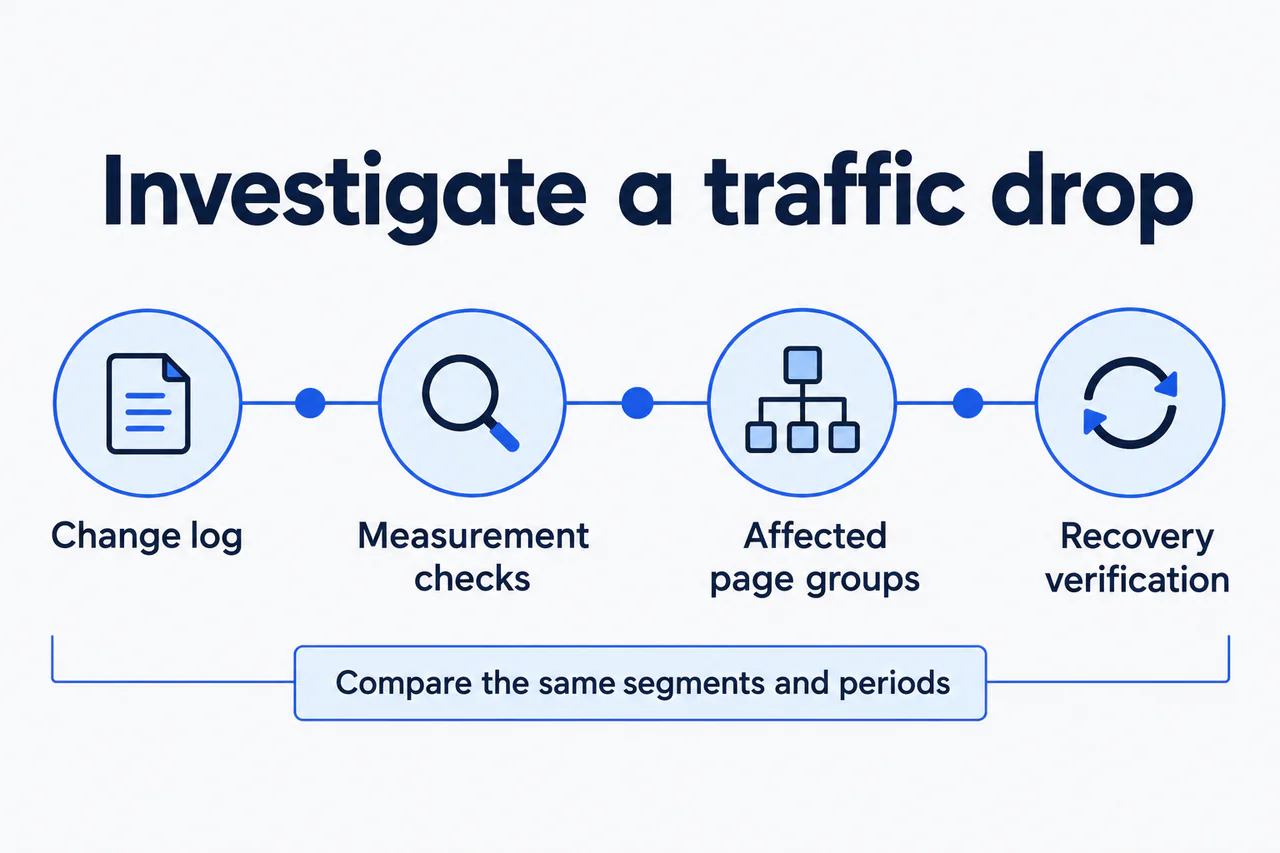
Illustrative incident investigation. Connect the change log with measurement checks, affected page groups, and recovery verification; compare consistent segments and periods before drawing conclusions.
View full-size diagram (opens in a new tab)Verify that the comparison is valid
Compare equivalent periods and avoid treating incomplete recent data as a finished month. Consider weekday patterns, seasonal demand, holidays, unusual publicity, and changes in the practice's services or availability.
Check whether the report's filters changed. A different country, device, page group, or property can create an apparent decline. A domain or URL migration can also move data between views if the report is not configured appropriately.
Review tracking changes. A consent update, removed tag, broken event, or new form integration can alter recorded activity without an equivalent change in actual demand. Conversely, a functioning analytics dashboard does not prove that every contact route works.
Keep the definitions stable. If last month's “leads” included every phone click and this month's count includes only unique new inquiries, the comparison is not meaningful without adjustment.
Practical check. Reproduce the chart from the original system using documented dates and filters before accepting a screenshot as the basis for a recovery project.
Inspect material technical changes promptly
Check whether the website and important pages are available and return the intended responses. Look for outages, server errors, accidental noindex instructions, crawling restrictions, incorrect canonicals, broken redirects, and missing internal links.
If a redesign or migration occurred, compare the live site with the approved URL map and content inventory. Important pages may have been removed, redirected to unrelated destinations, or replaced with less useful information. Gallery images and embedded content can break separately from page URLs.
Inspect Search Console for relevant indexing, security, or manual-action information. Do not call a decline a manual penalty without evidence of a manual action. Algorithmic changes and manual actions are different concepts.
Coordinate urgent corrections with the responsible technical team. A verified sitewide indexing block deserves prompt attention. A speculative theory about a ranking update does not justify changing dozens of unrelated settings at once.
Practical check. Start with a representative sample of high-value affected URLs and a few unaffected URLs. Differences between the groups can reveal the scope of the issue.
Segment the decline until it becomes explainable
Break the change down by page type, service, location, query group, device, and geography where data allows. A whole-site total can conceal that nearly all of the loss comes from one old article or one location page.
Separate branded demand from nonbranded demand. A decline in searches for a named surgeon may relate to a departure, referral pattern, or publicity change. A decline in a procedure cluster may point toward page relevance, competition, or changing demand.
Compare clicks and impressions together. If both fall for a stable query group, investigate demand and visibility. If impressions remain but clicks fall, inspect position and result presentation. Average position alone can be distorted by changes in the mix of searches.
Google's Search Console metric definitions explain why these measures need context. Query reporting also has limitations, so avoid treating a partial export as a complete record of every search.
Practical check. Identify the smallest meaningful group that explains most of the decline. That group should guide the next investigation.
Consider demand and search-result changes without assuming them
Not every decline comes from the website. Search demand can change, competitors can improve, and the result page can present information differently. Review current results for representative searches and compare them with reliable earlier records where available.
If an algorithm update occurred around the same time, record it as context rather than proof. Many things can happen near the same date. Examine whether the affected pages share a content, technical, or intent problem before proposing a broad rewrite.
AI-generated features may affect how some searches are experienced, but do not label every click decline an AI effect. Use current available reporting and compare relevant pages and query contexts. Dedicated AI impressions are not a complete measure of lost clicks or business outcomes.
A competitor's new page may provide a better answer, but copying it is not a recovery plan. Identify the missing information or usability improvement your practice can honestly provide. The practice-owner SEO guide provides the foundation for that review.
Practical check. For each external explanation, state what evidence would make it more or less likely. If nothing could change the conclusion, it is probably too vague to guide action.
Choose a remedy that matches the diagnosis
For a technical fault, correct the fault and verify the live behavior. For a content gap, improve the relevant page with accurate, useful information. For a measurement issue, repair the reporting and annotate the break. For changed demand, reconsider priorities rather than pretending the site can force people to search.
Avoid simultaneous sweeping changes unless necessary. Rewriting all titles, changing URLs, buying links, and replacing tracking at the same time makes it harder to learn what helped. It can also introduce new problems.
Define recovery evidence in stages. First verify that the correction exists. Then monitor search-system response and relevant performance. Finally review inquiry and consultation evidence with appropriate timing. A technically corrected page may still need reassessment, and no provider can promise a precise recovery date.
The SEO process should record the diagnosis, action, and verification. If local profiles or location information are involved, the local SEO workstream may need its own investigation.
Practical check. Keep one incident record rather than scattering hypotheses across chat messages. Include facts, actions, owners, dates, and unresolved questions.
Communicate the incident without false certainty
A useful update says what is known, what is being tested, what has been corrected, and when the next review will occur. It should not blame a vendor, Google, or the practice before the evidence supports that conclusion.
Explain the business effect separately from the search chart. A decline in an irrelevant article may have little effect on appropriate inquiries. A smaller decline in a priority procedure page may matter more. The practice needs that distinction to choose the right level of response.
Preserve the incident history after recovery. It can improve deployment checks, monitoring, and future handovers. A resolved problem should leave the practice with a better system, not only a restored chart.
Practical check. Ask the provider to produce a short post-incident explanation of the cause, correction, uncertainty, and prevention steps.
Frequently asked questions
Does a sudden decline mean Google penalized the site?
No. Technical faults, measurement changes, demand shifts, and other causes can produce declines. Check Search Console notices and the underlying evidence before using the word penalty.
Should we immediately reverse the last website change?
Only when evidence supports that action and the technical team understands the consequences. Timing alone does not prove causation. A verified harmful deployment may justify rollback, while an unrelated change may not.
Can a traffic drop be seasonal?
Yes, but seasonality should be investigated rather than used as a default explanation. Compare appropriate historical periods and relevant query groups, noting other changes in the practice and market.
Should we buy backlinks to recover?
Not without a diagnosis showing a legitimate need for that work. Links do not repair broken indexing, lost content, or failed tracking. Opaque link packages can add risk rather than solve the problem.
How long will recovery take?
It depends on the cause, the correction, and search-system reassessment. Verify implementation first, then monitor relevant indicators. A fixed recovery promise without a diagnosis is not credible.
Investigate before prescribing
A useful response to a decline narrows the uncertainty and fixes the actual problem. If the cause remains unclear, request a traffic-drop audit and provide the date range, affected pages, reports, and recent change log. Good evidence makes a focused recovery plan possible.