SEO for a new plastic surgery practice begins before launch with a clear website, accurate business identity, and practice-owned accounts. The first objective is readiness: prospective patients should be able to understand who you are, which services you offer, where they can see you, and how to take the next step.
Early search visibility is uncertain. A newly launched website does not inherit a guaranteed position because the surgeon has extensive clinical experience. Equally, a practice should not wait for a large blog library before publishing essential, accurate information.
Build the launch around a small set of useful pages and a verifiable operational checklist. Expand after the fundamentals are working.
SEO for a new plastic surgery practice starts with ownership
The practice should control its domain, hosting relationship, website administration, Search Console, and eligible business profiles. A vendor may administer these assets, but administration is not the same as ownership or a reliable recovery route.
Use a practice-controlled account structure and appropriate security controls. Document the registrar, renewal details, responsible owner, recovery method, and vendor permissions. Avoid relying on a departing employee's personal email address as the only way to recover a critical account.
Clarify what the practice owns in the website contract: content, design assets, custom code where applicable, photographs, licenses, and the ability to move to another provider. Some third-party assets may be licensed rather than transferable. Resolve that distinction before the website becomes operationally important.
Practical check. Ask someone authorized by the practice to demonstrate owner-level access to the domain and primary website accounts without asking the agency to log in for them.
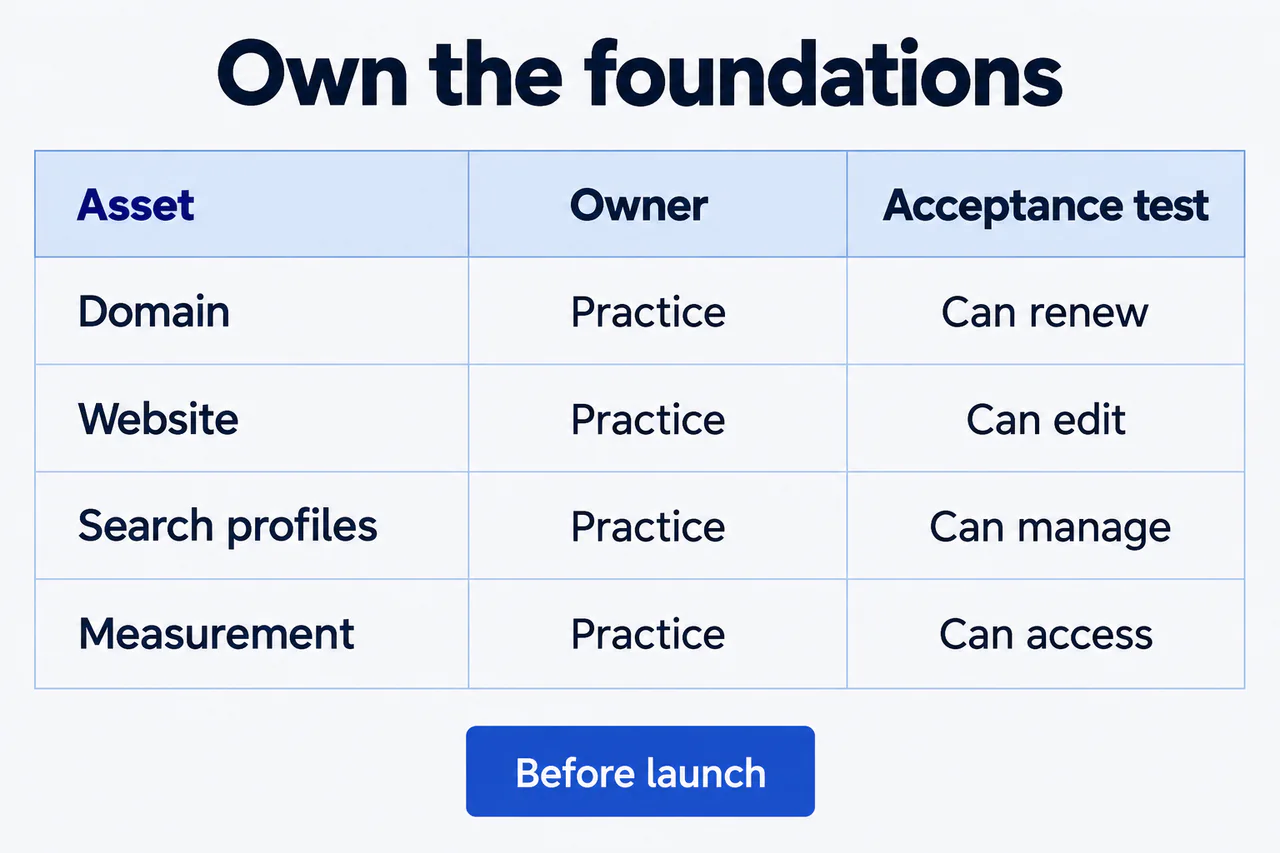
Illustrative prelaunch checklist. The practice should control its domain, website, search profiles, and measurement accounts—and test that access before launch.
View full-size diagram (opens in a new tab)Define the minimum useful website
Start with the practice identity, priority procedures, surgeon biographies, real locations, and contact information. Add legally reviewed privacy and terms information appropriate to the site's operation. Do not make a decorative homepage carry every service explanation.
Each priority procedure needs enough detail to support an informed inquiry. Identify the treating surgeon where appropriate, explain the consultation process, and establish clinical review for medical statements. A writer can organize the information, but should not invent candidacy criteria, recovery promises, or treatment outcomes.
A biography should distinguish the surgeon's credentials and experience from the age of the new business. Existing professional experience can be described accurately without implying that the newly opened practice has a long operating history.
Location information should reflect what actually happens at each address. Consultation offices, surgical facilities, and administrative locations are not interchangeable. Explain practical arrangements clearly so that patients do not travel to the wrong place.
Before-and-after images and testimonials are not compulsory launch decorations. Use only material with the necessary rights and approvals, and avoid borrowing cases from a former employer without explicit authorization. If suitable assets are not ready, launch accurate text rather than fabricated evidence.
Practical check. Ask a person unfamiliar with the practice to find the right surgeon, a priority procedure, and the consultation location in a short browsing session. Note where they hesitate.
Prepare local information without creating a fictional footprint
Collect the official business name, public contact number, address, signage information, opening arrangements, and profile ownership details. Then assess eligibility under Google's current rules before creating or changing listings.
A new practice should not create profiles at virtual addresses simply to cover a larger region. Practitioner profiles also need individual eligibility review. If several clinicians share a location, the organization and practitioner arrangements may differ from those of a sole practitioner representing a branded organization.
Use Google's representation guidelines as the starting point. Opening dates and verification workflows can vary, so check the applicable product instructions when the practice is ready to establish its profile. Do not promise a verified listing by a particular date without knowing the actual process.
Prepare a short directory inventory based on real professional memberships and relevant local sources. Accuracy matters more than launching hundreds of low-value listings. Our local SEO overview explains how profile work fits into a broader launch plan.
Practical check. Keep one approved record of names, addresses, hours, and contact routes. Let every vendor work from that record rather than independently interpreting old documents.
Run a launch acceptance test
The final prelaunch check should verify behavior, not just appearance. Open the site on several devices, test navigation and forms, confirm that contact information is correct, and check that important images and text load as expected.
Ask the developer to confirm the intended production indexing settings. Staging environments often need restrictions, but those restrictions should not accidentally carry into the public site. Check canonical URLs, redirects where relevant, server responses, internal links, and the XML sitemap.
Use test data clearly marked as synthetic when checking forms. Confirm where submissions go and who receives alerts. Do not place real patient information into analytics debugging tools or general project-management systems. Tracking and call-recording choices need privacy review before launch.
| Acceptance area | Evidence of completion |
|---|---|
| Content | Approved procedures, biographies, locations, and claims |
| Technical | Production pages accessible with intended indexing settings |
| Contact | Test inquiry received and routed to the responsible person |
| Ownership | Practice has working access and recovery documentation |
| Measurement | Baseline plan and approved data collection configuration |
Practical check. Make the launch signoff a shared record. A designer approving the visual layout does not automatically approve clinical content, privacy decisions, or search configuration.
Set first-quarter priorities around learning
After launch, confirm that important pages can be discovered and monitor their search performance. Look for relevant impressions, indexing issues, incorrect business information, and confusion in actual inquiries. Early data may be sparse, so avoid treating a few clicks as a stable trend.
Use the first conversations with prospective patients to improve clarity. Staff can record recurring question categories without collecting unnecessary personal detail in the marketing workflow. A repeated question about location or consultation fees may indicate a page problem that is easier to fix than a ranking gap.
Prioritize corrections before expansion. Then improve the most important procedure pages and add articles only where a distinct, useful question deserves a separate answer. The practice-owner SEO guide provides the larger structure; the launch plan should remain manageable.
Review work and outcomes separately. Account setup, corrected page settings, and approved content are implementation milestones. Search visibility and consultation demand are outcomes influenced by factors beyond the implementer's control. Our SEO process can help organize those reviews without treating a calendar milestone as a guaranteed growth result.
Practical check. At the end of each review, choose one correction, one opportunity to investigate, and one thing you will deliberately postpone.
Frequently asked questions
Should we buy an old domain to rank faster?
An older domain is not automatically a useful asset. Its history, ownership, relevance, and potential problems require investigation. A clear brand and a well-managed launch are more defensible than purchasing a domain based only on age.
Can we launch without a blog?
Yes. Essential service, clinician, location, and contact information should take priority. Add educational articles when you have a distinct audience need and a reliable review process.
Can the surgeon use experience from a previous practice?
Accurately describe the surgeon's own credentials and experience, subject to appropriate review. Do not imply that the new business produced another organization's results or owns its patient photographs and testimonials. Rights and authorization need separate confirmation.
Should we create pages for every nearby city?
Not automatically. A separate page needs a genuine purpose and useful, accurate information. Changing city names in otherwise identical content can create a poor experience and a risky search strategy.
What should we expect in the first three months?
Expect a defined implementation and learning plan, not a guaranteed position. The practice should be able to see what was built, what was corrected, what search evidence is emerging, and what remains uncertain. Any commercial refund commitment needs separately agreed written terms.
Launch something the practice can maintain
A useful launch is a controlled beginning, not the final version of the website. Keep ownership clear, verify the important journeys, and improve from evidence.
If you want help setting the sequence, request a prelaunch SEO assessment with your planned services, locations, and opening schedule. The aim is to identify what must work on day one and what can responsibly follow.